

Photodeactivation Channels of Transition Metal Complexes …
275
values were computed with the TVCF formalism (see Sect. 2.2) using B3LYP and
TD-B3LYP data (in practical terms, one should perform the calculation of energy
differences between the involved states and their effective SOC and nonadiabatic
couplings along with the calculation of vibrational frequencies and normal modes for
both the
3 MLCT and GS states). Three main factors lead to enhanced k ISC values: (i)
a small
3 MLCT-S 0 adiabatic energy difference, (ii) large
3 MLCT-S 0 SOCs, and (iii)
large reorganization energies, which measure the extent of vibronic coupling between
these two electronic states. For these complexes, the k ISC values only slightly depend
with temperature, and this is because the relevant vibrational modes promoting ISC
(notably, C=C stretchings and in-plane deformations of the ligands) are of high
frequency. The k nr (T ) values were for the first time computed in [37]. This latter
channel is characterized by the population of the
3 MC state through a transition
state (TS, see Fig. 3b) and the irreversible recovery of the GS geometry through a
MECP. The rate-limiting step is often the
3 MLCT →
3 MC transformation (see E a in
Fig. 3b). Under these circumstances, assuming a thermally equilibrated scenario and
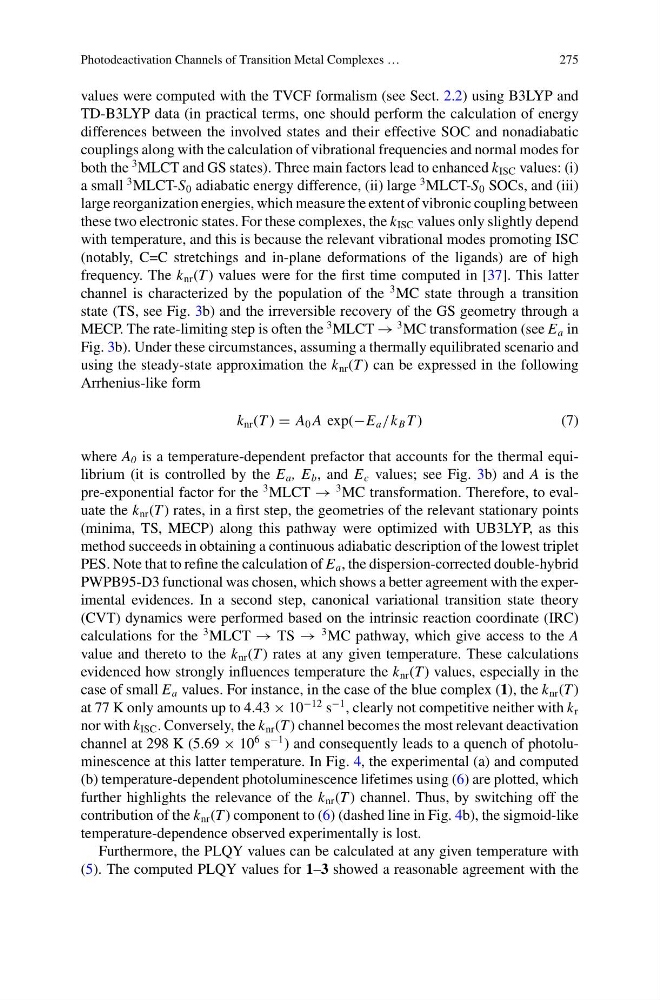
using the steady-state approximation the k nr (T ) can be expressed in the following
Arrhenius-like form
k nr (T ) A 0 A exp(−E a /k B T )
( 7 )
where A 0 is a temperature-dependent prefactor that accounts for the thermal equilibrium (it is controlled by the E a , E b , and E c values; see Fig. 3b) and A is the
pre-exponential factor for the
3 MLCT →
3 MC transformation. Therefore, to evaluate the k nr (T ) rates, in a first step, the geometries of the relevant stationary points
(minima, TS, MECP) along this pathway were optimized with UB3LYP, as this
method succeeds in obtaining a continuous adiabatic description of the lowest triplet
PES. Note that to refine the calculation of E a , the dispersion-corrected double-hybrid
PWPB95-D3 functional was chosen, which shows a better agreement with the experimental evidences. In a second step, canonical variational transition state theory
(CVT) dynamics were performed based on the intrinsic reaction coordinate (IRC)
calculations for the
3 MLCT → TS →
3 MC pathway, which give access to the A
value and thereto to the k nr (T ) rates at any given temperature. These calculations
evidenced how strongly influences temperature the k nr (T ) values, especially in the
case of small E a values. For instance, in the case of the blue complex (1), the k nr (T )
at 77 K only amounts up to 4.43 × 10
−12 s
−1 , clearly not competitive neither with k r
nor with k ISC . Conversely, the k nr (T ) channel becomes the most relevant deactivation
channel at 298 K (5.69 × 10
6 s
−1 ) and consequently leads to a quench of photoluminescence at this latter temperature. In Fig. 4, the experimental (a) and computed
(b) temperature-dependent photoluminescence lifetimes using (6) are plotted, which
further highlights the relevance of the k nr (T ) channel. Thus, by switching off the
contribution of the k nr (T ) component to (6) (dashed line in Fig. 4b), the sigmoid-like
temperature-dependence observed experimentally is lost.
Furthermore, the PLQY values can be calculated at any given temperature with
(5). The computed PLQY values for 1–3 showed a reasonable agreement with the
275
values were computed with the TVCF formalism (see Sect. 2.2) using B3LYP and
TD-B3LYP data (in practical terms, one should perform the calculation of energy
differences between the involved states and their effective SOC and nonadiabatic
couplings along with the calculation of vibrational frequencies and normal modes for
both the
3 MLCT and GS states). Three main factors lead to enhanced k ISC values: (i)
a small
3 MLCT-S 0 adiabatic energy difference, (ii) large
3 MLCT-S 0 SOCs, and (iii)
large reorganization energies, which measure the extent of vibronic coupling between
these two electronic states. For these complexes, the k ISC values only slightly depend
with temperature, and this is because the relevant vibrational modes promoting ISC
(notably, C=C stretchings and in-plane deformations of the ligands) are of high
frequency. The k nr (T ) values were for the first time computed in [37]. This latter
channel is characterized by the population of the
3 MC state through a transition
state (TS, see Fig. 3b) and the irreversible recovery of the GS geometry through a
MECP. The rate-limiting step is often the
3 MLCT →
3 MC transformation (see E a in
Fig. 3b). Under these circumstances, assuming a thermally equilibrated scenario and
using the steady-state approximation the k nr (T ) can be expressed in the following
Arrhenius-like form
k nr (T ) A 0 A exp(−E a /k B T )
( 7 )
where A 0 is a temperature-dependent prefactor that accounts for the thermal equilibrium (it is controlled by the E a , E b , and E c values; see Fig. 3b) and A is the
pre-exponential factor for the
3 MLCT →
3 MC transformation. Therefore, to evaluate the k nr (T ) rates, in a first step, the geometries of the relevant stationary points
(minima, TS, MECP) along this pathway were optimized with UB3LYP, as this
method succeeds in obtaining a continuous adiabatic description of the lowest triplet
PES. Note that to refine the calculation of E a , the dispersion-corrected double-hybrid
PWPB95-D3 functional was chosen, which shows a better agreement with the experimental evidences. In a second step, canonical variational transition state theory
(CVT) dynamics were performed based on the intrinsic reaction coordinate (IRC)
calculations for the
3 MLCT → TS →
3 MC pathway, which give access to the A
value and thereto to the k nr (T ) rates at any given temperature. These calculations
evidenced how strongly influences temperature the k nr (T ) values, especially in the
case of small E a values. For instance, in the case of the blue complex (1), the k nr (T )
at 77 K only amounts up to 4.43 × 10
−12 s
−1 , clearly not competitive neither with k r
nor with k ISC . Conversely, the k nr (T ) channel becomes the most relevant deactivation
channel at 298 K (5.69 × 10
6 s
−1 ) and consequently leads to a quench of photoluminescence at this latter temperature. In Fig. 4, the experimental (a) and computed
(b) temperature-dependent photoluminescence lifetimes using (6) are plotted, which
further highlights the relevance of the k nr (T ) channel. Thus, by switching off the
contribution of the k nr (T ) component to (6) (dashed line in Fig. 4b), the sigmoid-like
temperature-dependence observed experimentally is lost.
Furthermore, the PLQY values can be calculated at any given temperature with
(5). The computed PLQY values for 1–3 showed a reasonable agreement with the