

274
D. Escudero
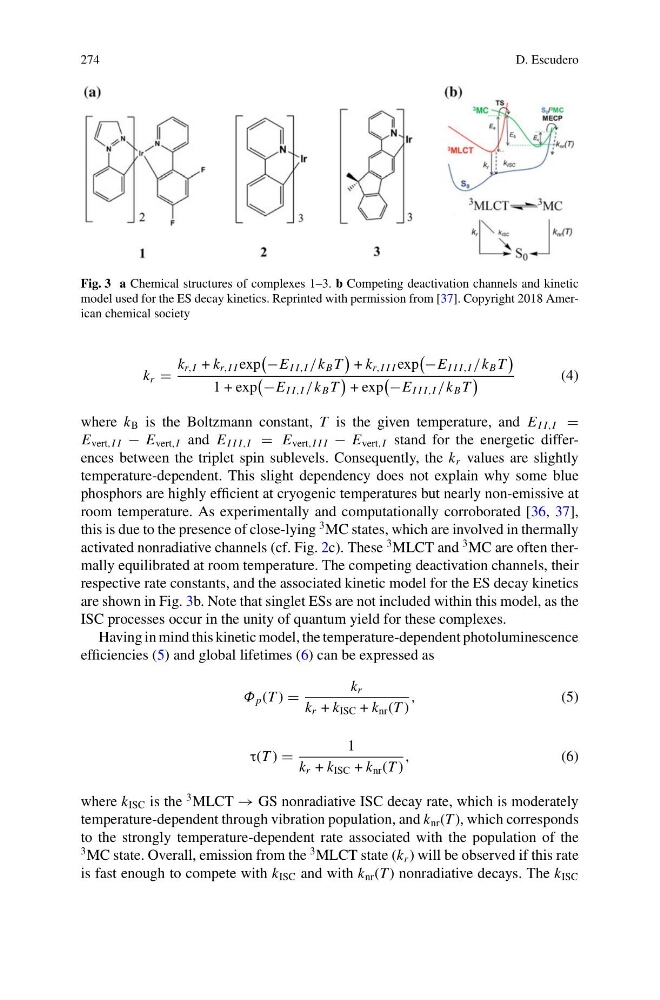
Fig. 3 a Chemical structures of complexes 1–3. b Competing deactivation channels and kinetic
model used for the ES decay kinetics. Reprinted with permission from [37]. Copyright 2018 American chemical society
k r
k r,I + k r,I I exp
−E I I,I /k B T
+ k r,I I I exp
−E I I I,I /k B T
1 + exp
−E I I,I /k B T
+ exp
−E I I I,I /k B T
(4)
where k B is the Boltzmann constant, T is the given temperature, and E I I,I
E vert,I I − E vert,I and E I I I,I E vert,I I I − E vert,I stand for the energetic differences between the triplet spin sublevels. Consequently, the k r values are slightly
temperature-dependent. This slight dependency does not explain why some blue
phosphors are highly efficient at cryogenic temperatures but nearly non-emissive at
room temperature. As experimentally and computationally corroborated [36, 37],
this is due to the presence of close-lying
3 MC states, which are involved in thermally
activated nonradiative channels (cf. Fig. 2c). These
3 MLCT and
3 MC are often thermally equilibrated at room temperature. The competing deactivation channels, their
respective rate constants, and the associated kinetic model for the ES decay kinetics
are shown in Fig. 3b. Note that singlet ESs are not included within this model, as the
ISC processes occur in the unity of quantum yield for these complexes.
Having in mind this kinetic model, the temperature-dependent photoluminescence
efficiencies (5) and global lifetimes (6) can be expressed as
Φ p (T )
k r
k r + k ISC + k nr (T )
,
(5)
τ(T )
1
k r + k ISC + k nr (T )
,
(6)
where k ISC is the
3 MLCT → GS nonradiative ISC decay rate, which is moderately
temperature-dependent through vibration population, and k nr (T ), which corresponds
to the strongly temperature-dependent rate associated with the population of the
3 MC state. Overall, emission from the
3 MLCT state (k r ) will be observed if this rate
is fast enough to compete with k ISC and with k nr (T ) nonradiative decays. The k ISC
D. Escudero
Fig. 3 a Chemical structures of complexes 1–3. b Competing deactivation channels and kinetic
model used for the ES decay kinetics. Reprinted with permission from [37]. Copyright 2018 American chemical society
k r
k r,I + k r,I I exp
−E I I,I /k B T
+ k r,I I I exp
−E I I I,I /k B T
1 + exp
−E I I,I /k B T
+ exp
−E I I I,I /k B T
(4)
where k B is the Boltzmann constant, T is the given temperature, and E I I,I
E vert,I I − E vert,I and E I I I,I E vert,I I I − E vert,I stand for the energetic differences between the triplet spin sublevels. Consequently, the k r values are slightly
temperature-dependent. This slight dependency does not explain why some blue
phosphors are highly efficient at cryogenic temperatures but nearly non-emissive at
room temperature. As experimentally and computationally corroborated [36, 37],
this is due to the presence of close-lying
3 MC states, which are involved in thermally
activated nonradiative channels (cf. Fig. 2c). These
3 MLCT and
3 MC are often thermally equilibrated at room temperature. The competing deactivation channels, their
respective rate constants, and the associated kinetic model for the ES decay kinetics
are shown in Fig. 3b. Note that singlet ESs are not included within this model, as the
ISC processes occur in the unity of quantum yield for these complexes.
Having in mind this kinetic model, the temperature-dependent photoluminescence
efficiencies (5) and global lifetimes (6) can be expressed as
Φ p (T )
k r
k r + k ISC + k nr (T )
,
(5)
τ(T )
1
k r + k ISC + k nr (T )
,
(6)
where k ISC is the
3 MLCT → GS nonradiative ISC decay rate, which is moderately
temperature-dependent through vibration population, and k nr (T ), which corresponds
to the strongly temperature-dependent rate associated with the population of the
3 MC state. Overall, emission from the
3 MLCT state (k r ) will be observed if this rate
is fast enough to compete with k ISC and with k nr (T ) nonradiative decays. The k ISC