

248
M. J. Toda et al.
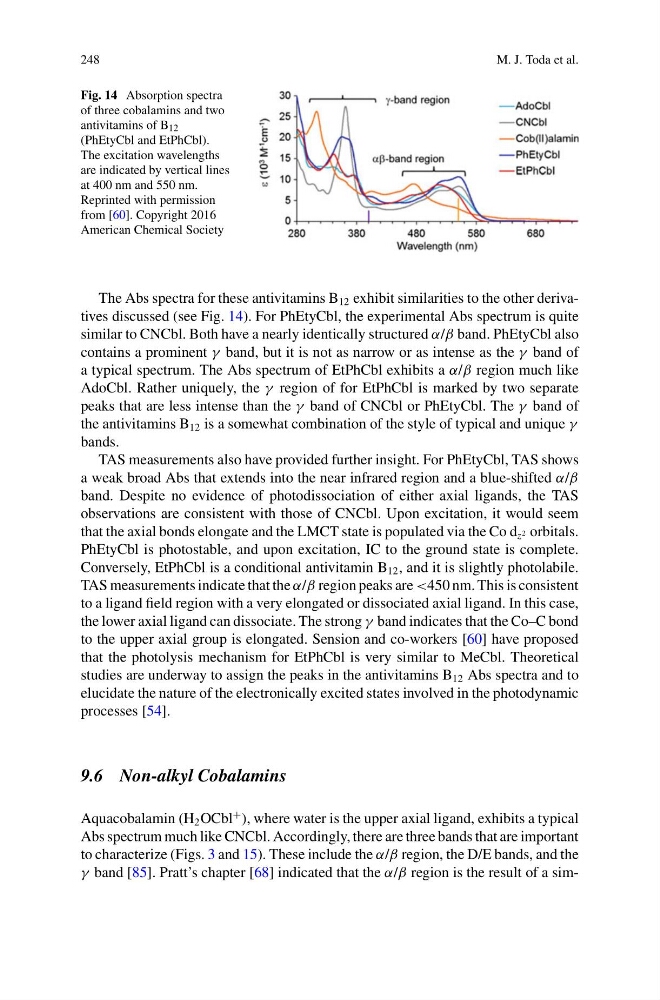
Fig. 14 Absorption spectra
of three cobalamins and two
antivitamins of B 12
(PhEtyCbl and EtPhCbl).
The excitation wavelengths
are indicated by vertical lines
at 400 nm and 550 nm.
Reprinted with permission
from [60]. Copyright 2016
American Chemical Society
The Abs spectra for these antivitamins B 12 exhibit similarities to the other derivatives discussed (see Fig. 14). For PhEtyCbl, the experimental Abs spectrum is quite
similar to CNCbl. Both have a nearly identically structured α/β band. PhEtyCbl also
contains a prominent γ band, but it is not as narrow or as intense as the γ band of
a typical spectrum. The Abs spectrum of EtPhCbl exhibits a α/β region much like
AdoCbl. Rather uniquely, the γ region of for EtPhCbl is marked by two separate
peaks that are less intense than the γ band of CNCbl or PhEtyCbl. The γ band of
the antivitamins B 12 is a somewhat combination of the style of typical and unique γ
bands.
TAS measurements also have provided further insight. For PhEtyCbl, TAS shows
a weak broad Abs that extends into the near infrared region and a blue-shifted α/β
band. Despite no evidence of photodissociation of either axial ligands, the TAS
observations are consistent with those of CNCbl. Upon excitation, it would seem
that the axial bonds elongate and the LMCT state is populated via the Co d z 2 orbitals.
PhEtyCbl is photostable, and upon excitation, IC to the ground state is complete.
Conversely, EtPhCbl is a conditional antivitamin B 12 , and it is slightly photolabile.
TAS measurements indicate that the α/β region peaks are <450 nm. This is consistent
to a ligand field region with a very elongated or dissociated axial ligand. In this case,
the lower axial ligand can dissociate. The strong γ band indicates that the Co–C bond
to the upper axial group is elongated. Sension and co-workers [60] have proposed
that the photolysis mechanism for EtPhCbl is very similar to MeCbl. Theoretical
studies are underway to assign the peaks in the antivitamins B 12 Abs spectra and to
elucidate the nature of the electronically excited states involved in the photodynamic
processes [54].
9.6 Non-alkyl Cobalamins
Aquacobalamin (H 2 OCbl
+ ), where water is the upper axial ligand, exhibits a typical
Abs spectrum much like CNCbl. Accordingly, there are three bands that are important
to characterize (Figs. 3 and 15). These include the α/β region, the D/E bands, and the
γ band [85]. Pratt’s chapter [68] indicated that the α/β region is the result of a sim-
M. J. Toda et al.
Fig. 14 Absorption spectra
of three cobalamins and two
antivitamins of B 12
(PhEtyCbl and EtPhCbl).
The excitation wavelengths
are indicated by vertical lines
at 400 nm and 550 nm.
Reprinted with permission
from [60]. Copyright 2016
American Chemical Society
The Abs spectra for these antivitamins B 12 exhibit similarities to the other derivatives discussed (see Fig. 14). For PhEtyCbl, the experimental Abs spectrum is quite
similar to CNCbl. Both have a nearly identically structured α/β band. PhEtyCbl also
contains a prominent γ band, but it is not as narrow or as intense as the γ band of
a typical spectrum. The Abs spectrum of EtPhCbl exhibits a α/β region much like
AdoCbl. Rather uniquely, the γ region of for EtPhCbl is marked by two separate
peaks that are less intense than the γ band of CNCbl or PhEtyCbl. The γ band of
the antivitamins B 12 is a somewhat combination of the style of typical and unique γ
bands.
TAS measurements also have provided further insight. For PhEtyCbl, TAS shows
a weak broad Abs that extends into the near infrared region and a blue-shifted α/β
band. Despite no evidence of photodissociation of either axial ligands, the TAS
observations are consistent with those of CNCbl. Upon excitation, it would seem
that the axial bonds elongate and the LMCT state is populated via the Co d z 2 orbitals.
PhEtyCbl is photostable, and upon excitation, IC to the ground state is complete.
Conversely, EtPhCbl is a conditional antivitamin B 12 , and it is slightly photolabile.
TAS measurements indicate that the α/β region peaks are <450 nm. This is consistent
to a ligand field region with a very elongated or dissociated axial ligand. In this case,
the lower axial ligand can dissociate. The strong γ band indicates that the Co–C bond
to the upper axial group is elongated. Sension and co-workers [60] have proposed
that the photolysis mechanism for EtPhCbl is very similar to MeCbl. Theoretical
studies are underway to assign the peaks in the antivitamins B 12 Abs spectra and to
elucidate the nature of the electronically excited states involved in the photodynamic
processes [54].
9.6 Non-alkyl Cobalamins
Aquacobalamin (H 2 OCbl
+ ), where water is the upper axial ligand, exhibits a typical
Abs spectrum much like CNCbl. Accordingly, there are three bands that are important
to characterize (Figs. 3 and 15). These include the α/β region, the D/E bands, and the
γ band [85]. Pratt’s chapter [68] indicated that the α/β region is the result of a sim-