

244
M. J. Toda et al.
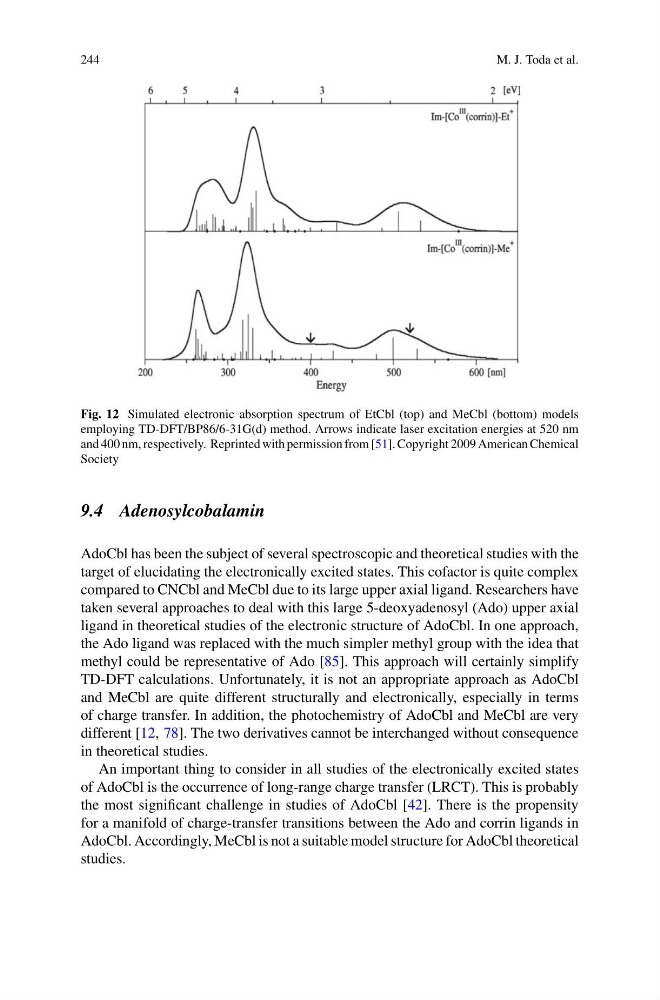
Fig. 12 Simulated electronic absorption spectrum of EtCbl (top) and MeCbl (bottom) models
employing TD-DFT/BP86/6-31G(d) method. Arrows indicate laser excitation energies at 520 nm
and 400 nm, respectively. Reprinted with permission from [51]. Copyright 2009 American Chemical
Society
9.4 Adenosylcobalamin
AdoCbl has been the subject of several spectroscopic and theoretical studies with the
target of elucidating the electronically excited states. This cofactor is quite complex
compared to CNCbl and MeCbl due to its large upper axial ligand. Researchers have
taken several approaches to deal with this large 5-deoxyadenosyl (Ado) upper axial
ligand in theoretical studies of the electronic structure of AdoCbl. In one approach,
the Ado ligand was replaced with the much simpler methyl group with the idea that
methyl could be representative of Ado [85]. This approach will certainly simplify
TD-DFT calculations. Unfortunately, it is not an appropriate approach as AdoCbl
and MeCbl are quite different structurally and electronically, especially in terms
of charge transfer. In addition, the photochemistry of AdoCbl and MeCbl are very
different [12, 78]. The two derivatives cannot be interchanged without consequence
in theoretical studies.
An important thing to consider in all studies of the electronically excited states
of AdoCbl is the occurrence of long-range charge transfer (LRCT). This is probably
the most significant challenge in studies of AdoCbl [42]. There is the propensity
for a manifold of charge-transfer transitions between the Ado and corrin ligands in
AdoCbl. Accordingly, MeCbl is not a suitable model structure for AdoCbl theoretical
studies.
M. J. Toda et al.
Fig. 12 Simulated electronic absorption spectrum of EtCbl (top) and MeCbl (bottom) models
employing TD-DFT/BP86/6-31G(d) method. Arrows indicate laser excitation energies at 520 nm
and 400 nm, respectively. Reprinted with permission from [51]. Copyright 2009 American Chemical
Society
9.4 Adenosylcobalamin
AdoCbl has been the subject of several spectroscopic and theoretical studies with the
target of elucidating the electronically excited states. This cofactor is quite complex
compared to CNCbl and MeCbl due to its large upper axial ligand. Researchers have
taken several approaches to deal with this large 5-deoxyadenosyl (Ado) upper axial
ligand in theoretical studies of the electronic structure of AdoCbl. In one approach,
the Ado ligand was replaced with the much simpler methyl group with the idea that
methyl could be representative of Ado [85]. This approach will certainly simplify
TD-DFT calculations. Unfortunately, it is not an appropriate approach as AdoCbl
and MeCbl are quite different structurally and electronically, especially in terms
of charge transfer. In addition, the photochemistry of AdoCbl and MeCbl are very
different [12, 78]. The two derivatives cannot be interchanged without consequence
in theoretical studies.
An important thing to consider in all studies of the electronically excited states
of AdoCbl is the occurrence of long-range charge transfer (LRCT). This is probably
the most significant challenge in studies of AdoCbl [42]. There is the propensity
for a manifold of charge-transfer transitions between the Ado and corrin ligands in
AdoCbl. Accordingly, MeCbl is not a suitable model structure for AdoCbl theoretical
studies.