

Assessing Electronically Excited States of Cobalamins …
237
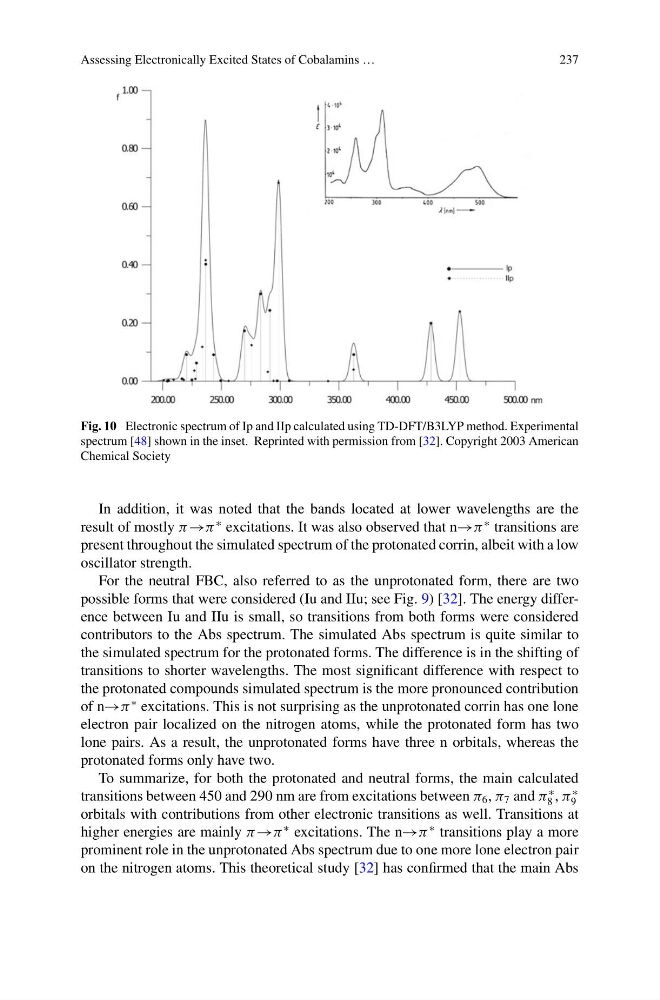
Fig. 10 Electronic spectrum of Ip and IIp calculated using TD-DFT/B3LYP method. Experimental
spectrum [48] shown in the inset. Reprinted with permission from [32]. Copyright 2003 American
Chemical Society
In addition, it was noted that the bands located at lower wavelengths are the
result of mostly π →π
∗ excitations. It was also observed that n→π
∗ transitions are
present throughout the simulated spectrum of the protonated corrin, albeit with a low
oscillator strength.
For the neutral FBC, also referred to as the unprotonated form, there are two
possible forms that were considered (Iu and IIu; see Fig. 9) [32]. The energy difference between Iu and IIu is small, so transitions from both forms were considered
contributors to the Abs spectrum. The simulated Abs spectrum is quite similar to
the simulated spectrum for the protonated forms. The difference is in the shifting of
transitions to shorter wavelengths. The most significant difference with respect to
the protonated compounds simulated spectrum is the more pronounced contribution
of n→π
∗ excitations. This is not surprising as the unprotonated corrin has one lone
electron pair localized on the nitrogen atoms, while the protonated form has two
lone pairs. As a result, the unprotonated forms have three n orbitals, whereas the
protonated forms only have two.
To summarize, for both the protonated and neutral forms, the main calculated
transitions between 450 and 290 nm are from excitations between π 6 , π 7 and π
∗
8 , π
∗
9
orbitals with contributions from other electronic transitions as well. Transitions at
higher energies are mainly π →π
∗ excitations. The n→π
∗ transitions play a more
prominent role in the unprotonated Abs spectrum due to one more lone electron pair
on the nitrogen atoms. This theoretical study [32] has confirmed that the main Abs
237
Fig. 10 Electronic spectrum of Ip and IIp calculated using TD-DFT/B3LYP method. Experimental
spectrum [48] shown in the inset. Reprinted with permission from [32]. Copyright 2003 American
Chemical Society
In addition, it was noted that the bands located at lower wavelengths are the
result of mostly π →π
∗ excitations. It was also observed that n→π
∗ transitions are
present throughout the simulated spectrum of the protonated corrin, albeit with a low
oscillator strength.
For the neutral FBC, also referred to as the unprotonated form, there are two
possible forms that were considered (Iu and IIu; see Fig. 9) [32]. The energy difference between Iu and IIu is small, so transitions from both forms were considered
contributors to the Abs spectrum. The simulated Abs spectrum is quite similar to
the simulated spectrum for the protonated forms. The difference is in the shifting of
transitions to shorter wavelengths. The most significant difference with respect to
the protonated compounds simulated spectrum is the more pronounced contribution
of n→π
∗ excitations. This is not surprising as the unprotonated corrin has one lone
electron pair localized on the nitrogen atoms, while the protonated form has two
lone pairs. As a result, the unprotonated forms have three n orbitals, whereas the
protonated forms only have two.
To summarize, for both the protonated and neutral forms, the main calculated
transitions between 450 and 290 nm are from excitations between π 6 , π 7 and π
∗
8 , π
∗
9
orbitals with contributions from other electronic transitions as well. Transitions at
higher energies are mainly π →π
∗ excitations. The n→π
∗ transitions play a more
prominent role in the unprotonated Abs spectrum due to one more lone electron pair
on the nitrogen atoms. This theoretical study [32] has confirmed that the main Abs