

Assessing Electronically Excited States of Cobalamins …
233
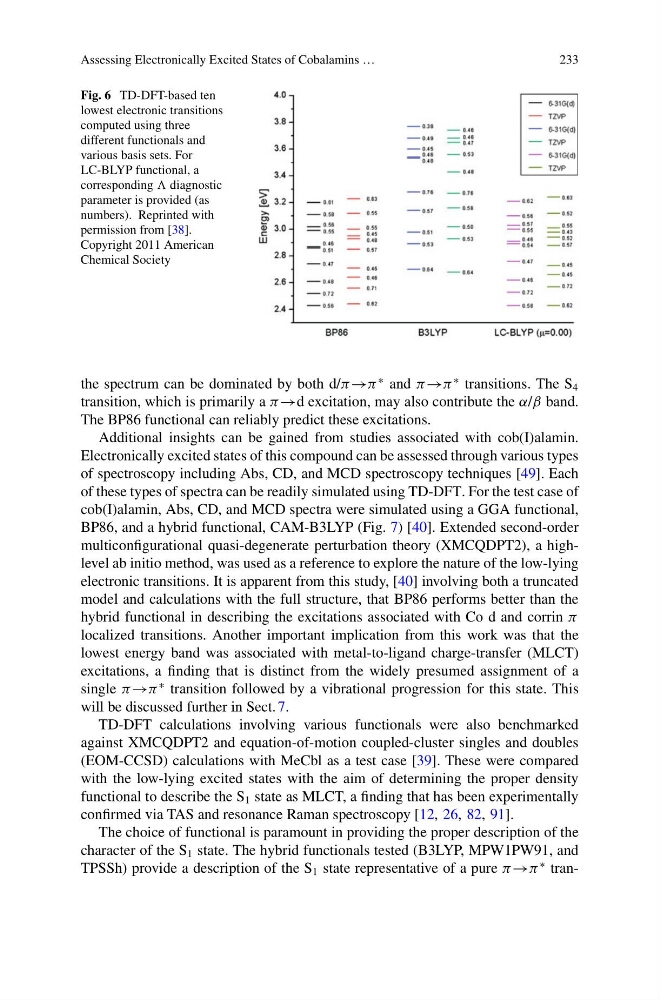
Fig. 6 TD-DFT-based ten
lowest electronic transitions
computed using three
different functionals and
various basis sets. For
LC-BLYP functional, a
corresponding diagnostic
parameter is provided (as
numbers). Reprinted with
permission from [38].
Copyright 2011 American
Chemical Society
the spectrum can be dominated by both d/π →π
∗ and π →π
∗ transitions. The S 4
transition, which is primarily a π →d excitation, may also contribute the α/β band.
The BP86 functional can reliably predict these excitations.
Additional insights can be gained from studies associated with cob(I)alamin.
Electronically excited states of this compound can be assessed through various types
of spectroscopy including Abs, CD, and MCD spectroscopy techniques [49]. Each
of these types of spectra can be readily simulated using TD-DFT. For the test case of
cob(I)alamin, Abs, CD, and MCD spectra were simulated using a GGA functional,
BP86, and a hybrid functional, CAM-B3LYP (Fig. 7) [40]. Extended second-order
multiconfigurational quasi-degenerate perturbation theory (XMCQDPT2), a highlevel ab initio method, was used as a reference to explore the nature of the low-lying
electronic transitions. It is apparent from this study, [40] involving both a truncated
model and calculations with the full structure, that BP86 performs better than the
hybrid functional in describing the excitations associated with Co d and corrin π
localized transitions. Another important implication from this work was that the
lowest energy band was associated with metal-to-ligand charge-transfer (MLCT)
excitations, a finding that is distinct from the widely presumed assignment of a
single π →π
∗ transition followed by a vibrational progression for this state. This
will be discussed further in Sect. 7.
TD-DFT calculations involving various functionals were also benchmarked
against XMCQDPT2 and equation-of-motion coupled-cluster singles and doubles
(EOM-CCSD) calculations with MeCbl as a test case [39]. These were compared
with the low-lying excited states with the aim of determining the proper density
functional to describe the S 1 state as MLCT, a finding that has been experimentally
confirmed via TAS and resonance Raman spectroscopy [12, 26, 82, 91].
The choice of functional is paramount in providing the proper description of the
character of the S 1 state. The hybrid functionals tested (B3LYP, MPW1PW91, and
TPSSh) provide a description of the S 1 state representative of a pure π →π
∗ tran-
233
Fig. 6 TD-DFT-based ten
lowest electronic transitions
computed using three
different functionals and
various basis sets. For
LC-BLYP functional, a
corresponding diagnostic
parameter is provided (as
numbers). Reprinted with
permission from [38].
Copyright 2011 American
Chemical Society
the spectrum can be dominated by both d/π →π
∗ and π →π
∗ transitions. The S 4
transition, which is primarily a π →d excitation, may also contribute the α/β band.
The BP86 functional can reliably predict these excitations.
Additional insights can be gained from studies associated with cob(I)alamin.
Electronically excited states of this compound can be assessed through various types
of spectroscopy including Abs, CD, and MCD spectroscopy techniques [49]. Each
of these types of spectra can be readily simulated using TD-DFT. For the test case of
cob(I)alamin, Abs, CD, and MCD spectra were simulated using a GGA functional,
BP86, and a hybrid functional, CAM-B3LYP (Fig. 7) [40]. Extended second-order
multiconfigurational quasi-degenerate perturbation theory (XMCQDPT2), a highlevel ab initio method, was used as a reference to explore the nature of the low-lying
electronic transitions. It is apparent from this study, [40] involving both a truncated
model and calculations with the full structure, that BP86 performs better than the
hybrid functional in describing the excitations associated with Co d and corrin π
localized transitions. Another important implication from this work was that the
lowest energy band was associated with metal-to-ligand charge-transfer (MLCT)
excitations, a finding that is distinct from the widely presumed assignment of a
single π →π
∗ transition followed by a vibrational progression for this state. This
will be discussed further in Sect. 7.
TD-DFT calculations involving various functionals were also benchmarked
against XMCQDPT2 and equation-of-motion coupled-cluster singles and doubles
(EOM-CCSD) calculations with MeCbl as a test case [39]. These were compared
with the low-lying excited states with the aim of determining the proper density
functional to describe the S 1 state as MLCT, a finding that has been experimentally
confirmed via TAS and resonance Raman spectroscopy [12, 26, 82, 91].
The choice of functional is paramount in providing the proper description of the
character of the S 1 state. The hybrid functionals tested (B3LYP, MPW1PW91, and
TPSSh) provide a description of the S 1 state representative of a pure π →π
∗ tran-