

Assessing Electronically Excited States of Cobalamins …
229
Table 1 Experimental values of Co–C BDEs [kcal/mol] in selected cobalamins
Cobalamin
BDE
Method
References
MeCbl
37±3
Thermolysis
[58, 59]
MeCbl
36±4
Calorimetry
[30]
AdoCbl
31.5±1.3
Thermolysis
[19, 27]
AdoCbl
30.9±4.1
Calorimetry
[55]
inverse and normal trans influence in alkylcobalamins [46]. The geometries of 28
corrin-containing models were optimized, and it was concluded that the inverse trans
influence is not a general characteristic of B 12 compounds as was supposed based
on experimental results. The BP86/6-31G(d) level of theory yielded bond lengths
that were comparable to experimental data. It was also shown that inverse trans
influence is observed when the upper axial ligand is enlarged or has an increased
electron-donating ability.
As far as determining the proper functional to use within the DFT framework
to study cobalamins, one must rely on benchmark calculations. With access to over
three hundred density functionals, it is not automatically apparent which functional
is appropriate to study a particular system, including cobalamins. Thus, a number
of thorough benchmark studies have been reported where different functionals have
been applied to estimate dissociation of the Co–C bond in cobalamins [34, 37,
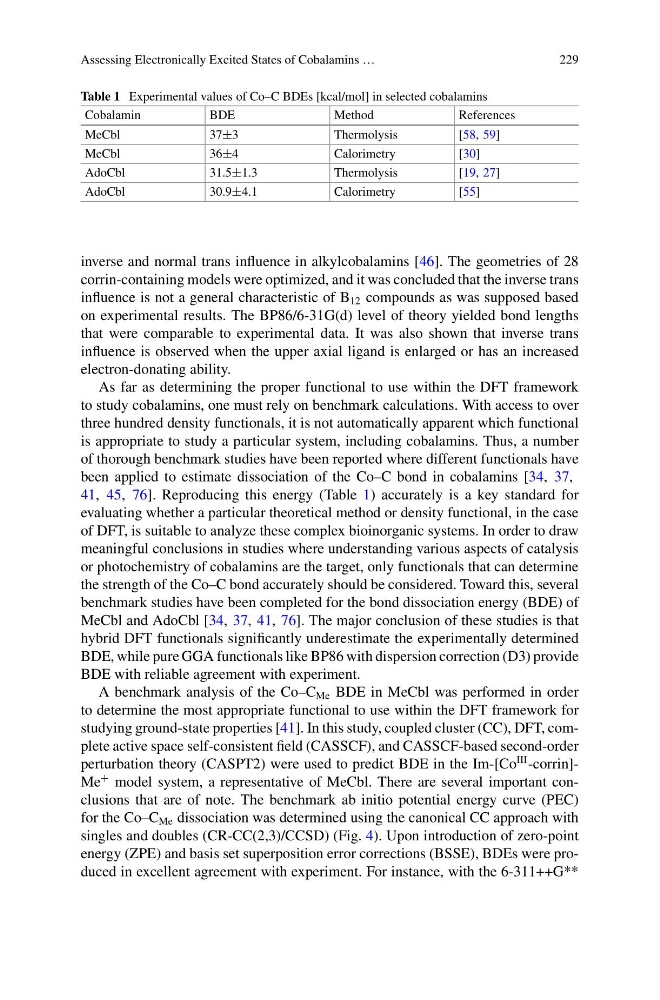
41, 45, 76]. Reproducing this energy (Table 1) accurately is a key standard for
evaluating whether a particular theoretical method or density functional, in the case
of DFT, is suitable to analyze these complex bioinorganic systems. In order to draw
meaningful conclusions in studies where understanding various aspects of catalysis
or photochemistry of cobalamins are the target, only functionals that can determine
the strength of the Co–C bond accurately should be considered. Toward this, several
benchmark studies have been completed for the bond dissociation energy (BDE) of
MeCbl and AdoCbl [34, 37, 41, 76]. The major conclusion of these studies is that
hybrid DFT functionals significantly underestimate the experimentally determined
BDE, while pure GGA functionals like BP86 with dispersion correction (D3) provide
BDE with reliable agreement with experiment.
A benchmark analysis of the Co–C Me BDE in MeCbl was performed in order
to determine the most appropriate functional to use within the DFT framework for
studying ground-state properties [41]. In this study, coupled cluster (CC), DFT, complete active space self-consistent field (CASSCF), and CASSCF-based second-order
perturbation theory (CASPT2) were used to predict BDE in the Im-[Co
III -corrin]Me
+ model system, a representative of MeCbl. There are several important conclusions that are of note. The benchmark ab initio potential energy curve (PEC)
for the Co–C Me dissociation was determined using the canonical CC approach with
singles and doubles (CR-CC(2,3)/CCSD) (Fig. 4). Upon introduction of zero-point
energy (ZPE) and basis set superposition error corrections (BSSE), BDEs were produced in excellent agreement with experiment. For instance, with the 6-311++G**
229
Table 1 Experimental values of Co–C BDEs [kcal/mol] in selected cobalamins
Cobalamin
BDE
Method
References
MeCbl
37±3
Thermolysis
[58, 59]
MeCbl
36±4
Calorimetry
[30]
AdoCbl
31.5±1.3
Thermolysis
[19, 27]
AdoCbl
30.9±4.1
Calorimetry
[55]
inverse and normal trans influence in alkylcobalamins [46]. The geometries of 28
corrin-containing models were optimized, and it was concluded that the inverse trans
influence is not a general characteristic of B 12 compounds as was supposed based
on experimental results. The BP86/6-31G(d) level of theory yielded bond lengths
that were comparable to experimental data. It was also shown that inverse trans
influence is observed when the upper axial ligand is enlarged or has an increased
electron-donating ability.
As far as determining the proper functional to use within the DFT framework
to study cobalamins, one must rely on benchmark calculations. With access to over
three hundred density functionals, it is not automatically apparent which functional
is appropriate to study a particular system, including cobalamins. Thus, a number
of thorough benchmark studies have been reported where different functionals have
been applied to estimate dissociation of the Co–C bond in cobalamins [34, 37,
41, 45, 76]. Reproducing this energy (Table 1) accurately is a key standard for
evaluating whether a particular theoretical method or density functional, in the case
of DFT, is suitable to analyze these complex bioinorganic systems. In order to draw
meaningful conclusions in studies where understanding various aspects of catalysis
or photochemistry of cobalamins are the target, only functionals that can determine
the strength of the Co–C bond accurately should be considered. Toward this, several
benchmark studies have been completed for the bond dissociation energy (BDE) of
MeCbl and AdoCbl [34, 37, 41, 76]. The major conclusion of these studies is that
hybrid DFT functionals significantly underestimate the experimentally determined
BDE, while pure GGA functionals like BP86 with dispersion correction (D3) provide
BDE with reliable agreement with experiment.
A benchmark analysis of the Co–C Me BDE in MeCbl was performed in order
to determine the most appropriate functional to use within the DFT framework for
studying ground-state properties [41]. In this study, coupled cluster (CC), DFT, complete active space self-consistent field (CASSCF), and CASSCF-based second-order
perturbation theory (CASPT2) were used to predict BDE in the Im-[Co
III -corrin]Me
+ model system, a representative of MeCbl. There are several important conclusions that are of note. The benchmark ab initio potential energy curve (PEC)
for the Co–C Me dissociation was determined using the canonical CC approach with
singles and doubles (CR-CC(2,3)/CCSD) (Fig. 4). Upon introduction of zero-point
energy (ZPE) and basis set superposition error corrections (BSSE), BDEs were produced in excellent agreement with experiment. For instance, with the 6-311++G**