

Multiconfigurational Approach to X-ray Spectroscopy …
211
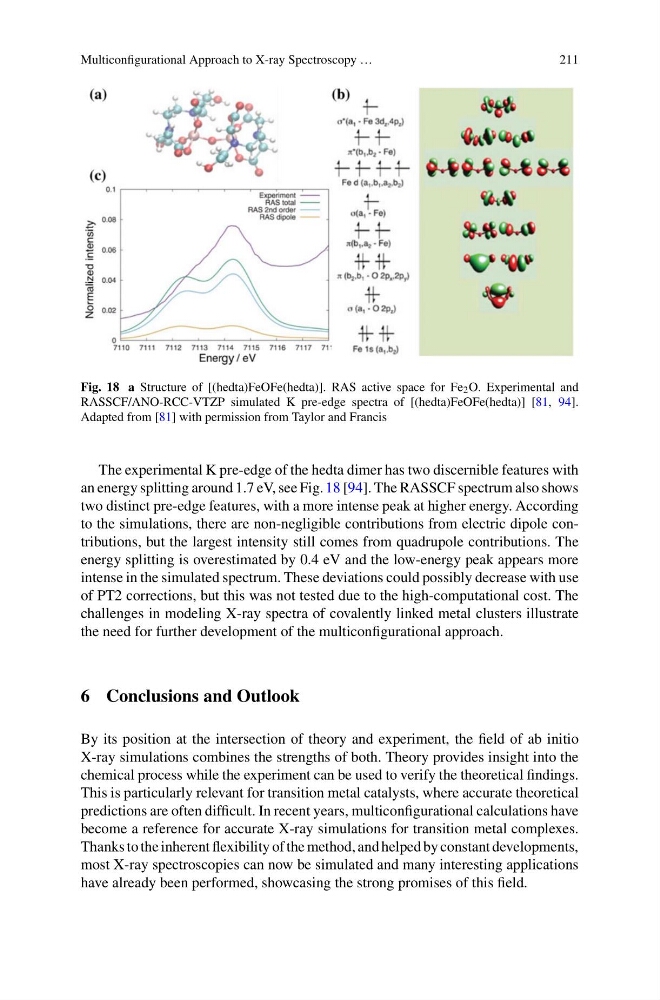
Fig. 18 a Structure of [(hedta)FeOFe(hedta)]. RAS active space for Fe 2 O. Experimental and
RASSCF/ANO-RCC-VTZP simulated K pre-edge spectra of [(hedta)FeOFe(hedta)] [81, 94].
Adapted from [81] with permission from Taylor and Francis
The experimental K pre-edge of the hedta dimer has two discernible features with
an energy splitting around 1.7 eV, see Fig. 18 [94]. The RASSCF spectrum also shows
two distinct pre-edge features, with a more intense peak at higher energy. According
to the simulations, there are non-negligible contributions from electric dipole contributions, but the largest intensity still comes from quadrupole contributions. The
energy splitting is overestimated by 0.4 eV and the low-energy peak appears more
intense in the simulated spectrum. These deviations could possibly decrease with use
of PT2 corrections, but this was not tested due to the high-computational cost. The
challenges in modeling X-ray spectra of covalently linked metal clusters illustrate
the need for further development of the multiconfigurational approach.
6 Conclusions and Outlook
By its position at the intersection of theory and experiment, the field of ab initio
X-ray simulations combines the strengths of both. Theory provides insight into the
chemical process while the experiment can be used to verify the theoretical findings.
This is particularly relevant for transition metal catalysts, where accurate theoretical
predictions are often difficult. In recent years, multiconfigurational calculations have
become a reference for accurate X-ray simulations for transition metal complexes.
Thanks to the inherent flexibility of the method, and helped by constant developments,
most X-ray spectroscopies can now be simulated and many interesting applications
have already been performed, showcasing the strong promises of this field.
211
Fig. 18 a Structure of [(hedta)FeOFe(hedta)]. RAS active space for Fe 2 O. Experimental and
RASSCF/ANO-RCC-VTZP simulated K pre-edge spectra of [(hedta)FeOFe(hedta)] [81, 94].
Adapted from [81] with permission from Taylor and Francis
The experimental K pre-edge of the hedta dimer has two discernible features with
an energy splitting around 1.7 eV, see Fig. 18 [94]. The RASSCF spectrum also shows
two distinct pre-edge features, with a more intense peak at higher energy. According
to the simulations, there are non-negligible contributions from electric dipole contributions, but the largest intensity still comes from quadrupole contributions. The
energy splitting is overestimated by 0.4 eV and the low-energy peak appears more
intense in the simulated spectrum. These deviations could possibly decrease with use
of PT2 corrections, but this was not tested due to the high-computational cost. The
challenges in modeling X-ray spectra of covalently linked metal clusters illustrate
the need for further development of the multiconfigurational approach.
6 Conclusions and Outlook
By its position at the intersection of theory and experiment, the field of ab initio
X-ray simulations combines the strengths of both. Theory provides insight into the
chemical process while the experiment can be used to verify the theoretical findings.
This is particularly relevant for transition metal catalysts, where accurate theoretical
predictions are often difficult. In recent years, multiconfigurational calculations have
become a reference for accurate X-ray simulations for transition metal complexes.
Thanks to the inherent flexibility of the method, and helped by constant developments,
most X-ray spectroscopies can now be simulated and many interesting applications
have already been performed, showcasing the strong promises of this field.