

210
M. Lundberg and M. G. Delcey
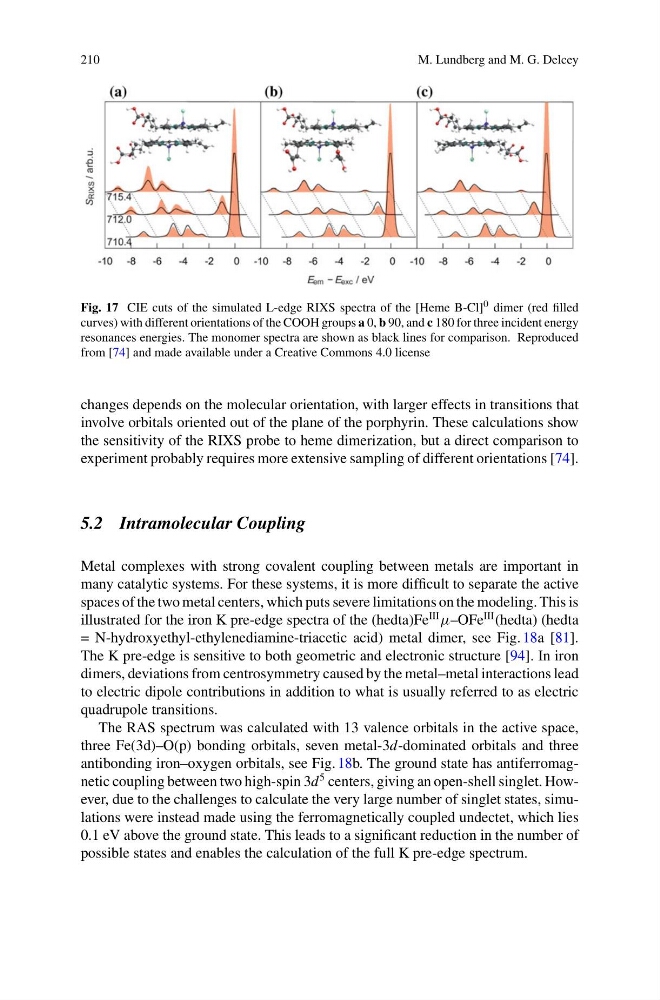
Fig. 17 CIE cuts of the simulated L-edge RIXS spectra of the [Heme B-Cl] 0 dimer (red filled
curves) with different orientations of the COOH groups a 0, b 90, and c 180 for three incident energy
resonances energies. The monomer spectra are shown as black lines for comparison. Reproduced
from [74] and made available under a Creative Commons 4.0 license
changes depends on the molecular orientation, with larger effects in transitions that
involve orbitals oriented out of the plane of the porphyrin. These calculations show
the sensitivity of the RIXS probe to heme dimerization, but a direct comparison to
experiment probably requires more extensive sampling of different orientations [74].
5.2 Intramolecular Coupling
Metal complexes with strong covalent coupling between metals are important in
many catalytic systems. For these systems, it is more difficult to separate the active
spaces of the two metal centers, which puts severe limitations on the modeling. This is
illustrated for the iron K pre-edge spectra of the (hedta)Fe
III
μ–OFe
III (hedta) (hedta
= N-hydroxyethyl-ethylenediamine-triacetic acid) metal dimer, see Fig. 18a [81].
The K pre-edge is sensitive to both geometric and electronic structure [94]. In iron
dimers, deviations from centrosymmetry caused by the metal–metal interactions lead
to electric dipole contributions in addition to what is usually referred to as electric
quadrupole transitions.
The RAS spectrum was calculated with 13 valence orbitals in the active space,
three Fe(3d)–O(p) bonding orbitals, seven metal-3d-dominated orbitals and three
antibonding iron–oxygen orbitals, see Fig. 18b. The ground state has antiferromagnetic coupling between two high-spin 3d
5 centers, giving an open-shell singlet. However, due to the challenges to calculate the very large number of singlet states, simulations were instead made using the ferromagnetically coupled undectet, which lies
0.1 eV above the ground state. This leads to a significant reduction in the number of
possible states and enables the calculation of the full K pre-edge spectrum.
M. Lundberg and M. G. Delcey
Fig. 17 CIE cuts of the simulated L-edge RIXS spectra of the [Heme B-Cl] 0 dimer (red filled
curves) with different orientations of the COOH groups a 0, b 90, and c 180 for three incident energy
resonances energies. The monomer spectra are shown as black lines for comparison. Reproduced
from [74] and made available under a Creative Commons 4.0 license
changes depends on the molecular orientation, with larger effects in transitions that
involve orbitals oriented out of the plane of the porphyrin. These calculations show
the sensitivity of the RIXS probe to heme dimerization, but a direct comparison to
experiment probably requires more extensive sampling of different orientations [74].
5.2 Intramolecular Coupling
Metal complexes with strong covalent coupling between metals are important in
many catalytic systems. For these systems, it is more difficult to separate the active
spaces of the two metal centers, which puts severe limitations on the modeling. This is
illustrated for the iron K pre-edge spectra of the (hedta)Fe
III
μ–OFe
III (hedta) (hedta
= N-hydroxyethyl-ethylenediamine-triacetic acid) metal dimer, see Fig. 18a [81].
The K pre-edge is sensitive to both geometric and electronic structure [94]. In iron
dimers, deviations from centrosymmetry caused by the metal–metal interactions lead
to electric dipole contributions in addition to what is usually referred to as electric
quadrupole transitions.
The RAS spectrum was calculated with 13 valence orbitals in the active space,
three Fe(3d)–O(p) bonding orbitals, seven metal-3d-dominated orbitals and three
antibonding iron–oxygen orbitals, see Fig. 18b. The ground state has antiferromagnetic coupling between two high-spin 3d
5 centers, giving an open-shell singlet. However, due to the challenges to calculate the very large number of singlet states, simulations were instead made using the ferromagnetically coupled undectet, which lies
0.1 eV above the ground state. This leads to a significant reduction in the number of
possible states and enables the calculation of the full K pre-edge spectrum.