

206
M. Lundberg and M. G. Delcey
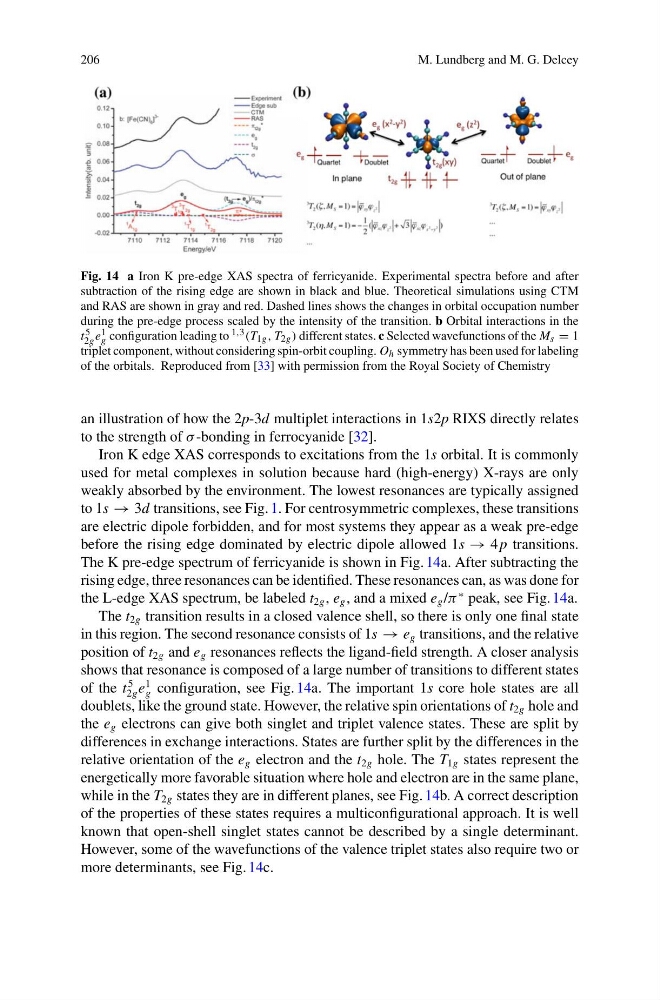
Fig. 14 a Iron K pre-edge XAS spectra of ferricyanide. Experimental spectra before and after
subtraction of the rising edge are shown in black and blue. Theoretical simulations using CTM
and RAS are shown in gray and red. Dashed lines shows the changes in orbital occupation number
during the pre-edge process scaled by the intensity of the transition. b Orbital interactions in the
t 5
2g e 1
g configuration leading to 1,3 (T 1g , T 2g ) different states. c Selected wavefunctions of the M s = 1
triplet component, without considering spin-orbit coupling. O h symmetry has been used for labeling
of the orbitals. Reproduced from [33] with permission from the Royal Society of Chemistry
an illustration of how the 2p-3d multiplet interactions in 1s2p RIXS directly relates
to the strength of σ -bonding in ferrocyanide [32].
Iron K edge XAS corresponds to excitations from the 1s orbital. It is commonly
used for metal complexes in solution because hard (high-energy) X-rays are only
weakly absorbed by the environment. The lowest resonances are typically assigned
to 1s → 3d transitions, see Fig. 1. For centrosymmetric complexes, these transitions
are electric dipole forbidden, and for most systems they appear as a weak pre-edge
before the rising edge dominated by electric dipole allowed 1s → 4 p transitions.
The K pre-edge spectrum of ferricyanide is shown in Fig. 14a. After subtracting the
rising edge, three resonances can be identified. These resonances can, as was done for
the L-edge XAS spectrum, be labeled t 2g , e g , and a mixed e g /π
∗ peak, see Fig. 14a.
The t 2g transition results in a closed valence shell, so there is only one final state
in this region. The second resonance consists of 1s → e g transitions, and the relative
position of t 2g and e g resonances reflects the ligand-field strength. A closer analysis
shows that resonance is composed of a large number of transitions to different states
of the t
5
2g e
1
g configuration, see Fig. 14a. The important 1s core hole states are all
doublets, like the ground state. However, the relative spin orientations of t 2g hole and
the e g electrons can give both singlet and triplet valence states. These are split by
differences in exchange interactions. States are further split by the differences in the
relative orientation of the e g electron and the t 2g hole. The T 1g states represent the
energetically more favorable situation where hole and electron are in the same plane,
while in the T 2g states they are in different planes, see Fig. 14b. A correct description
of the properties of these states requires a multiconfigurational approach. It is well
known that open-shell singlet states cannot be described by a single determinant.
However, some of the wavefunctions of the valence triplet states also require two or
more determinants, see Fig. 14c.
M. Lundberg and M. G. Delcey
Fig. 14 a Iron K pre-edge XAS spectra of ferricyanide. Experimental spectra before and after
subtraction of the rising edge are shown in black and blue. Theoretical simulations using CTM
and RAS are shown in gray and red. Dashed lines shows the changes in orbital occupation number
during the pre-edge process scaled by the intensity of the transition. b Orbital interactions in the
t 5
2g e 1
g configuration leading to 1,3 (T 1g , T 2g ) different states. c Selected wavefunctions of the M s = 1
triplet component, without considering spin-orbit coupling. O h symmetry has been used for labeling
of the orbitals. Reproduced from [33] with permission from the Royal Society of Chemistry
an illustration of how the 2p-3d multiplet interactions in 1s2p RIXS directly relates
to the strength of σ -bonding in ferrocyanide [32].
Iron K edge XAS corresponds to excitations from the 1s orbital. It is commonly
used for metal complexes in solution because hard (high-energy) X-rays are only
weakly absorbed by the environment. The lowest resonances are typically assigned
to 1s → 3d transitions, see Fig. 1. For centrosymmetric complexes, these transitions
are electric dipole forbidden, and for most systems they appear as a weak pre-edge
before the rising edge dominated by electric dipole allowed 1s → 4 p transitions.
The K pre-edge spectrum of ferricyanide is shown in Fig. 14a. After subtracting the
rising edge, three resonances can be identified. These resonances can, as was done for
the L-edge XAS spectrum, be labeled t 2g , e g , and a mixed e g /π
∗ peak, see Fig. 14a.
The t 2g transition results in a closed valence shell, so there is only one final state
in this region. The second resonance consists of 1s → e g transitions, and the relative
position of t 2g and e g resonances reflects the ligand-field strength. A closer analysis
shows that resonance is composed of a large number of transitions to different states
of the t
5
2g e
1
g configuration, see Fig. 14a. The important 1s core hole states are all
doublets, like the ground state. However, the relative spin orientations of t 2g hole and
the e g electrons can give both singlet and triplet valence states. These are split by
differences in exchange interactions. States are further split by the differences in the
relative orientation of the e g electron and the t 2g hole. The T 1g states represent the
energetically more favorable situation where hole and electron are in the same plane,
while in the T 2g states they are in different planes, see Fig. 14b. A correct description
of the properties of these states requires a multiconfigurational approach. It is well
known that open-shell singlet states cannot be described by a single determinant.
However, some of the wavefunctions of the valence triplet states also require two or
more determinants, see Fig. 14c.