

Multiconfigurational Approach to X-ray Spectroscopy …
205
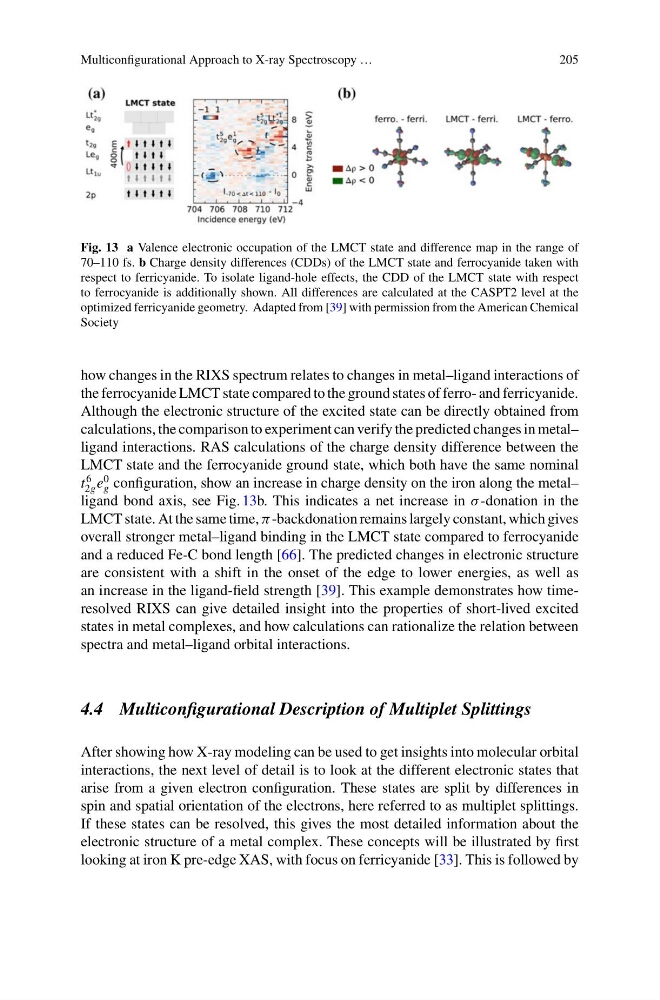
Fig. 13 a Valence electronic occupation of the LMCT state and difference map in the range of
70–110 fs. b Charge density differences (CDDs) of the LMCT state and ferrocyanide taken with
respect to ferricyanide. To isolate ligand-hole effects, the CDD of the LMCT state with respect
to ferrocyanide is additionally shown. All differences are calculated at the CASPT2 level at the
optimized ferricyanide geometry. Adapted from [39] with permission from the American Chemical
Society
how changes in the RIXS spectrum relates to changes in metal–ligand interactions of
the ferrocyanide LMCT state compared to the ground states of ferro- and ferricyanide.
Although the electronic structure of the excited state can be directly obtained from
calculations, the comparison to experiment can verify the predicted changes in metal–
ligand interactions. RAS calculations of the charge density difference between the
LMCT state and the ferrocyanide ground state, which both have the same nominal
t
6
2g e
0
g configuration, show an increase in charge density on the iron along the metal–
ligand bond axis, see Fig. 13b. This indicates a net increase in σ -donation in the
LMCT state. At the same time, π -backdonation remains largely constant, which gives
overall stronger metal–ligand binding in the LMCT state compared to ferrocyanide
and a reduced Fe-C bond length [66]. The predicted changes in electronic structure
are consistent with a shift in the onset of the edge to lower energies, as well as
an increase in the ligand-field strength [39]. This example demonstrates how timeresolved RIXS can give detailed insight into the properties of short-lived excited
states in metal complexes, and how calculations can rationalize the relation between
spectra and metal–ligand orbital interactions.
4.4 Multiconfigurational Description of Multiplet Splittings
After showing how X-ray modeling can be used to get insights into molecular orbital
interactions, the next level of detail is to look at the different electronic states that
arise from a given electron configuration. These states are split by differences in
spin and spatial orientation of the electrons, here referred to as multiplet splittings.
If these states can be resolved, this gives the most detailed information about the
electronic structure of a metal complex. These concepts will be illustrated by first
looking at iron K pre-edge XAS, with focus on ferricyanide [33]. This is followed by
205
Fig. 13 a Valence electronic occupation of the LMCT state and difference map in the range of
70–110 fs. b Charge density differences (CDDs) of the LMCT state and ferrocyanide taken with
respect to ferricyanide. To isolate ligand-hole effects, the CDD of the LMCT state with respect
to ferrocyanide is additionally shown. All differences are calculated at the CASPT2 level at the
optimized ferricyanide geometry. Adapted from [39] with permission from the American Chemical
Society
how changes in the RIXS spectrum relates to changes in metal–ligand interactions of
the ferrocyanide LMCT state compared to the ground states of ferro- and ferricyanide.
Although the electronic structure of the excited state can be directly obtained from
calculations, the comparison to experiment can verify the predicted changes in metal–
ligand interactions. RAS calculations of the charge density difference between the
LMCT state and the ferrocyanide ground state, which both have the same nominal
t
6
2g e
0
g configuration, show an increase in charge density on the iron along the metal–
ligand bond axis, see Fig. 13b. This indicates a net increase in σ -donation in the
LMCT state. At the same time, π -backdonation remains largely constant, which gives
overall stronger metal–ligand binding in the LMCT state compared to ferrocyanide
and a reduced Fe-C bond length [66]. The predicted changes in electronic structure
are consistent with a shift in the onset of the edge to lower energies, as well as
an increase in the ligand-field strength [39]. This example demonstrates how timeresolved RIXS can give detailed insight into the properties of short-lived excited
states in metal complexes, and how calculations can rationalize the relation between
spectra and metal–ligand orbital interactions.
4.4 Multiconfigurational Description of Multiplet Splittings
After showing how X-ray modeling can be used to get insights into molecular orbital
interactions, the next level of detail is to look at the different electronic states that
arise from a given electron configuration. These states are split by differences in
spin and spatial orientation of the electrons, here referred to as multiplet splittings.
If these states can be resolved, this gives the most detailed information about the
electronic structure of a metal complex. These concepts will be illustrated by first
looking at iron K pre-edge XAS, with focus on ferricyanide [33]. This is followed by