

198
M. Lundberg and M. G. Delcey
be compared to the 30 eV range of the full spectrum. The accuracy gives, in most
cases, sufficient predictive power to identify the charge, spin, or electronic structure
of a chemical species [34].
3.6 Relativistic Effects
Even for first-row transition metals, because of the direct involvement of core orbitals,
relativistic effects are very significant. Scalar relativistic effects affect the energy and
radial extent of the core orbitals and thus have a significant effect of the spectrum,
though mostly as a global shift. In our methodology, scalar effects are included using
a second-order Douglas–Kroll–Hess (DKH) Hamiltonian [21, 35], coupled with a
basis set designed specifically to be used in conjunction with DKH, namely the
ANO-RCC basis [77, 78].
When dealing with 2p core holes, the description of spin–orbit coupling is also
essential because the 2p orbitals split into 2 spin–orbit levels, P 1/2 and P 3/2 separated
by around 10 eV (depending on the metal). A computationally efficient way to
include spin–orbit coupling in active-space calculations is to compute core-hole states
with spin multiplicities S = 0, ±1 relative to the ground state, and diagonalizing an
approximate spin–orbit hamiltonian in the basis of those states [63]. This is equivalent
to using Russell-Saunders (LS) coupling. It is only an approximation of the correct
four-component solution, but it is significantly simpler and sufficiently accurate for
most purposes. A full four-component multiconfigurational code has been applied to
X-ray spectroscopy, but only to systems with a small number of active orbitals and
without dynamical correlation [7].
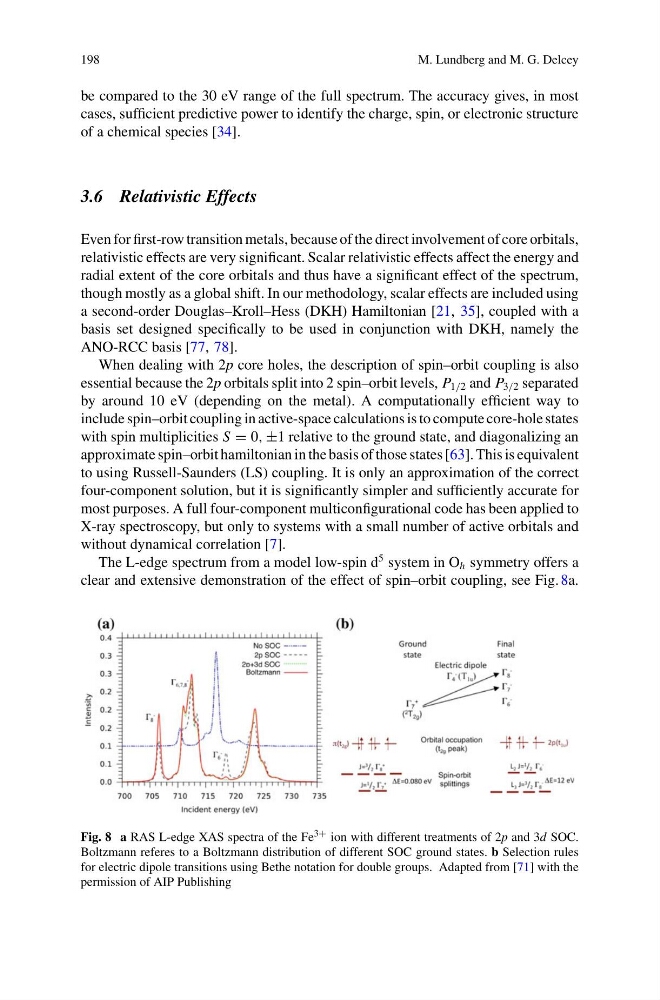
The L-edge spectrum from a model low-spin d
5 system in O h symmetry offers a
clear and extensive demonstration of the effect of spin–orbit coupling, see Fig. 8a.
Fig. 8 a RAS L-edge XAS spectra of the Fe 3+ ion with different treatments of 2p and 3d SOC.
Boltzmann referes to a Boltzmann distribution of different SOC ground states. b Selection rules
for electric dipole transitions using Bethe notation for double groups. Adapted from [71] with the
permission of AIP Publishing
M. Lundberg and M. G. Delcey
be compared to the 30 eV range of the full spectrum. The accuracy gives, in most
cases, sufficient predictive power to identify the charge, spin, or electronic structure
of a chemical species [34].
3.6 Relativistic Effects
Even for first-row transition metals, because of the direct involvement of core orbitals,
relativistic effects are very significant. Scalar relativistic effects affect the energy and
radial extent of the core orbitals and thus have a significant effect of the spectrum,
though mostly as a global shift. In our methodology, scalar effects are included using
a second-order Douglas–Kroll–Hess (DKH) Hamiltonian [21, 35], coupled with a
basis set designed specifically to be used in conjunction with DKH, namely the
ANO-RCC basis [77, 78].
When dealing with 2p core holes, the description of spin–orbit coupling is also
essential because the 2p orbitals split into 2 spin–orbit levels, P 1/2 and P 3/2 separated
by around 10 eV (depending on the metal). A computationally efficient way to
include spin–orbit coupling in active-space calculations is to compute core-hole states
with spin multiplicities S = 0, ±1 relative to the ground state, and diagonalizing an
approximate spin–orbit hamiltonian in the basis of those states [63]. This is equivalent
to using Russell-Saunders (LS) coupling. It is only an approximation of the correct
four-component solution, but it is significantly simpler and sufficiently accurate for
most purposes. A full four-component multiconfigurational code has been applied to
X-ray spectroscopy, but only to systems with a small number of active orbitals and
without dynamical correlation [7].
The L-edge spectrum from a model low-spin d
5 system in O h symmetry offers a
clear and extensive demonstration of the effect of spin–orbit coupling, see Fig. 8a.
Fig. 8 a RAS L-edge XAS spectra of the Fe 3+ ion with different treatments of 2p and 3d SOC.
Boltzmann referes to a Boltzmann distribution of different SOC ground states. b Selection rules
for electric dipole transitions using Bethe notation for double groups. Adapted from [71] with the
permission of AIP Publishing