

196
M. Lundberg and M. G. Delcey
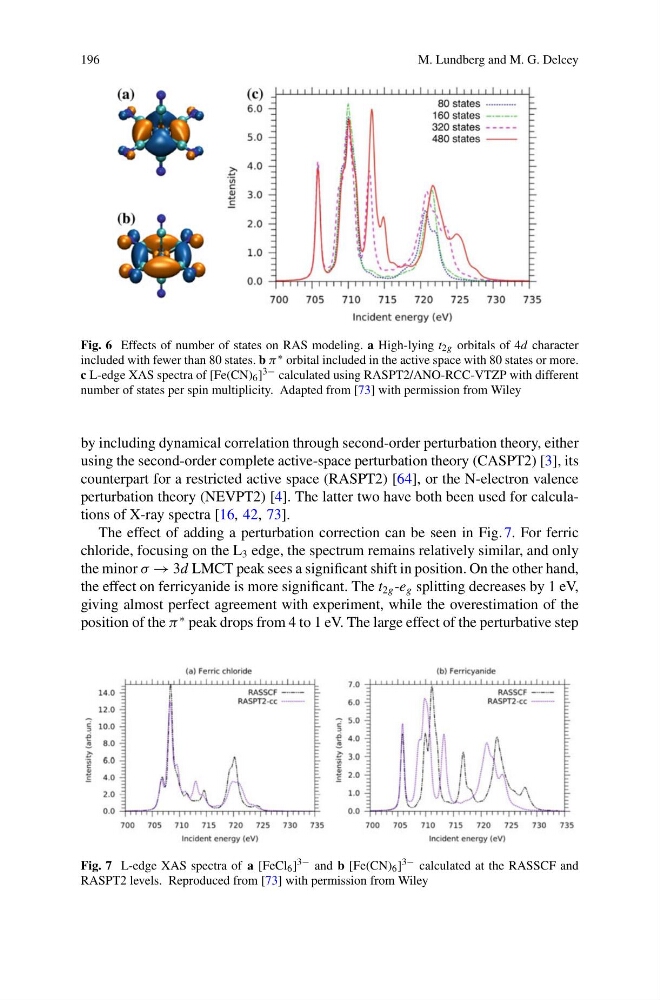
Fig. 6 Effects of number of states on RAS modeling. a High-lying t 2g orbitals of 4d character
included with fewer than 80 states. b π ∗ orbital included in the active space with 80 states or more.
c L-edge XAS spectra of [Fe(CN) 6 ] 3− calculated using RASPT2/ANO-RCC-VTZP with different
number of states per spin multiplicity. Adapted from [73] with permission from Wiley
by including dynamical correlation through second-order perturbation theory, either
using the second-order complete active-space perturbation theory (CASPT2) [3], its
counterpart for a restricted active space (RASPT2) [64], or the N-electron valence
perturbation theory (NEVPT2) [4]. The latter two have both been used for calculations of X-ray spectra [16, 42, 73].
The effect of adding a perturbation correction can be seen in Fig. 7. For ferric
chloride, focusing on the L 3 edge, the spectrum remains relatively similar, and only
the minor σ → 3d LMCT peak sees a significant shift in position. On the other hand,
the effect on ferricyanide is more significant. The t 2g -e g splitting decreases by 1 eV,
giving almost perfect agreement with experiment, while the overestimation of the
position of the π
∗ peak drops from 4 to 1 eV. The large effect of the perturbative step
Fig. 7 L-edge XAS spectra of a [FeCl 6 ] 3− and b [Fe(CN) 6 ] 3− calculated at the RASSCF and
RASPT2 levels. Reproduced from [73] with permission from Wiley
M. Lundberg and M. G. Delcey
Fig. 6 Effects of number of states on RAS modeling. a High-lying t 2g orbitals of 4d character
included with fewer than 80 states. b π ∗ orbital included in the active space with 80 states or more.
c L-edge XAS spectra of [Fe(CN) 6 ] 3− calculated using RASPT2/ANO-RCC-VTZP with different
number of states per spin multiplicity. Adapted from [73] with permission from Wiley
by including dynamical correlation through second-order perturbation theory, either
using the second-order complete active-space perturbation theory (CASPT2) [3], its
counterpart for a restricted active space (RASPT2) [64], or the N-electron valence
perturbation theory (NEVPT2) [4]. The latter two have both been used for calculations of X-ray spectra [16, 42, 73].
The effect of adding a perturbation correction can be seen in Fig. 7. For ferric
chloride, focusing on the L 3 edge, the spectrum remains relatively similar, and only
the minor σ → 3d LMCT peak sees a significant shift in position. On the other hand,
the effect on ferricyanide is more significant. The t 2g -e g splitting decreases by 1 eV,
giving almost perfect agreement with experiment, while the overestimation of the
position of the π
∗ peak drops from 4 to 1 eV. The large effect of the perturbative step
Fig. 7 L-edge XAS spectra of a [FeCl 6 ] 3− and b [Fe(CN) 6 ] 3− calculated at the RASSCF and
RASPT2 levels. Reproduced from [73] with permission from Wiley