

194
M. Lundberg and M. G. Delcey
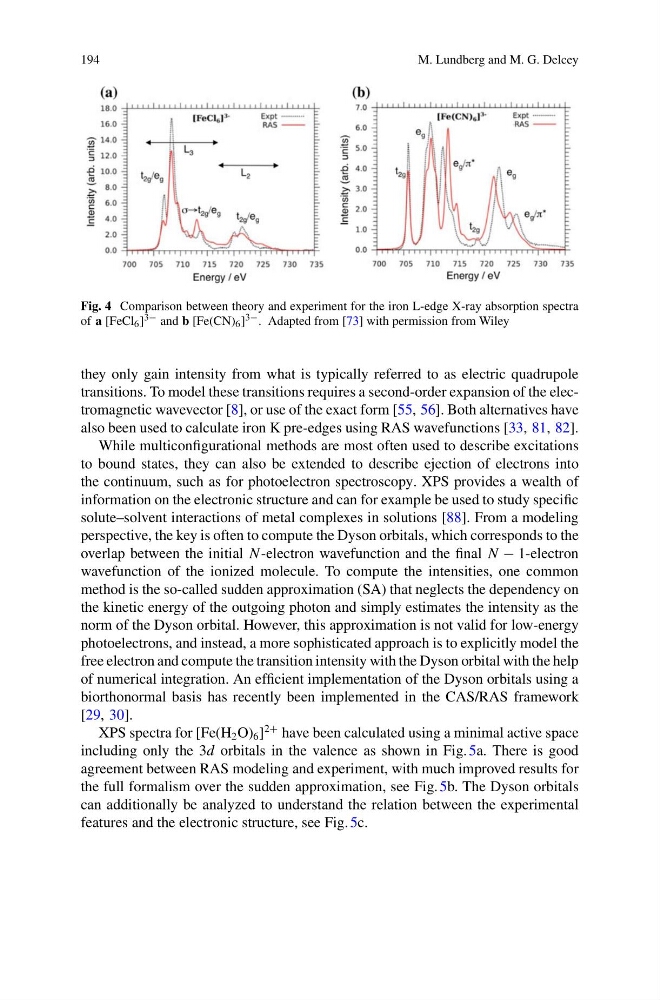
Fig. 4 Comparison between theory and experiment for the iron L-edge X-ray absorption spectra
of a [FeCl 6 ] 3− and b [Fe(CN) 6 ] 3− . Adapted from [73] with permission from Wiley
they only gain intensity from what is typically referred to as electric quadrupole
transitions. To model these transitions requires a second-order expansion of the electromagnetic wavevector [8], or use of the exact form [55, 56]. Both alternatives have
also been used to calculate iron K pre-edges using RAS wavefunctions [33, 81, 82].
While multiconfigurational methods are most often used to describe excitations
to bound states, they can also be extended to describe ejection of electrons into
the continuum, such as for photoelectron spectroscopy. XPS provides a wealth of
information on the electronic structure and can for example be used to study specific
solute–solvent interactions of metal complexes in solutions [88]. From a modeling
perspective, the key is often to compute the Dyson orbitals, which corresponds to the
overlap between the initial N -electron wavefunction and the final N − 1-electron
wavefunction of the ionized molecule. To compute the intensities, one common
method is the so-called sudden approximation (SA) that neglects the dependency on
the kinetic energy of the outgoing photon and simply estimates the intensity as the
norm of the Dyson orbital. However, this approximation is not valid for low-energy
photoelectrons, and instead, a more sophisticated approach is to explicitly model the
free electron and compute the transition intensity with the Dyson orbital with the help
of numerical integration. An efficient implementation of the Dyson orbitals using a
biorthonormal basis has recently been implemented in the CAS/RAS framework
[29, 30].
XPS spectra for [Fe(H 2 O) 6 ]
2+ have been calculated using a minimal active space
including only the 3d orbitals in the valence as shown in Fig. 5a. There is good
agreement between RAS modeling and experiment, with much improved results for
the full formalism over the sudden approximation, see Fig. 5b. The Dyson orbitals
can additionally be analyzed to understand the relation between the experimental
features and the electronic structure, see Fig. 5c.
M. Lundberg and M. G. Delcey
Fig. 4 Comparison between theory and experiment for the iron L-edge X-ray absorption spectra
of a [FeCl 6 ] 3− and b [Fe(CN) 6 ] 3− . Adapted from [73] with permission from Wiley
they only gain intensity from what is typically referred to as electric quadrupole
transitions. To model these transitions requires a second-order expansion of the electromagnetic wavevector [8], or use of the exact form [55, 56]. Both alternatives have
also been used to calculate iron K pre-edges using RAS wavefunctions [33, 81, 82].
While multiconfigurational methods are most often used to describe excitations
to bound states, they can also be extended to describe ejection of electrons into
the continuum, such as for photoelectron spectroscopy. XPS provides a wealth of
information on the electronic structure and can for example be used to study specific
solute–solvent interactions of metal complexes in solutions [88]. From a modeling
perspective, the key is often to compute the Dyson orbitals, which corresponds to the
overlap between the initial N -electron wavefunction and the final N − 1-electron
wavefunction of the ionized molecule. To compute the intensities, one common
method is the so-called sudden approximation (SA) that neglects the dependency on
the kinetic energy of the outgoing photon and simply estimates the intensity as the
norm of the Dyson orbital. However, this approximation is not valid for low-energy
photoelectrons, and instead, a more sophisticated approach is to explicitly model the
free electron and compute the transition intensity with the Dyson orbital with the help
of numerical integration. An efficient implementation of the Dyson orbitals using a
biorthonormal basis has recently been implemented in the CAS/RAS framework
[29, 30].
XPS spectra for [Fe(H 2 O) 6 ]
2+ have been calculated using a minimal active space
including only the 3d orbitals in the valence as shown in Fig. 5a. There is good
agreement between RAS modeling and experiment, with much improved results for
the full formalism over the sudden approximation, see Fig. 5b. The Dyson orbitals
can additionally be analyzed to understand the relation between the experimental
features and the electronic structure, see Fig. 5c.