

Multiconfigurational Approach to X-ray Spectroscopy …
187
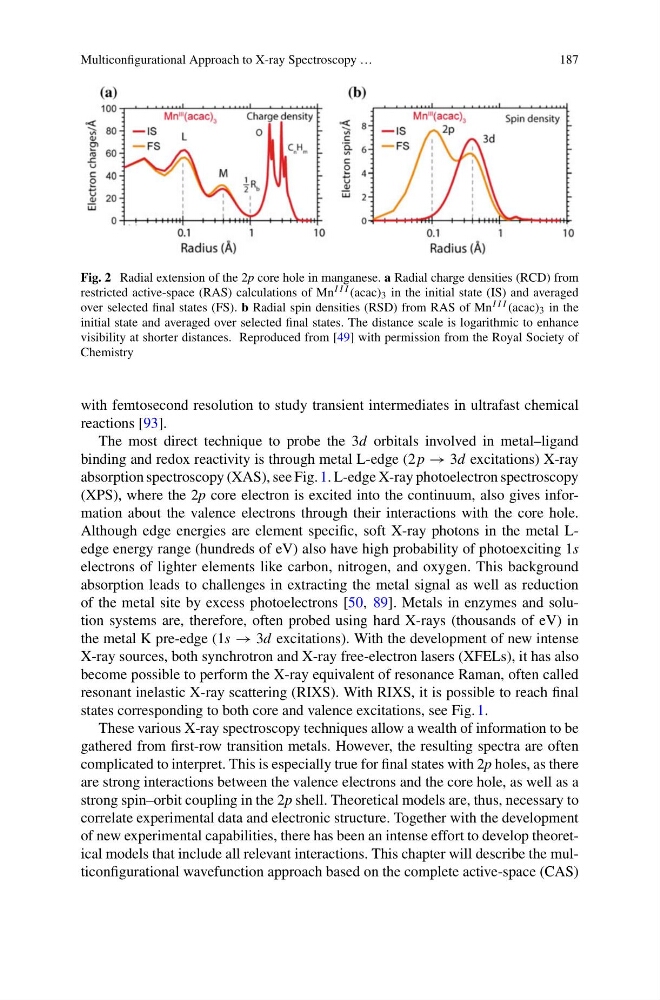
Fig. 2 Radial extension of the 2p core hole in manganese. a Radial charge densities (RCD) from
restricted active-space (RAS) calculations of Mn I I I (acac) 3 in the initial state (IS) and averaged
over selected final states (FS). b Radial spin densities (RSD) from RAS of Mn I I I (acac) 3 in the
initial state and averaged over selected final states. The distance scale is logarithmic to enhance
visibility at shorter distances. Reproduced from [49] with permission from the Royal Society of
Chemistry
with femtosecond resolution to study transient intermediates in ultrafast chemical
reactions [93].
The most direct technique to probe the 3d orbitals involved in metal–ligand
binding and redox reactivity is through metal L-edge (2 p → 3d excitations) X-ray
absorption spectroscopy (XAS), see Fig. 1. L-edge X-ray photoelectron spectroscopy
(XPS), where the 2p core electron is excited into the continuum, also gives information about the valence electrons through their interactions with the core hole.
Although edge energies are element specific, soft X-ray photons in the metal Ledge energy range (hundreds of eV) also have high probability of photoexciting 1s
electrons of lighter elements like carbon, nitrogen, and oxygen. This background
absorption leads to challenges in extracting the metal signal as well as reduction
of the metal site by excess photoelectrons [50, 89]. Metals in enzymes and solution systems are, therefore, often probed using hard X-rays (thousands of eV) in
the metal K pre-edge (1s → 3d excitations). With the development of new intense
X-ray sources, both synchrotron and X-ray free-electron lasers (XFELs), it has also
become possible to perform the X-ray equivalent of resonance Raman, often called
resonant inelastic X-ray scattering (RIXS). With RIXS, it is possible to reach final
states corresponding to both core and valence excitations, see Fig. 1.
These various X-ray spectroscopy techniques allow a wealth of information to be
gathered from first-row transition metals. However, the resulting spectra are often
complicated to interpret. This is especially true for final states with 2p holes, as there
are strong interactions between the valence electrons and the core hole, as well as a
strong spin–orbit coupling in the 2p shell. Theoretical models are, thus, necessary to
correlate experimental data and electronic structure. Together with the development
of new experimental capabilities, there has been an intense effort to develop theoretical models that include all relevant interactions. This chapter will describe the multiconfigurational wavefunction approach based on the complete active-space (CAS)
187
Fig. 2 Radial extension of the 2p core hole in manganese. a Radial charge densities (RCD) from
restricted active-space (RAS) calculations of Mn I I I (acac) 3 in the initial state (IS) and averaged
over selected final states (FS). b Radial spin densities (RSD) from RAS of Mn I I I (acac) 3 in the
initial state and averaged over selected final states. The distance scale is logarithmic to enhance
visibility at shorter distances. Reproduced from [49] with permission from the Royal Society of
Chemistry
with femtosecond resolution to study transient intermediates in ultrafast chemical
reactions [93].
The most direct technique to probe the 3d orbitals involved in metal–ligand
binding and redox reactivity is through metal L-edge (2 p → 3d excitations) X-ray
absorption spectroscopy (XAS), see Fig. 1. L-edge X-ray photoelectron spectroscopy
(XPS), where the 2p core electron is excited into the continuum, also gives information about the valence electrons through their interactions with the core hole.
Although edge energies are element specific, soft X-ray photons in the metal Ledge energy range (hundreds of eV) also have high probability of photoexciting 1s
electrons of lighter elements like carbon, nitrogen, and oxygen. This background
absorption leads to challenges in extracting the metal signal as well as reduction
of the metal site by excess photoelectrons [50, 89]. Metals in enzymes and solution systems are, therefore, often probed using hard X-rays (thousands of eV) in
the metal K pre-edge (1s → 3d excitations). With the development of new intense
X-ray sources, both synchrotron and X-ray free-electron lasers (XFELs), it has also
become possible to perform the X-ray equivalent of resonance Raman, often called
resonant inelastic X-ray scattering (RIXS). With RIXS, it is possible to reach final
states corresponding to both core and valence excitations, see Fig. 1.
These various X-ray spectroscopy techniques allow a wealth of information to be
gathered from first-row transition metals. However, the resulting spectra are often
complicated to interpret. This is especially true for final states with 2p holes, as there
are strong interactions between the valence electrons and the core hole, as well as a
strong spin–orbit coupling in the 2p shell. Theoretical models are, thus, necessary to
correlate experimental data and electronic structure. Together with the development
of new experimental capabilities, there has been an intense effort to develop theoretical models that include all relevant interactions. This chapter will describe the multiconfigurational wavefunction approach based on the complete active-space (CAS)