

168
M. Gruden et al.
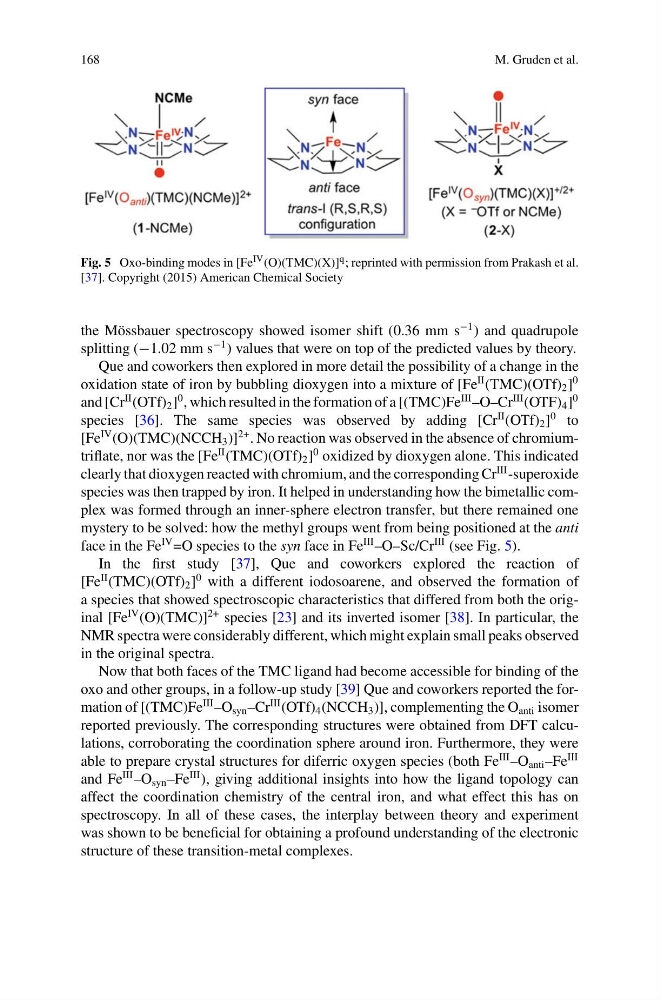
Fig. 5 Oxo-binding modes in [Fe IV (O)(TMC)(X)] q ; reprinted with permission from Prakash et al.
[37]. Copyright (2015) American Chemical Society
the Mössbauer spectroscopy showed isomer shift (0.36 mm s
−1 ) and quadrupole
splitting (−1.02 mm s
−1 ) values that were on top of the predicted values by theory.
Que and coworkers then explored in more detail the possibility of a change in the
oxidation state of iron by bubbling dioxygen into a mixture of [Fe
II (TMC)(OTf) 2 ]
0
and [Cr
II (OTf) 2 ]
0 , which resulted in the formation of a [(TMC)Fe
III –O–Cr
III (OTF) 4 ]
0
species [36]. The same species was observed by adding [Cr
II (OTf) 2 ]
0 to
[Fe
IV (O)(TMC)(NCCH 3 )]
2+ . No reaction was observed in the absence of chromiumtriflate, nor was the [Fe
II (TMC)(OTf) 2 ]
0 oxidized by dioxygen alone. This indicated
clearly that dioxygen reacted with chromium, and the corresponding Cr
III -superoxide
species was then trapped by iron. It helped in understanding how the bimetallic complex was formed through an inner-sphere electron transfer, but there remained one
mystery to be solved: how the methyl groups went from being positioned at the anti
face in the Fe
IV =O species to the syn face in Fe
III –O–Sc/Cr
III (see Fig. 5).
In the first study [37], Que and coworkers explored the reaction of
[Fe
II (TMC)(OTf) 2 ]
0 with a different iodosoarene, and observed the formation of
a species that showed spectroscopic characteristics that differed from both the original [Fe
IV (O)(TMC)]
2+ species [23] and its inverted isomer [38]. In particular, the
NMR spectra were considerably different, which might explain small peaks observed
in the original spectra.
Now that both faces of the TMC ligand had become accessible for binding of the
oxo and other groups, in a follow-up study [39] Que and coworkers reported the formation of [(TMC)Fe
III –O syn –Cr
III (OTf) 4 (NCCH 3 )], complementing the O anti isomer
reported previously. The corresponding structures were obtained from DFT calculations, corroborating the coordination sphere around iron. Furthermore, they were
able to prepare crystal structures for diferric oxygen species (both Fe
III –O anti –Fe
III
and Fe
III –O syn –Fe
III ), giving additional insights into how the ligand topology can
affect the coordination chemistry of the central iron, and what effect this has on
spectroscopy. In all of these cases, the interplay between theory and experiment
was shown to be beneficial for obtaining a profound understanding of the electronic
structure of these transition-metal complexes.
M. Gruden et al.
Fig. 5 Oxo-binding modes in [Fe IV (O)(TMC)(X)] q ; reprinted with permission from Prakash et al.
[37]. Copyright (2015) American Chemical Society
the Mössbauer spectroscopy showed isomer shift (0.36 mm s
−1 ) and quadrupole
splitting (−1.02 mm s
−1 ) values that were on top of the predicted values by theory.
Que and coworkers then explored in more detail the possibility of a change in the
oxidation state of iron by bubbling dioxygen into a mixture of [Fe
II (TMC)(OTf) 2 ]
0
and [Cr
II (OTf) 2 ]
0 , which resulted in the formation of a [(TMC)Fe
III –O–Cr
III (OTF) 4 ]
0
species [36]. The same species was observed by adding [Cr
II (OTf) 2 ]
0 to
[Fe
IV (O)(TMC)(NCCH 3 )]
2+ . No reaction was observed in the absence of chromiumtriflate, nor was the [Fe
II (TMC)(OTf) 2 ]
0 oxidized by dioxygen alone. This indicated
clearly that dioxygen reacted with chromium, and the corresponding Cr
III -superoxide
species was then trapped by iron. It helped in understanding how the bimetallic complex was formed through an inner-sphere electron transfer, but there remained one
mystery to be solved: how the methyl groups went from being positioned at the anti
face in the Fe
IV =O species to the syn face in Fe
III –O–Sc/Cr
III (see Fig. 5).
In the first study [37], Que and coworkers explored the reaction of
[Fe
II (TMC)(OTf) 2 ]
0 with a different iodosoarene, and observed the formation of
a species that showed spectroscopic characteristics that differed from both the original [Fe
IV (O)(TMC)]
2+ species [23] and its inverted isomer [38]. In particular, the
NMR spectra were considerably different, which might explain small peaks observed
in the original spectra.
Now that both faces of the TMC ligand had become accessible for binding of the
oxo and other groups, in a follow-up study [39] Que and coworkers reported the formation of [(TMC)Fe
III –O syn –Cr
III (OTf) 4 (NCCH 3 )], complementing the O anti isomer
reported previously. The corresponding structures were obtained from DFT calculations, corroborating the coordination sphere around iron. Furthermore, they were
able to prepare crystal structures for diferric oxygen species (both Fe
III –O anti –Fe
III
and Fe
III –O syn –Fe
III ), giving additional insights into how the ligand topology can
affect the coordination chemistry of the central iron, and what effect this has on
spectroscopy. In all of these cases, the interplay between theory and experiment
was shown to be beneficial for obtaining a profound understanding of the electronic
structure of these transition-metal complexes.