

New Strategies in Modeling Electronic Structures and Properties …
151
4.4 Cation–cation Attraction in [NpO 2 ]
2+
2
The attractive interaction between two cations is a characteristic feature of heavyelement-containing molecules and has been observed for the first time in uranyl
perchlorate solution and aqueous chlorate media [138–140]. This so-called cation–
cation interactions (CCI) are exploited in the synthesis of new crystalline structures [2, 5, 36, 41, 71, 72, 134, 159, 161, 162]. Most importantly, CCIs pose a
technical difficulty when reprocessing spent nuclear fuel.
Another example for this peculiar interaction are neptunyls. Specifically, neptunyl
CCIs feature an end-on or side-on interaction producing the T-shaped or diamondshaped dimers. The CCIs structures are stable primarily because of the bonding
interaction between the oxygen and the neptunium atoms of two neighbouring complexes, where the effective charge of the oxygen atoms is negative [155] in contrast to
the effective positive charge localised on the actinide atoms [28]. The stability of CCIs
is strongly influenced by the Np–O bond distance, [54] which changes in different
environments [43, 56, 118, 126]. In order to describe the ground- and excited-state
properties of such CCIs, the theoretical model needs to account for environmental
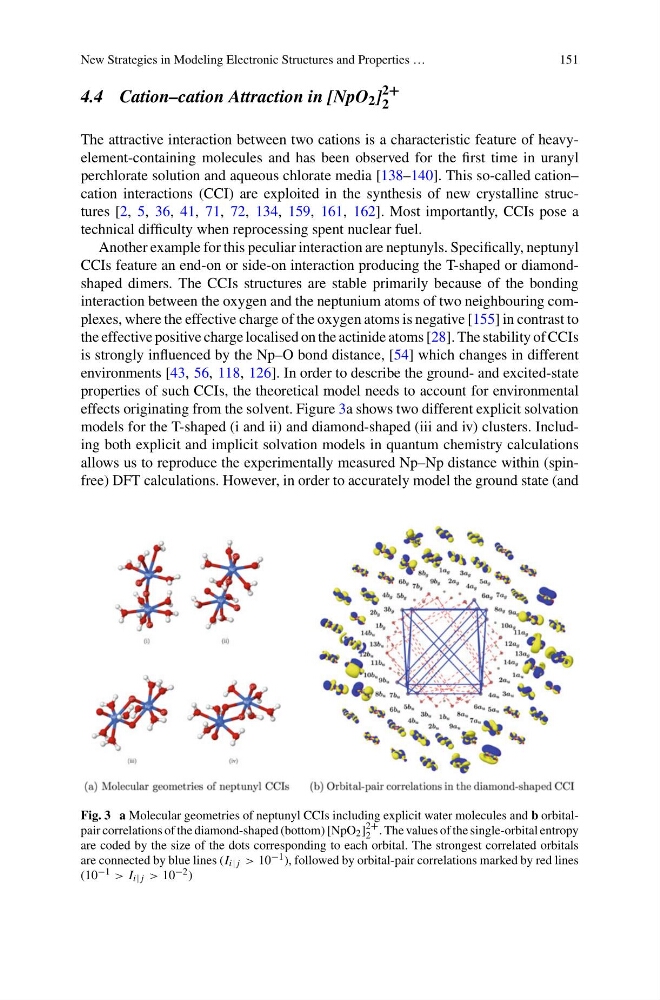
effects originating from the solvent. Figure 3a shows two different explicit solvation
models for the T-shaped (i and ii) and diamond-shaped (iii and iv) clusters. Including both explicit and implicit solvation models in quantum chemistry calculations
allows us to reproduce the experimentally measured Np–Np distance within (spinfree) DFT calculations. However, in order to accurately model the ground state (and
Fig. 3 a Molecular geometries of neptunyl CCIs including explicit water molecules and b orbitalpair correlations of the diamond-shaped (bottom) [NpO 2 ]
2+
2 . The values of the single-orbital entropy
are coded by the size of the dots corresponding to each orbital. The strongest correlated orbitals
are connected by blue lines (I i| j > 10 −1 ), followed by orbital-pair correlations marked by red lines
(10 −1 > I i| j > 10 −2 )
151
4.4 Cation–cation Attraction in [NpO 2 ]
2+
2
The attractive interaction between two cations is a characteristic feature of heavyelement-containing molecules and has been observed for the first time in uranyl
perchlorate solution and aqueous chlorate media [138–140]. This so-called cation–
cation interactions (CCI) are exploited in the synthesis of new crystalline structures [2, 5, 36, 41, 71, 72, 134, 159, 161, 162]. Most importantly, CCIs pose a
technical difficulty when reprocessing spent nuclear fuel.
Another example for this peculiar interaction are neptunyls. Specifically, neptunyl
CCIs feature an end-on or side-on interaction producing the T-shaped or diamondshaped dimers. The CCIs structures are stable primarily because of the bonding
interaction between the oxygen and the neptunium atoms of two neighbouring complexes, where the effective charge of the oxygen atoms is negative [155] in contrast to
the effective positive charge localised on the actinide atoms [28]. The stability of CCIs
is strongly influenced by the Np–O bond distance, [54] which changes in different
environments [43, 56, 118, 126]. In order to describe the ground- and excited-state
properties of such CCIs, the theoretical model needs to account for environmental
effects originating from the solvent. Figure 3a shows two different explicit solvation
models for the T-shaped (i and ii) and diamond-shaped (iii and iv) clusters. Including both explicit and implicit solvation models in quantum chemistry calculations
allows us to reproduce the experimentally measured Np–Np distance within (spinfree) DFT calculations. However, in order to accurately model the ground state (and
Fig. 3 a Molecular geometries of neptunyl CCIs including explicit water molecules and b orbitalpair correlations of the diamond-shaped (bottom) [NpO 2 ]
2+
2 . The values of the single-orbital entropy
are coded by the size of the dots corresponding to each orbital. The strongest correlated orbitals
are connected by blue lines (I i| j > 10 −1 ), followed by orbital-pair correlations marked by red lines
(10 −1 > I i| j > 10 −2 )