

150
A. Łachma´ nska et al.
4.3 CUO Diluted in Noble Gas Matrices
As noble gases are known to be inert, they constitute an ideal environment to investigate properties of single molecules. Diluted in a noble gas matrix, the studied
substance should not interact with the environment and thus its electronic structure should remain unaffected. A peculiar observation has been made for the CUO
molecule and was reported by Andrews et al. [93, 94, 171]. Experiments revealed a
blue shift in the asymmetric U–O and U–C vibrational spectra when the composition
of the noble gas matrix—a mixture of neon and argon—was changed. To explain the
observed shifts, experimentalist anticipated that the noble gas environment may not
be inert and may interact with the CUO unit differently depending on its composition
[93, 94].
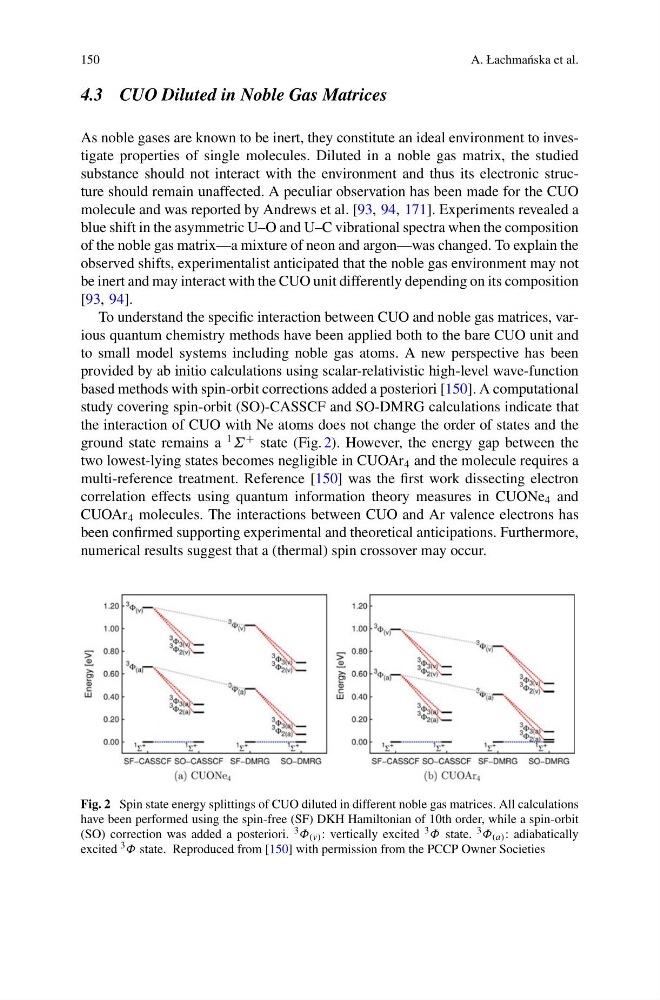
To understand the specific interaction between CUO and noble gas matrices, various quantum chemistry methods have been applied both to the bare CUO unit and
to small model systems including noble gas atoms. A new perspective has been
provided by ab initio calculations using scalar-relativistic high-level wave-function
based methods with spin-orbit corrections added a posteriori [150]. A computational
study covering spin-orbit (SO)-CASSCF and SO-DMRG calculations indicate that
the interaction of CUO with Ne atoms does not change the order of states and the
ground state remains a
1
Σ
+ state (Fig. 2). However, the energy gap between the
two lowest-lying states becomes negligible in CUOAr 4 and the molecule requires a
multi-reference treatment. Reference [150] was the first work dissecting electron
correlation effects using quantum information theory measures in CUONe 4 and
CUOAr 4 molecules. The interactions between CUO and Ar valence electrons has
been confirmed supporting experimental and theoretical anticipations. Furthermore,
numerical results suggest that a (thermal) spin crossover may occur.
Fig. 2 Spin state energy splittings of CUO diluted in different noble gas matrices. All calculations
have been performed using the spin-free (SF) DKH Hamiltonian of 10th order, while a spin-orbit
(SO) correction was added a posteriori. 3 Φ (v) : vertically excited 3 Φ state. 3 Φ (a) : adiabatically
excited 3 Φ state. Reproduced from [150] with permission from the PCCP Owner Societies
A. Łachma´ nska et al.
4.3 CUO Diluted in Noble Gas Matrices
As noble gases are known to be inert, they constitute an ideal environment to investigate properties of single molecules. Diluted in a noble gas matrix, the studied
substance should not interact with the environment and thus its electronic structure should remain unaffected. A peculiar observation has been made for the CUO
molecule and was reported by Andrews et al. [93, 94, 171]. Experiments revealed a
blue shift in the asymmetric U–O and U–C vibrational spectra when the composition
of the noble gas matrix—a mixture of neon and argon—was changed. To explain the
observed shifts, experimentalist anticipated that the noble gas environment may not
be inert and may interact with the CUO unit differently depending on its composition
[93, 94].
To understand the specific interaction between CUO and noble gas matrices, various quantum chemistry methods have been applied both to the bare CUO unit and
to small model systems including noble gas atoms. A new perspective has been
provided by ab initio calculations using scalar-relativistic high-level wave-function
based methods with spin-orbit corrections added a posteriori [150]. A computational
study covering spin-orbit (SO)-CASSCF and SO-DMRG calculations indicate that
the interaction of CUO with Ne atoms does not change the order of states and the
ground state remains a
1
Σ
+ state (Fig. 2). However, the energy gap between the
two lowest-lying states becomes negligible in CUOAr 4 and the molecule requires a
multi-reference treatment. Reference [150] was the first work dissecting electron
correlation effects using quantum information theory measures in CUONe 4 and
CUOAr 4 molecules. The interactions between CUO and Ar valence electrons has
been confirmed supporting experimental and theoretical anticipations. Furthermore,
numerical results suggest that a (thermal) spin crossover may occur.
Fig. 2 Spin state energy splittings of CUO diluted in different noble gas matrices. All calculations
have been performed using the spin-free (SF) DKH Hamiltonian of 10th order, while a spin-orbit
(SO) correction was added a posteriori. 3 Φ (v) : vertically excited 3 Φ state. 3 Φ (a) : adiabatically
excited 3 Φ state. Reproduced from [150] with permission from the PCCP Owner Societies