

140
A. Łachma´ nska et al.
system and its properties are determined by its electron density ρ(r) instead of the
electronic wave function. Specifically, Hohenberg and Kohn [63] proved that the
non-degenerate ground-state wave function is uniquely determined by the electron
density that corresponds to some external potential v ext (r).
The most common implementation of this method is within the Kohn-Sham formalism (KS) [78]. Specifically, in KS-DFT, an artificial reference system of noninteracting electrons is introduced that yields exactly the same electron density as
the fully interacting system. Furthermore, the electronic energy is a functional of the
density and is decomposed into different contributions,
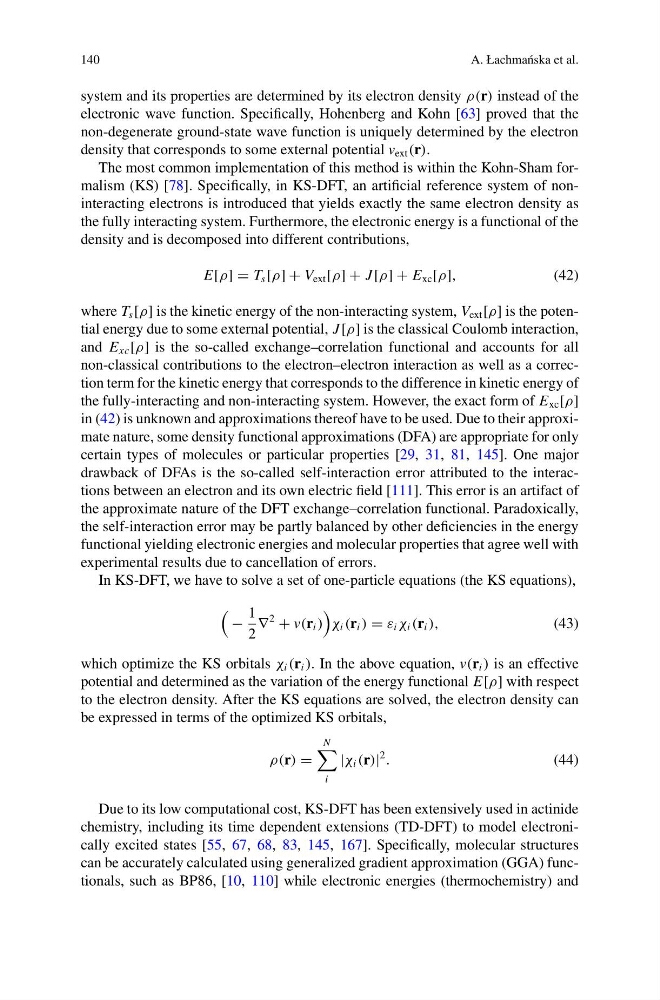
E[ρ] = T s [ρ] + V ext [ρ] + J [ρ] + E xc [ρ],
(42)
where T s [ρ] is the kinetic energy of the non-interacting system, V ext [ρ] is the potential energy due to some external potential, J [ρ] is the classical Coulomb interaction,
and E xc [ρ] is the so-called exchange–correlation functional and accounts for all
non-classical contributions to the electron–electron interaction as well as a correction term for the kinetic energy that corresponds to the difference in kinetic energy of
the fully-interacting and non-interacting system. However, the exact form of E xc [ρ]
in (42) is unknown and approximations thereof have to be used. Due to their approximate nature, some density functional approximations (DFA) are appropriate for only
certain types of molecules or particular properties [29, 31, 81, 145]. One major
drawback of DFAs is the so-called self-interaction error attributed to the interactions between an electron and its own electric field [111]. This error is an artifact of
the approximate nature of the DFT exchange–correlation functional. Paradoxically,
the self-interaction error may be partly balanced by other deficiencies in the energy
functional yielding electronic energies and molecular properties that agree well with
experimental results due to cancellation of errors.
In KS-DFT, we have to solve a set of one-particle equations (the KS equations),
−
1
2
∇
2
+ v(r i )
χ i (r i ) = ε i χ i (r i ),
(43)
which optimize the KS orbitals χ i (r i ). In the above equation, v(r i ) is an effective
potential and determined as the variation of the energy functional E[ρ] with respect
to the electron density. After the KS equations are solved, the electron density can
be expressed in terms of the optimized KS orbitals,
ρ(r) =
N
i
|χ i (r)|
2
.
(44)
Due to its low computational cost, KS-DFT has been extensively used in actinide
chemistry, including its time dependent extensions (TD-DFT) to model electronically excited states [55, 67, 68, 83, 145, 167]. Specifically, molecular structures
can be accurately calculated using generalized gradient approximation (GGA) functionals, such as BP86, [10, 110] while electronic energies (thermochemistry) and
A. Łachma´ nska et al.
system and its properties are determined by its electron density ρ(r) instead of the
electronic wave function. Specifically, Hohenberg and Kohn [63] proved that the
non-degenerate ground-state wave function is uniquely determined by the electron
density that corresponds to some external potential v ext (r).
The most common implementation of this method is within the Kohn-Sham formalism (KS) [78]. Specifically, in KS-DFT, an artificial reference system of noninteracting electrons is introduced that yields exactly the same electron density as
the fully interacting system. Furthermore, the electronic energy is a functional of the
density and is decomposed into different contributions,
E[ρ] = T s [ρ] + V ext [ρ] + J [ρ] + E xc [ρ],
(42)
where T s [ρ] is the kinetic energy of the non-interacting system, V ext [ρ] is the potential energy due to some external potential, J [ρ] is the classical Coulomb interaction,
and E xc [ρ] is the so-called exchange–correlation functional and accounts for all
non-classical contributions to the electron–electron interaction as well as a correction term for the kinetic energy that corresponds to the difference in kinetic energy of
the fully-interacting and non-interacting system. However, the exact form of E xc [ρ]
in (42) is unknown and approximations thereof have to be used. Due to their approximate nature, some density functional approximations (DFA) are appropriate for only
certain types of molecules or particular properties [29, 31, 81, 145]. One major
drawback of DFAs is the so-called self-interaction error attributed to the interactions between an electron and its own electric field [111]. This error is an artifact of
the approximate nature of the DFT exchange–correlation functional. Paradoxically,
the self-interaction error may be partly balanced by other deficiencies in the energy
functional yielding electronic energies and molecular properties that agree well with
experimental results due to cancellation of errors.
In KS-DFT, we have to solve a set of one-particle equations (the KS equations),
−
1
2
∇
2
+ v(r i )
χ i (r i ) = ε i χ i (r i ),
(43)
which optimize the KS orbitals χ i (r i ). In the above equation, v(r i ) is an effective
potential and determined as the variation of the energy functional E[ρ] with respect
to the electron density. After the KS equations are solved, the electron density can
be expressed in terms of the optimized KS orbitals,
ρ(r) =
N
i
|χ i (r)|
2
.
(44)
Due to its low computational cost, KS-DFT has been extensively used in actinide
chemistry, including its time dependent extensions (TD-DFT) to model electronically excited states [55, 67, 68, 83, 145, 167]. Specifically, molecular structures
can be accurately calculated using generalized gradient approximation (GGA) functionals, such as BP86, [10, 110] while electronic energies (thermochemistry) and