

New Strategies in Modeling Electronic Structures and Properties …
139
In the case of AP1roG-tailored CC, the corresponding CC corrections are referred
to as frozen-pair (fp) CCD, fpCCSD, fpCCSDT, etc. In the fpCCD and fpCCSD
methods, the single and non-pair double amplitudes can provide a balanced description of electron correlation effects when both CCD and CCSD fail in describing
strongly-correlated systems.
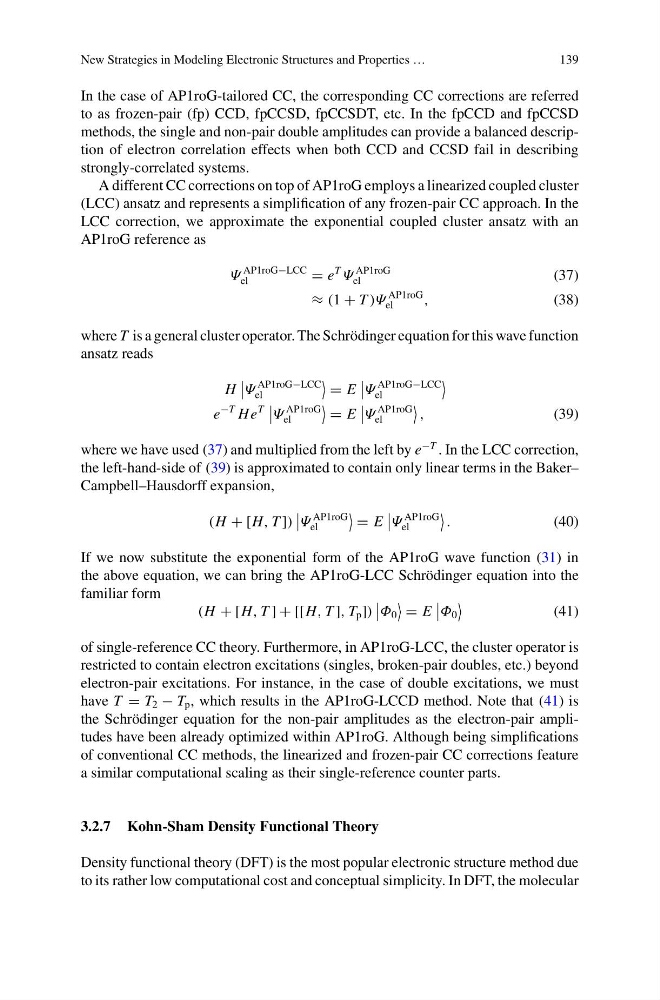
A different CC corrections on top of AP1roG employs a linearized coupled cluster
(LCC) ansatz and represents a simplification of any frozen-pair CC approach. In the
LCC correction, we approximate the exponential coupled cluster ansatz with an
AP1roG reference as
Ψ
AP1roG−LCC
el
= e
T
Ψ
AP1roG
el
(37)
≈ (1 + T )Ψ
AP1roG
el
,
(38)
where T is a general cluster operator. The Schrödinger equation for this wave function
ansatz reads
H
Ψ
AP1roG−LCC
el
= E
Ψ
AP1roG−LCC
el
e
−T He
T
Ψ
AP1roG
el
= E
Ψ
AP1roG
el
,
(39)
where we have used (37) and multiplied from the left by e
−T . In the LCC correction,
the left-hand-side of (39) is approximated to contain only linear terms in the Baker–
Campbell–Hausdorff expansion,
(H + [H, T ])
Ψ
AP1roG
el
= E
Ψ
AP1roG
el
.
(40)
If we now substitute the exponential form of the AP1roG wave function (31) in
the above equation, we can bring the AP1roG-LCC Schrödinger equation into the
familiar form
(H + [H, T ] + [[H, T ], T p ])
Φ 0
= E
Φ 0
(41)
of single-reference CC theory. Furthermore, in AP1roG-LCC, the cluster operator is
restricted to contain electron excitations (singles, broken-pair doubles, etc.) beyond
electron-pair excitations. For instance, in the case of double excitations, we must
have T = T 2 − T p , which results in the AP1roG-LCCD method. Note that (41) is
the Schrödinger equation for the non-pair amplitudes as the electron-pair amplitudes have been already optimized within AP1roG. Although being simplifications
of conventional CC methods, the linearized and frozen-pair CC corrections feature
a similar computational scaling as their single-reference counter parts.
3.2.7 Kohn-Sham Density Functional Theory
Density functional theory (DFT) is the most popular electronic structure method due
to its rather low computational cost and conceptual simplicity. In DFT, the molecular
139
In the case of AP1roG-tailored CC, the corresponding CC corrections are referred
to as frozen-pair (fp) CCD, fpCCSD, fpCCSDT, etc. In the fpCCD and fpCCSD
methods, the single and non-pair double amplitudes can provide a balanced description of electron correlation effects when both CCD and CCSD fail in describing
strongly-correlated systems.
A different CC corrections on top of AP1roG employs a linearized coupled cluster
(LCC) ansatz and represents a simplification of any frozen-pair CC approach. In the
LCC correction, we approximate the exponential coupled cluster ansatz with an
AP1roG reference as
Ψ
AP1roG−LCC
el
= e
T
Ψ
AP1roG
el
(37)
≈ (1 + T )Ψ
AP1roG
el
,
(38)
where T is a general cluster operator. The Schrödinger equation for this wave function
ansatz reads
H
Ψ
AP1roG−LCC
el
= E
Ψ
AP1roG−LCC
el
e
−T He
T
Ψ
AP1roG
el
= E
Ψ
AP1roG
el
,
(39)
where we have used (37) and multiplied from the left by e
−T . In the LCC correction,
the left-hand-side of (39) is approximated to contain only linear terms in the Baker–
Campbell–Hausdorff expansion,
(H + [H, T ])
Ψ
AP1roG
el
= E
Ψ
AP1roG
el
.
(40)
If we now substitute the exponential form of the AP1roG wave function (31) in
the above equation, we can bring the AP1roG-LCC Schrödinger equation into the
familiar form
(H + [H, T ] + [[H, T ], T p ])
Φ 0
= E
Φ 0
(41)
of single-reference CC theory. Furthermore, in AP1roG-LCC, the cluster operator is
restricted to contain electron excitations (singles, broken-pair doubles, etc.) beyond
electron-pair excitations. For instance, in the case of double excitations, we must
have T = T 2 − T p , which results in the AP1roG-LCCD method. Note that (41) is
the Schrödinger equation for the non-pair amplitudes as the electron-pair amplitudes have been already optimized within AP1roG. Although being simplifications
of conventional CC methods, the linearized and frozen-pair CC corrections feature
a similar computational scaling as their single-reference counter parts.
3.2.7 Kohn-Sham Density Functional Theory
Density functional theory (DFT) is the most popular electronic structure method due
to its rather low computational cost and conceptual simplicity. In DFT, the molecular