

108
V. Krewald and D. A. Pantazis
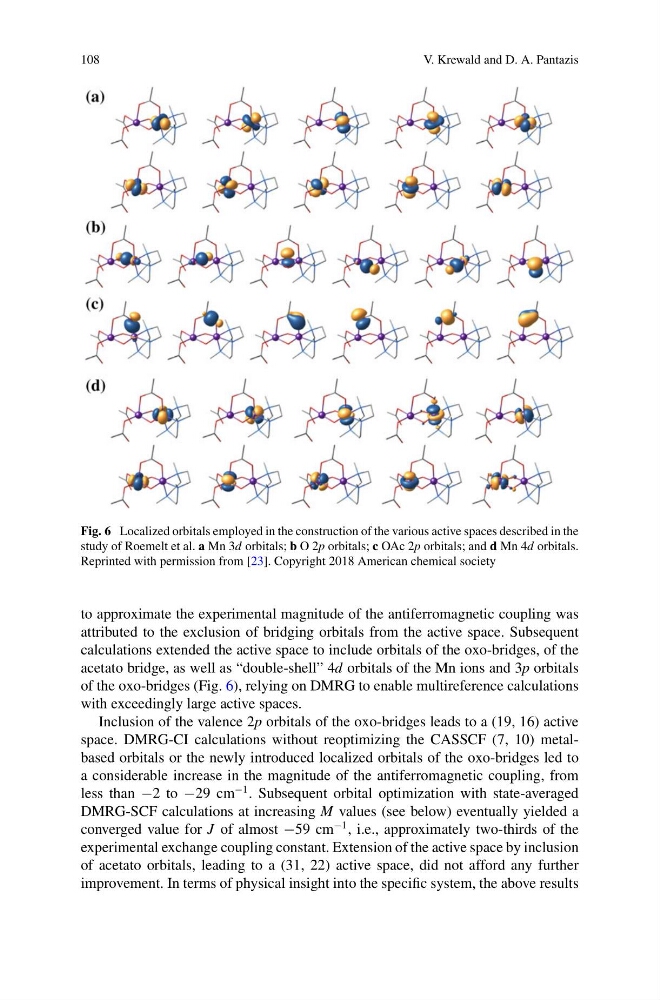
Fig. 6 Localized orbitals employed in the construction of the various active spaces described in the
study of Roemelt et al. a Mn 3d orbitals; b O 2p orbitals; c OAc 2p orbitals; and d Mn 4d orbitals.
Reprinted with permission from [23]. Copyright 2018 American chemical society
to approximate the experimental magnitude of the antiferromagnetic coupling was
attributed to the exclusion of bridging orbitals from the active space. Subsequent
calculations extended the active space to include orbitals of the oxo-bridges, of the
acetato bridge, as well as “double-shell” 4d orbitals of the Mn ions and 3p orbitals
of the oxo-bridges (Fig. 6), relying on DMRG to enable multireference calculations
with exceedingly large active spaces.
Inclusion of the valence 2p orbitals of the oxo-bridges leads to a (19, 16) active
space. DMRG-CI calculations without reoptimizing the CASSCF (7, 10) metalbased orbitals or the newly introduced localized orbitals of the oxo-bridges led to
a considerable increase in the magnitude of the antiferromagnetic coupling, from
less than −2 to −29 cm
−1 . Subsequent orbital optimization with state-averaged
DMRG-SCF calculations at increasing M values (see below) eventually yielded a
converged value for J of almost −59 cm
−1 , i.e., approximately two-thirds of the
experimental exchange coupling constant. Extension of the active space by inclusion
of acetato orbitals, leading to a (31, 22) active space, did not afford any further
improvement. In terms of physical insight into the specific system, the above results
V. Krewald and D. A. Pantazis
Fig. 6 Localized orbitals employed in the construction of the various active spaces described in the
study of Roemelt et al. a Mn 3d orbitals; b O 2p orbitals; c OAc 2p orbitals; and d Mn 4d orbitals.
Reprinted with permission from [23]. Copyright 2018 American chemical society
to approximate the experimental magnitude of the antiferromagnetic coupling was
attributed to the exclusion of bridging orbitals from the active space. Subsequent
calculations extended the active space to include orbitals of the oxo-bridges, of the
acetato bridge, as well as “double-shell” 4d orbitals of the Mn ions and 3p orbitals
of the oxo-bridges (Fig. 6), relying on DMRG to enable multireference calculations
with exceedingly large active spaces.
Inclusion of the valence 2p orbitals of the oxo-bridges leads to a (19, 16) active
space. DMRG-CI calculations without reoptimizing the CASSCF (7, 10) metalbased orbitals or the newly introduced localized orbitals of the oxo-bridges led to
a considerable increase in the magnitude of the antiferromagnetic coupling, from
less than −2 to −29 cm
−1 . Subsequent orbital optimization with state-averaged
DMRG-SCF calculations at increasing M values (see below) eventually yielded a
converged value for J of almost −59 cm
−1 , i.e., approximately two-thirds of the
experimental exchange coupling constant. Extension of the active space by inclusion
of acetato orbitals, leading to a (31, 22) active space, did not afford any further
improvement. In terms of physical insight into the specific system, the above results