

Applications of the Density Matrix Renormalization Group …
107
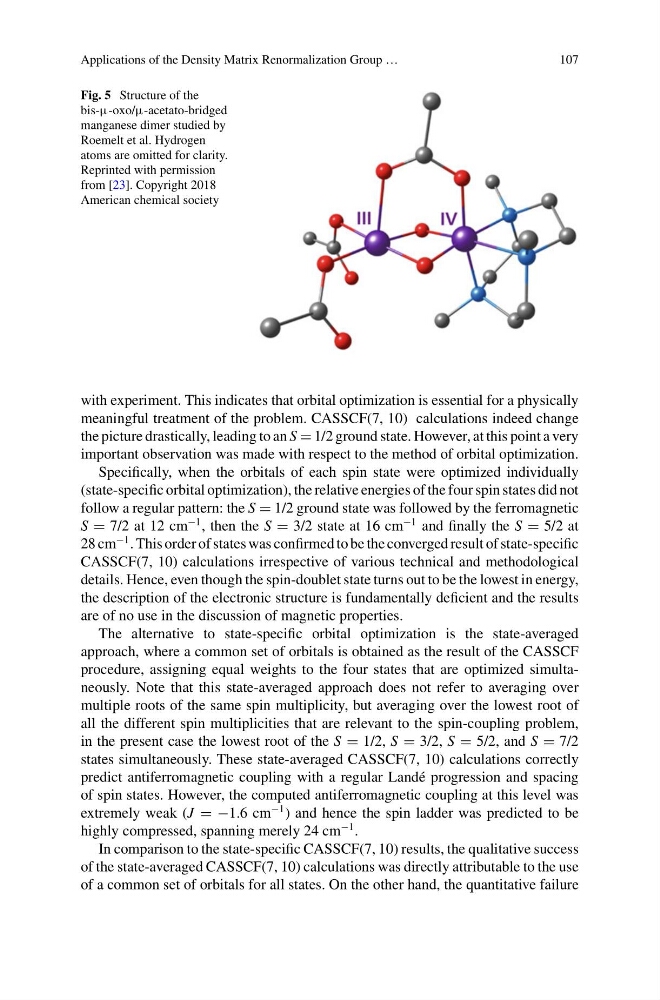
Fig. 5 Structure of the
bis-μ-oxo/μ-acetato-bridged
manganese dimer studied by
Roemelt et al. Hydrogen
atoms are omitted for clarity.
Reprinted with permission
from [23]. Copyright 2018
American chemical society
with experiment. This indicates that orbital optimization is essential for a physically
meaningful treatment of the problem. CASSCF(7, 10) calculations indeed change
the picture drastically, leading to an S 1/2 ground state. However, at this point a very
important observation was made with respect to the method of orbital optimization.
Specifically, when the orbitals of each spin state were optimized individually
(state-specific orbital optimization), the relative energies of the four spin states did not
follow a regular pattern: the S 1/2 ground state was followed by the ferromagnetic
S 7/2 at 12 cm
−1 , then the S 3/2 state at 16 cm
−1 and finally the S 5/2 at
28 cm
−1 . This order of states was confirmed to be the converged result of state-specific
CASSCF(7, 10) calculations irrespective of various technical and methodological
details. Hence, even though the spin-doublet state turns out to be the lowest in energy,
the description of the electronic structure is fundamentally deficient and the results
are of no use in the discussion of magnetic properties.
The alternative to state-specific orbital optimization is the state-averaged
approach, where a common set of orbitals is obtained as the result of the CASSCF
procedure, assigning equal weights to the four states that are optimized simultaneously. Note that this state-averaged approach does not refer to averaging over
multiple roots of the same spin multiplicity, but averaging over the lowest root of
all the different spin multiplicities that are relevant to the spin-coupling problem,
in the present case the lowest root of the S 1/2, S 3/2, S 5/2, and S 7/2
states simultaneously. These state-averaged CASSCF(7, 10) calculations correctly
predict antiferromagnetic coupling with a regular Landé progression and spacing
of spin states. However, the computed antiferromagnetic coupling at this level was
extremely weak (J −1.6 cm
−1 ) and hence the spin ladder was predicted to be
highly compressed, spanning merely 24 cm
−1 .
In comparison to the state-specific CASSCF(7, 10) results, the qualitative success
of the state-averaged CASSCF(7, 10) calculations was directly attributable to the use
of a common set of orbitals for all states. On the other hand, the quantitative failure
107
Fig. 5 Structure of the
bis-μ-oxo/μ-acetato-bridged
manganese dimer studied by
Roemelt et al. Hydrogen
atoms are omitted for clarity.
Reprinted with permission
from [23]. Copyright 2018
American chemical society
with experiment. This indicates that orbital optimization is essential for a physically
meaningful treatment of the problem. CASSCF(7, 10) calculations indeed change
the picture drastically, leading to an S 1/2 ground state. However, at this point a very
important observation was made with respect to the method of orbital optimization.
Specifically, when the orbitals of each spin state were optimized individually
(state-specific orbital optimization), the relative energies of the four spin states did not
follow a regular pattern: the S 1/2 ground state was followed by the ferromagnetic
S 7/2 at 12 cm
−1 , then the S 3/2 state at 16 cm
−1 and finally the S 5/2 at
28 cm
−1 . This order of states was confirmed to be the converged result of state-specific
CASSCF(7, 10) calculations irrespective of various technical and methodological
details. Hence, even though the spin-doublet state turns out to be the lowest in energy,
the description of the electronic structure is fundamentally deficient and the results
are of no use in the discussion of magnetic properties.
The alternative to state-specific orbital optimization is the state-averaged
approach, where a common set of orbitals is obtained as the result of the CASSCF
procedure, assigning equal weights to the four states that are optimized simultaneously. Note that this state-averaged approach does not refer to averaging over
multiple roots of the same spin multiplicity, but averaging over the lowest root of
all the different spin multiplicities that are relevant to the spin-coupling problem,
in the present case the lowest root of the S 1/2, S 3/2, S 5/2, and S 7/2
states simultaneously. These state-averaged CASSCF(7, 10) calculations correctly
predict antiferromagnetic coupling with a regular Landé progression and spacing
of spin states. However, the computed antiferromagnetic coupling at this level was
extremely weak (J −1.6 cm
−1 ) and hence the spin ladder was predicted to be
highly compressed, spanning merely 24 cm
−1 .
In comparison to the state-specific CASSCF(7, 10) results, the qualitative success
of the state-averaged CASSCF(7, 10) calculations was directly attributable to the use
of a common set of orbitals for all states. On the other hand, the quantitative failure