

Applications of the Density Matrix Renormalization Group …
101
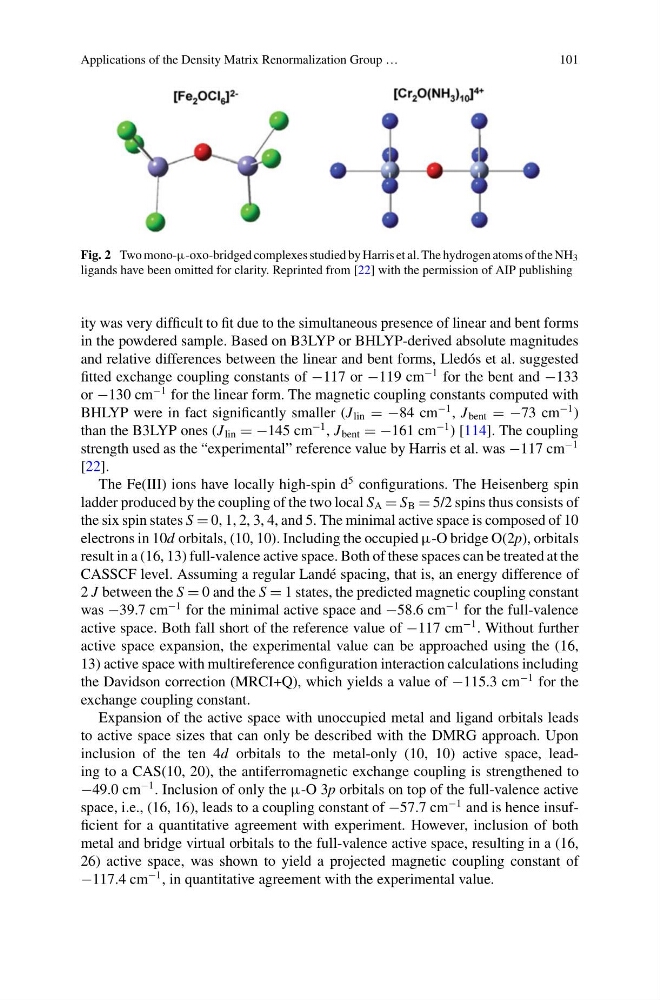
Fig. 2 Two mono-μ-oxo-bridged complexes studied by Harris et al. The hydrogen atoms of the NH 3
ligands have been omitted for clarity. Reprinted from [22] with the permission of AIP publishing
ity was very difficult to fit due to the simultaneous presence of linear and bent forms
in the powdered sample. Based on B3LYP or BHLYP-derived absolute magnitudes
and relative differences between the linear and bent forms, Lledós et al. suggested
fitted exchange coupling constants of −117 or −119 cm
−1 for the bent and −133
or −130 cm
−1 for the linear form. The magnetic coupling constants computed with
BHLYP were in fact significantly smaller (J lin −84 cm
−1 , J bent −73 cm
−1 )
than the B3LYP ones (J lin −145 cm
−1 , J bent −161 cm
−1 ) [114]. The coupling
strength used as the “experimental” reference value by Harris et al. was −117 cm
−1
[22].
The Fe(III) ions have locally high-spin d
5 configurations. The Heisenberg spin
ladder produced by the coupling of the two local S A S B 5/2 spins thus consists of
the six spin states S 0, 1, 2, 3, 4, and 5. The minimal active space is composed of 10
electrons in 10d orbitals, (10, 10). Including the occupied μ-O bridge O(2p), orbitals
result in a (16, 13) full-valence active space. Both of these spaces can be treated at the
CASSCF level. Assuming a regular Landé spacing, that is, an energy difference of
2 J between the S 0 and the S 1 states, the predicted magnetic coupling constant
was −39.7 cm
−1 for the minimal active space and −58.6 cm
−1 for the full-valence
active space. Both fall short of the reference value of −117 cm
−1 . Without further
active space expansion, the experimental value can be approached using the (16,
13) active space with multireference configuration interaction calculations including
the Davidson correction (MRCI+Q), which yields a value of −115.3 cm
−1 for the
exchange coupling constant.
Expansion of the active space with unoccupied metal and ligand orbitals leads
to active space sizes that can only be described with the DMRG approach. Upon
inclusion of the ten 4d orbitals to the metal-only (10, 10) active space, leading to a CAS(10, 20), the antiferromagnetic exchange coupling is strengthened to
−49.0 cm
−1 . Inclusion of only the μ-O 3p orbitals on top of the full-valence active
space, i.e., (16, 16), leads to a coupling constant of −57.7 cm
−1 and is hence insufficient for a quantitative agreement with experiment. However, inclusion of both
metal and bridge virtual orbitals to the full-valence active space, resulting in a (16,
26) active space, was shown to yield a projected magnetic coupling constant of
−117.4 cm
−1 , in quantitative agreement with the experimental value.
101
Fig. 2 Two mono-μ-oxo-bridged complexes studied by Harris et al. The hydrogen atoms of the NH 3
ligands have been omitted for clarity. Reprinted from [22] with the permission of AIP publishing
ity was very difficult to fit due to the simultaneous presence of linear and bent forms
in the powdered sample. Based on B3LYP or BHLYP-derived absolute magnitudes
and relative differences between the linear and bent forms, Lledós et al. suggested
fitted exchange coupling constants of −117 or −119 cm
−1 for the bent and −133
or −130 cm
−1 for the linear form. The magnetic coupling constants computed with
BHLYP were in fact significantly smaller (J lin −84 cm
−1 , J bent −73 cm
−1 )
than the B3LYP ones (J lin −145 cm
−1 , J bent −161 cm
−1 ) [114]. The coupling
strength used as the “experimental” reference value by Harris et al. was −117 cm
−1
[22].
The Fe(III) ions have locally high-spin d
5 configurations. The Heisenberg spin
ladder produced by the coupling of the two local S A S B 5/2 spins thus consists of
the six spin states S 0, 1, 2, 3, 4, and 5. The minimal active space is composed of 10
electrons in 10d orbitals, (10, 10). Including the occupied μ-O bridge O(2p), orbitals
result in a (16, 13) full-valence active space. Both of these spaces can be treated at the
CASSCF level. Assuming a regular Landé spacing, that is, an energy difference of
2 J between the S 0 and the S 1 states, the predicted magnetic coupling constant
was −39.7 cm
−1 for the minimal active space and −58.6 cm
−1 for the full-valence
active space. Both fall short of the reference value of −117 cm
−1 . Without further
active space expansion, the experimental value can be approached using the (16,
13) active space with multireference configuration interaction calculations including
the Davidson correction (MRCI+Q), which yields a value of −115.3 cm
−1 for the
exchange coupling constant.
Expansion of the active space with unoccupied metal and ligand orbitals leads
to active space sizes that can only be described with the DMRG approach. Upon
inclusion of the ten 4d orbitals to the metal-only (10, 10) active space, leading to a CAS(10, 20), the antiferromagnetic exchange coupling is strengthened to
−49.0 cm
−1 . Inclusion of only the μ-O 3p orbitals on top of the full-valence active
space, i.e., (16, 16), leads to a coupling constant of −57.7 cm
−1 and is hence insufficient for a quantitative agreement with experiment. However, inclusion of both
metal and bridge virtual orbitals to the full-valence active space, resulting in a (16,
26) active space, was shown to yield a projected magnetic coupling constant of
−117.4 cm
−1 , in quantitative agreement with the experimental value.