

100
V. Krewald and D. A. Pantazis
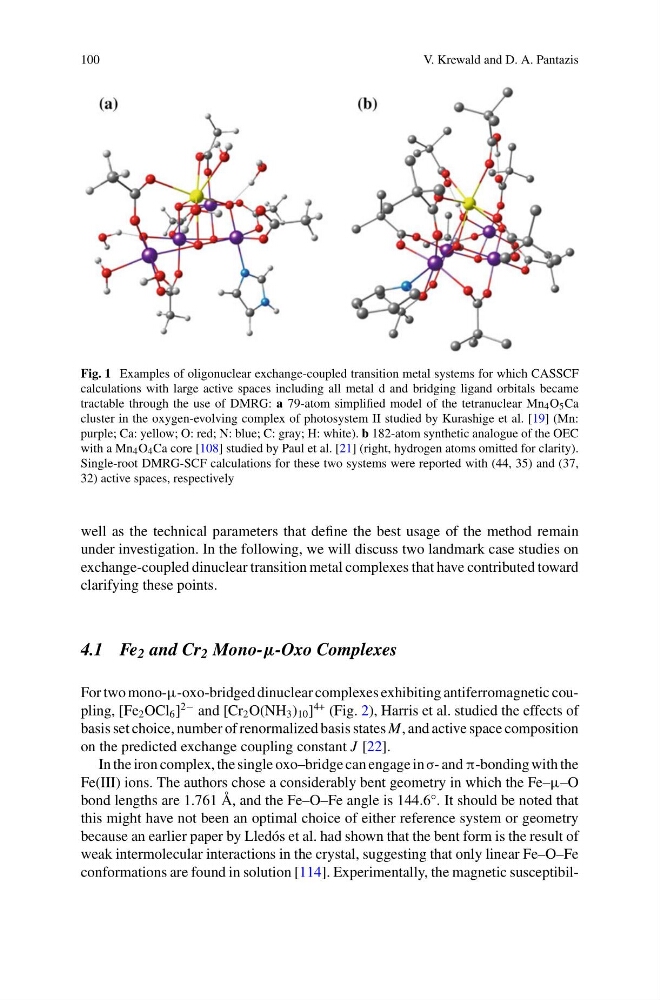
Fig. 1 Examples of oligonuclear exchange-coupled transition metal systems for which CASSCF
calculations with large active spaces including all metal d and bridging ligand orbitals became
tractable through the use of DMRG: a 79-atom simplified model of the tetranuclear Mn 4 O 5 Ca
cluster in the oxygen-evolving complex of photosystem II studied by Kurashige et al. [19] (Mn:
purple; Ca: yellow; O: red; N: blue; C: gray; H: white). b 182-atom synthetic analogue of the OEC
with a Mn 4 O 4 Ca core [108] studied by Paul et al. [21] (right, hydrogen atoms omitted for clarity).
Single-root DMRG-SCF calculations for these two systems were reported with (44, 35) and (37,
32) active spaces, respectively
well as the technical parameters that define the best usage of the method remain
under investigation. In the following, we will discuss two landmark case studies on
exchange-coupled dinuclear transition metal complexes that have contributed toward
clarifying these points.
4.1 Fe 2 and Cr 2 Mono-µ-Oxo Complexes
For two mono-μ-oxo-bridged dinuclear complexes exhibiting antiferromagnetic coupling, [Fe 2 OCl 6 ]
2− and [Cr 2 O(NH 3 ) 10 ]
4+ (Fig. 2), Harris et al. studied the effects of
basis set choice, number of renormalized basis states M, and active space composition
on the predicted exchange coupling constant J [22].
In the iron complex, the single oxo–bridge can engage in σ- and π-bonding with the
Fe(III) ions. The authors chose a considerably bent geometry in which the Fe–μ–O
bond lengths are 1.761 Å, and the Fe–O–Fe angle is 144.6°. It should be noted that
this might have not been an optimal choice of either reference system or geometry
because an earlier paper by Lledós et al. had shown that the bent form is the result of
weak intermolecular interactions in the crystal, suggesting that only linear Fe–O–Fe
conformations are found in solution [114]. Experimentally, the magnetic susceptibil-
V. Krewald and D. A. Pantazis
Fig. 1 Examples of oligonuclear exchange-coupled transition metal systems for which CASSCF
calculations with large active spaces including all metal d and bridging ligand orbitals became
tractable through the use of DMRG: a 79-atom simplified model of the tetranuclear Mn 4 O 5 Ca
cluster in the oxygen-evolving complex of photosystem II studied by Kurashige et al. [19] (Mn:
purple; Ca: yellow; O: red; N: blue; C: gray; H: white). b 182-atom synthetic analogue of the OEC
with a Mn 4 O 4 Ca core [108] studied by Paul et al. [21] (right, hydrogen atoms omitted for clarity).
Single-root DMRG-SCF calculations for these two systems were reported with (44, 35) and (37,
32) active spaces, respectively
well as the technical parameters that define the best usage of the method remain
under investigation. In the following, we will discuss two landmark case studies on
exchange-coupled dinuclear transition metal complexes that have contributed toward
clarifying these points.
4.1 Fe 2 and Cr 2 Mono-µ-Oxo Complexes
For two mono-μ-oxo-bridged dinuclear complexes exhibiting antiferromagnetic coupling, [Fe 2 OCl 6 ]
2− and [Cr 2 O(NH 3 ) 10 ]
4+ (Fig. 2), Harris et al. studied the effects of
basis set choice, number of renormalized basis states M, and active space composition
on the predicted exchange coupling constant J [22].
In the iron complex, the single oxo–bridge can engage in σ- and π-bonding with the
Fe(III) ions. The authors chose a considerably bent geometry in which the Fe–μ–O
bond lengths are 1.761 Å, and the Fe–O–Fe angle is 144.6°. It should be noted that
this might have not been an optimal choice of either reference system or geometry
because an earlier paper by Lledós et al. had shown that the bent form is the result of
weak intermolecular interactions in the crystal, suggesting that only linear Fe–O–Fe
conformations are found in solution [114]. Experimentally, the magnetic susceptibil-