

86
F. Sagan and M. P. Mitoraj
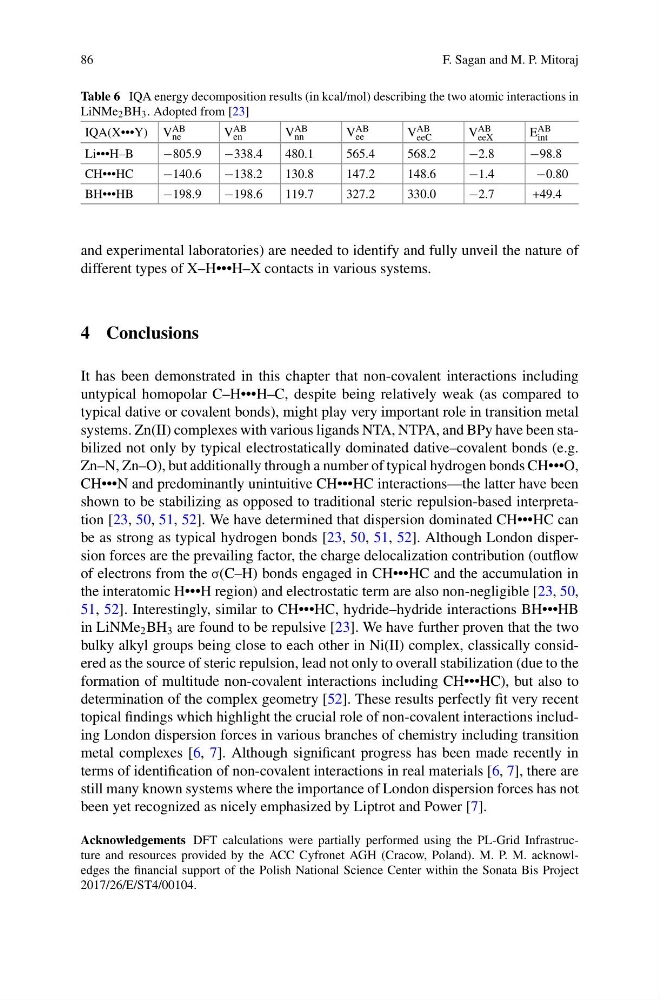
Table 6 IQA energy decomposition results (in kcal/mol) describing the two atomic interactions in
LiNMe 2 BH 3 . Adopted from [23]
IQA(X•••Y) V AB
ne
V AB
en
V AB
nn
V AB
ee
V AB
eeC
V AB
eeX
E AB
int
Li•••H–B
−805.9
−338.4
480.1
565.4
568.2
−2.8
−98.8
CH•••HC
−140.6
−138.2
130.8
147.2
148.6
−1.4
−0.80
BH•••HB
−198.9
−198.6
119.7
327.2
330.0
−2.7
+49.4
and experimental laboratories) are needed to identify and fully unveil the nature of
different types of X–H•••H–X contacts in various systems.
4 Conclusions
It has been demonstrated in this chapter that non-covalent interactions including
untypical homopolar C–H•••H–C, despite being relatively weak (as compared to
typical dative or covalent bonds), might play very important role in transition metal
systems. Zn(II) complexes with various ligands NTA, NTPA, and BPy have been stabilized not only by typical electrostatically dominated dative–covalent bonds (e.g.
Zn–N, Zn–O), but additionally through a number of typical hydrogen bonds CH•••O,
CH•••N and predominantly unintuitive CH•••HC interactions—the latter have been
shown to be stabilizing as opposed to traditional steric repulsion-based interpretation [23, 50, 51, 52]. We have determined that dispersion dominated CH•••HC can
be as strong as typical hydrogen bonds [23, 50, 51, 52]. Although London dispersion forces are the prevailing factor, the charge delocalization contribution (outflow
of electrons from the σ(C–H) bonds engaged in CH•••HC and the accumulation in
the interatomic H•••H region) and electrostatic term are also non-negligible [23, 50,
51, 52]. Interestingly, similar to CH•••HC, hydride–hydride interactions BH•••HB
in LiNMe 2 BH 3 are found to be repulsive [23]. We have further proven that the two
bulky alkyl groups being close to each other in Ni(II) complex, classically considered as the source of steric repulsion, lead not only to overall stabilization (due to the
formation of multitude non-covalent interactions including CH•••HC), but also to
determination of the complex geometry [52]. These results perfectly fit very recent
topical findings which highlight the crucial role of non-covalent interactions including London dispersion forces in various branches of chemistry including transition
metal complexes [6, 7]. Although significant progress has been made recently in
terms of identification of non-covalent interactions in real materials [6, 7], there are
still many known systems where the importance of London dispersion forces has not
been yet recognized as nicely emphasized by Liptrot and Power [7].
Acknowledgements DFT calculations were partially performed using the PL-Grid Infrastructure and resources provided by the ACC Cyfronet AGH (Cracow, Poland). M. P. M. acknowledges the financial support of the Polish National Science Center within the Sonata Bis Project
2017/26/E/ST4/00104.
F. Sagan and M. P. Mitoraj
Table 6 IQA energy decomposition results (in kcal/mol) describing the two atomic interactions in
LiNMe 2 BH 3 . Adopted from [23]
IQA(X•••Y) V AB
ne
V AB
en
V AB
nn
V AB
ee
V AB
eeC
V AB
eeX
E AB
int
Li•••H–B
−805.9
−338.4
480.1
565.4
568.2
−2.8
−98.8
CH•••HC
−140.6
−138.2
130.8
147.2
148.6
−1.4
−0.80
BH•••HB
−198.9
−198.6
119.7
327.2
330.0
−2.7
+49.4
and experimental laboratories) are needed to identify and fully unveil the nature of
different types of X–H•••H–X contacts in various systems.
4 Conclusions
It has been demonstrated in this chapter that non-covalent interactions including
untypical homopolar C–H•••H–C, despite being relatively weak (as compared to
typical dative or covalent bonds), might play very important role in transition metal
systems. Zn(II) complexes with various ligands NTA, NTPA, and BPy have been stabilized not only by typical electrostatically dominated dative–covalent bonds (e.g.
Zn–N, Zn–O), but additionally through a number of typical hydrogen bonds CH•••O,
CH•••N and predominantly unintuitive CH•••HC interactions—the latter have been
shown to be stabilizing as opposed to traditional steric repulsion-based interpretation [23, 50, 51, 52]. We have determined that dispersion dominated CH•••HC can
be as strong as typical hydrogen bonds [23, 50, 51, 52]. Although London dispersion forces are the prevailing factor, the charge delocalization contribution (outflow
of electrons from the σ(C–H) bonds engaged in CH•••HC and the accumulation in
the interatomic H•••H region) and electrostatic term are also non-negligible [23, 50,
51, 52]. Interestingly, similar to CH•••HC, hydride–hydride interactions BH•••HB
in LiNMe 2 BH 3 are found to be repulsive [23]. We have further proven that the two
bulky alkyl groups being close to each other in Ni(II) complex, classically considered as the source of steric repulsion, lead not only to overall stabilization (due to the
formation of multitude non-covalent interactions including CH•••HC), but also to
determination of the complex geometry [52]. These results perfectly fit very recent
topical findings which highlight the crucial role of non-covalent interactions including London dispersion forces in various branches of chemistry including transition
metal complexes [6, 7]. Although significant progress has been made recently in
terms of identification of non-covalent interactions in real materials [6, 7], there are
still many known systems where the importance of London dispersion forces has not
been yet recognized as nicely emphasized by Liptrot and Power [7].
Acknowledgements DFT calculations were partially performed using the PL-Grid Infrastructure and resources provided by the ACC Cyfronet AGH (Cracow, Poland). M. P. M. acknowledges the financial support of the Polish National Science Center within the Sonata Bis Project
2017/26/E/ST4/00104.