

5.7 Internal Standardization
63
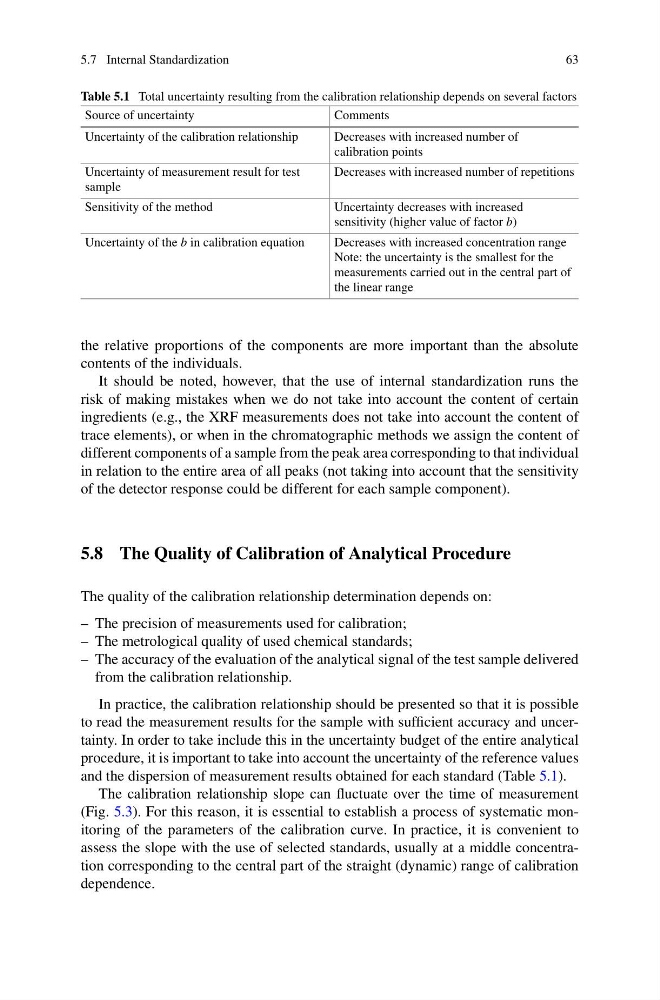
Table 5.1 Total uncertainty resulting from the calibration relationship depends on several factors
Source of uncertainty
Comments
Uncertainty of the calibration relationship
Decreases with increased number of
calibration points
Uncertainty of measurement result for test
sample
Decreases with increased number of repetitions
Sensitivity of the method
Uncertainty decreases with increased
sensitivity (higher value of factor b)
Uncertainty of the b in calibration equation
Decreases with increased concentration range
Note: the uncertainty is the smallest for the
measurements carried out in the central part of
the linear range
the relative proportions of the components are more important than the absolute
contents of the individuals.
It should be noted, however, that the use of internal standardization runs the
risk of making mistakes when we do not take into account the content of certain
ingredients (e.g., the XRF measurements does not take into account the content of
trace elements), or when in the chromatographic methods we assign the content of
different components of a sample from the peak area corresponding to that individual
in relation to the entire area of all peaks (not taking into account that the sensitivity
of the detector response could be different for each sample component).
5.8 The Quality of Calibration of Analytical Procedure
The quality of the calibration relationship determination depends on:
– The precision of measurements used for calibration;
– The metrological quality of used chemical standards;
– The accuracy of the evaluation of the analytical signal of the test sample delivered
from the calibration relationship.
In practice, the calibration relationship should be presented so that it is possible
to read the measurement results for the sample with sufficient accuracy and uncertainty. In order to take include this in the uncertainty budget of the entire analytical
procedure, it is important to take into account the uncertainty of the reference values
and the dispersion of measurement results obtained for each standard (Table 5.1).
The calibration relationship slope can fluctuate over the time of measurement
(Fig. 5.3). For this reason, it is essential to establish a process of systematic monitoring of the parameters of the calibration curve. In practice, it is convenient to
assess the slope with the use of selected standards, usually at a middle concentration corresponding to the central part of the straight (dynamic) range of calibration
dependence.
63
Table 5.1 Total uncertainty resulting from the calibration relationship depends on several factors
Source of uncertainty
Comments
Uncertainty of the calibration relationship
Decreases with increased number of
calibration points
Uncertainty of measurement result for test
sample
Decreases with increased number of repetitions
Sensitivity of the method
Uncertainty decreases with increased
sensitivity (higher value of factor b)
Uncertainty of the b in calibration equation
Decreases with increased concentration range
Note: the uncertainty is the smallest for the
measurements carried out in the central part of
the linear range
the relative proportions of the components are more important than the absolute
contents of the individuals.
It should be noted, however, that the use of internal standardization runs the
risk of making mistakes when we do not take into account the content of certain
ingredients (e.g., the XRF measurements does not take into account the content of
trace elements), or when in the chromatographic methods we assign the content of
different components of a sample from the peak area corresponding to that individual
in relation to the entire area of all peaks (not taking into account that the sensitivity
of the detector response could be different for each sample component).
5.8 The Quality of Calibration of Analytical Procedure
The quality of the calibration relationship determination depends on:
– The precision of measurements used for calibration;
– The metrological quality of used chemical standards;
– The accuracy of the evaluation of the analytical signal of the test sample delivered
from the calibration relationship.
In practice, the calibration relationship should be presented so that it is possible
to read the measurement results for the sample with sufficient accuracy and uncertainty. In order to take include this in the uncertainty budget of the entire analytical
procedure, it is important to take into account the uncertainty of the reference values
and the dispersion of measurement results obtained for each standard (Table 5.1).
The calibration relationship slope can fluctuate over the time of measurement
(Fig. 5.3). For this reason, it is essential to establish a process of systematic monitoring of the parameters of the calibration curve. In practice, it is convenient to
assess the slope with the use of selected standards, usually at a middle concentration corresponding to the central part of the straight (dynamic) range of calibration
dependence.