

4.1 Traceability and the Comparability of Results
37
Poland
GUM
Slovenia
MIRS
obtained results are comparable
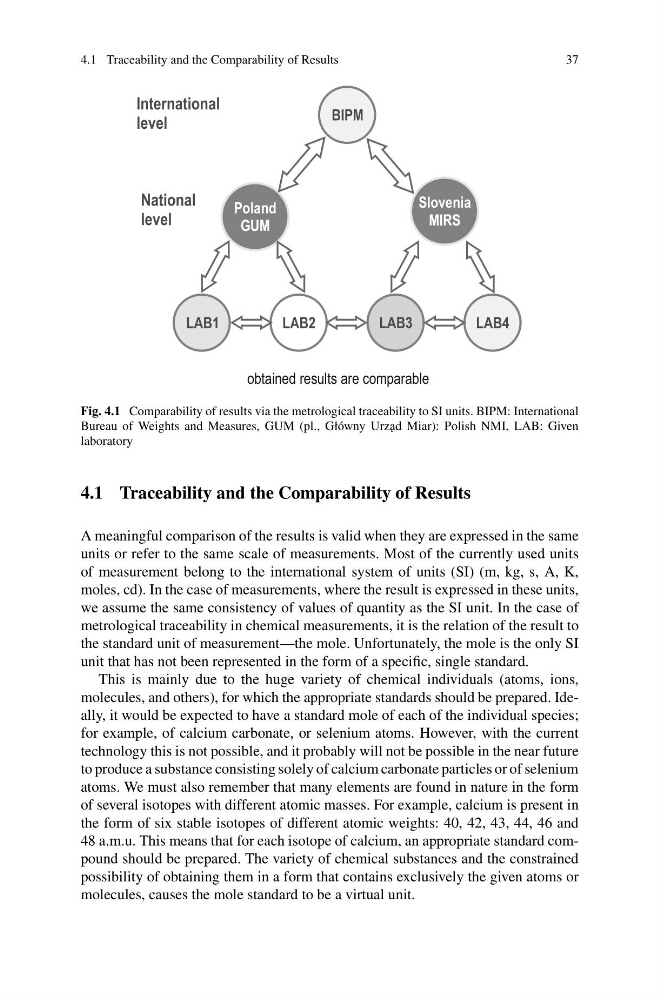
Fig. 4.1 Comparability of results via the metrological traceability to SI units. BIPM: International
Bureau of Weights and Measures, GUM (pl., Główny Urz˛ ad Miar): Polish NMI, LAB: Given
laboratory
4.1 Traceability and the Comparability of Results
A meaningful comparison of the results is valid when they are expressed in the same
units or refer to the same scale of measurements. Most of the currently used units
of measurement belong to the international system of units (SI) (m, kg, s, A, K,
moles, cd). In the case of measurements, where the result is expressed in these units,
we assume the same consistency of values of quantity as the SI unit. In the case of
metrological traceability in chemical measurements, it is the relation of the result to
the standard unit of measurement—the mole. Unfortunately, the mole is the only SI
unit that has not been represented in the form of a specific, single standard.
This is mainly due to the huge variety of chemical individuals (atoms, ions,
molecules, and others), for which the appropriate standards should be prepared. Ideally, it would be expected to have a standard mole of each of the individual species;
for example, of calcium carbonate, or selenium atoms. However, with the current
technology this is not possible, and it probably will not be possible in the near future
to produce a substance consisting solely of calcium carbonate particles or of selenium
atoms. We must also remember that many elements are found in nature in the form
of several isotopes with different atomic masses. For example, calcium is present in
the form of six stable isotopes of different atomic weights: 40, 42, 43, 44, 46 and
48 a.m.u. This means that for each isotope of calcium, an appropriate standard compound should be prepared. The variety of chemical substances and the constrained
possibility of obtaining them in a form that contains exclusively the given atoms or
molecules, causes the mole standard to be a virtual unit.
37
Poland
GUM
Slovenia
MIRS
obtained results are comparable
Fig. 4.1 Comparability of results via the metrological traceability to SI units. BIPM: International
Bureau of Weights and Measures, GUM (pl., Główny Urz˛ ad Miar): Polish NMI, LAB: Given
laboratory
4.1 Traceability and the Comparability of Results
A meaningful comparison of the results is valid when they are expressed in the same
units or refer to the same scale of measurements. Most of the currently used units
of measurement belong to the international system of units (SI) (m, kg, s, A, K,
moles, cd). In the case of measurements, where the result is expressed in these units,
we assume the same consistency of values of quantity as the SI unit. In the case of
metrological traceability in chemical measurements, it is the relation of the result to
the standard unit of measurement—the mole. Unfortunately, the mole is the only SI
unit that has not been represented in the form of a specific, single standard.
This is mainly due to the huge variety of chemical individuals (atoms, ions,
molecules, and others), for which the appropriate standards should be prepared. Ideally, it would be expected to have a standard mole of each of the individual species;
for example, of calcium carbonate, or selenium atoms. However, with the current
technology this is not possible, and it probably will not be possible in the near future
to produce a substance consisting solely of calcium carbonate particles or of selenium
atoms. We must also remember that many elements are found in nature in the form
of several isotopes with different atomic masses. For example, calcium is present in
the form of six stable isotopes of different atomic weights: 40, 42, 43, 44, 46 and
48 a.m.u. This means that for each isotope of calcium, an appropriate standard compound should be prepared. The variety of chemical substances and the constrained
possibility of obtaining them in a form that contains exclusively the given atoms or
molecules, causes the mole standard to be a virtual unit.