

36
4 Metrological Traceability
A novelty in the current edition of the VIM 3 dictionary is that the definition of
traceability is supplemented with eight comments, in which additional explanations
are given. In the eighth comment, the recommendation is underlined that, in relation
to the metrological use, the full wording of the term ‘measurement traceability’
should be used, since the term ‘traceability’ is also used in other contexts, whereas
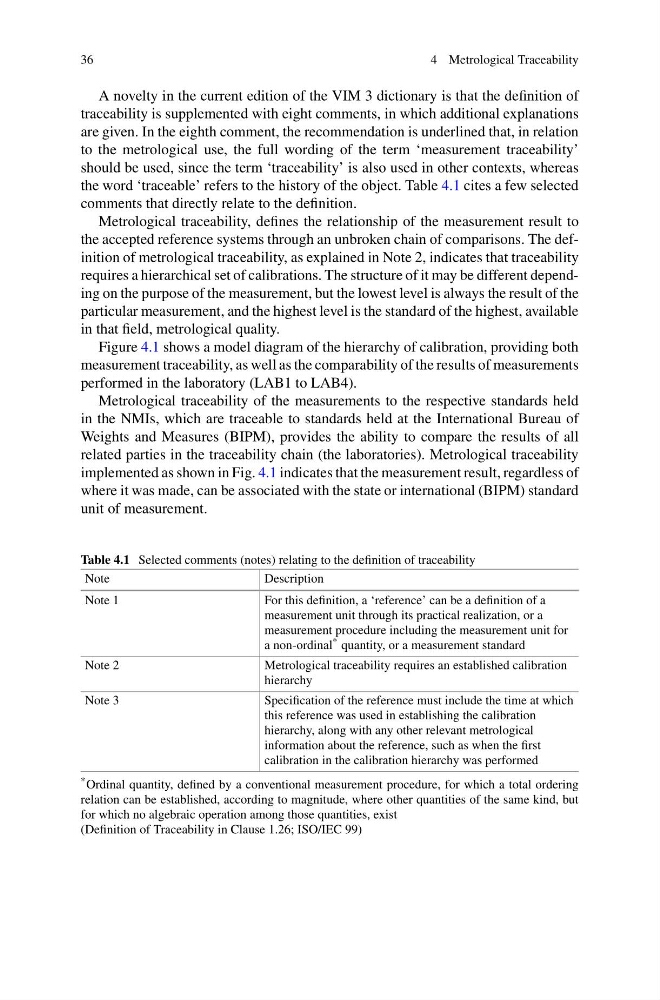
the word ‘traceable’ refers to the history of the object. Table 4.1 cites a few selected
comments that directly relate to the definition.
Metrological traceability, defines the relationship of the measurement result to
the accepted reference systems through an unbroken chain of comparisons. The definition of metrological traceability, as explained in Note 2, indicates that traceability
requires a hierarchical set of calibrations. The structure of it may be different depending on the purpose of the measurement, but the lowest level is always the result of the
particular measurement, and the highest level is the standard of the highest, available
in that field, metrological quality.
Figure 4.1 shows a model diagram of the hierarchy of calibration, providing both
measurement traceability, as well as the comparability of the results of measurements
performed in the laboratory (LAB1 to LAB4).
Metrological traceability of the measurements to the respective standards held
in the NMIs, which are traceable to standards held at the International Bureau of
Weights and Measures (BIPM), provides the ability to compare the results of all
related parties in the traceability chain (the laboratories). Metrological traceability
implemented as shown in Fig. 4.1 indicates that the measurement result, regardless of
where it was made, can be associated with the state or international (BIPM) standard
unit of measurement.
Table 4.1 Selected comments (notes) relating to the definition of traceability
Note
Description
Note 1
For this definition, a ‘reference’ can be a definition of a
measurement unit through its practical realization, or a
measurement procedure including the measurement unit for
a non-ordinal * quantity, or a measurement standard
Note 2
Metrological traceability requires an established calibration
hierarchy
Note 3
Specification of the reference must include the time at which
this reference was used in establishing the calibration
hierarchy, along with any other relevant metrological
information about the reference, such as when the first
calibration in the calibration hierarchy was performed
* Ordinal quantity, defined by a conventional measurement procedure, for which a total ordering
relation can be established, according to magnitude, where other quantities of the same kind, but
for which no algebraic operation among those quantities, exist
(Definition of Traceability in Clause 1.26; ISO/IEC 99)
4 Metrological Traceability
A novelty in the current edition of the VIM 3 dictionary is that the definition of
traceability is supplemented with eight comments, in which additional explanations
are given. In the eighth comment, the recommendation is underlined that, in relation
to the metrological use, the full wording of the term ‘measurement traceability’
should be used, since the term ‘traceability’ is also used in other contexts, whereas
the word ‘traceable’ refers to the history of the object. Table 4.1 cites a few selected
comments that directly relate to the definition.
Metrological traceability, defines the relationship of the measurement result to
the accepted reference systems through an unbroken chain of comparisons. The definition of metrological traceability, as explained in Note 2, indicates that traceability
requires a hierarchical set of calibrations. The structure of it may be different depending on the purpose of the measurement, but the lowest level is always the result of the
particular measurement, and the highest level is the standard of the highest, available
in that field, metrological quality.
Figure 4.1 shows a model diagram of the hierarchy of calibration, providing both
measurement traceability, as well as the comparability of the results of measurements
performed in the laboratory (LAB1 to LAB4).
Metrological traceability of the measurements to the respective standards held
in the NMIs, which are traceable to standards held at the International Bureau of
Weights and Measures (BIPM), provides the ability to compare the results of all
related parties in the traceability chain (the laboratories). Metrological traceability
implemented as shown in Fig. 4.1 indicates that the measurement result, regardless of
where it was made, can be associated with the state or international (BIPM) standard
unit of measurement.
Table 4.1 Selected comments (notes) relating to the definition of traceability
Note
Description
Note 1
For this definition, a ‘reference’ can be a definition of a
measurement unit through its practical realization, or a
measurement procedure including the measurement unit for
a non-ordinal * quantity, or a measurement standard
Note 2
Metrological traceability requires an established calibration
hierarchy
Note 3
Specification of the reference must include the time at which
this reference was used in establishing the calibration
hierarchy, along with any other relevant metrological
information about the reference, such as when the first
calibration in the calibration hierarchy was performed
* Ordinal quantity, defined by a conventional measurement procedure, for which a total ordering
relation can be established, according to magnitude, where other quantities of the same kind, but
for which no algebraic operation among those quantities, exist
(Definition of Traceability in Clause 1.26; ISO/IEC 99)