

3.2 Conventions for Writing Unit Symbols and Their Names
29
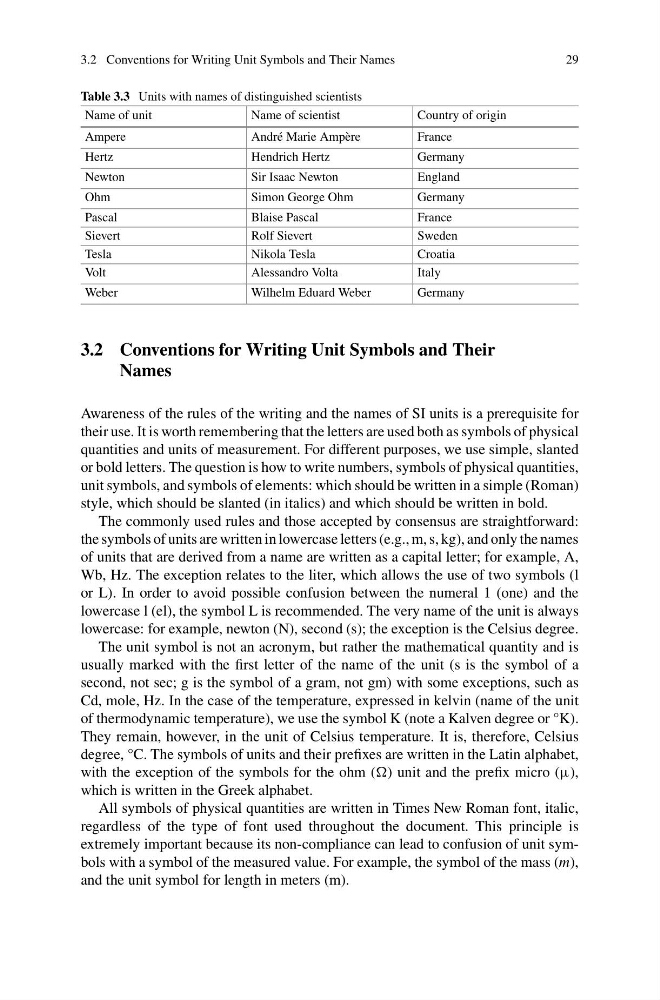
Table 3.3 Units with names of distinguished scientists
Name of unit
Name of scientist
Country of origin
Ampere
André Marie Ampère
France
Hertz
Hendrich Hertz
Germany
Newton
Sir Isaac Newton
England
Ohm
Simon George Ohm
Germany
Pascal
Blaise Pascal
France
Sievert
Rolf Sievert
Sweden
Tesla
Nikola Tesla
Croatia
Volt
Alessandro Volta
Italy
Weber
Wilhelm Eduard Weber
Germany
3.2 Conventions for Writing Unit Symbols and Their
Names
Awareness of the rules of the writing and the names of SI units is a prerequisite for
their use. It is worth remembering that the letters are used both as symbols of physical
quantities and units of measurement. For different purposes, we use simple, slanted
or bold letters. The question is how to write numbers, symbols of physical quantities,
unit symbols, and symbols of elements: which should be written in a simple (Roman)
style, which should be slanted (in italics) and which should be written in bold.
The commonly used rules and those accepted by consensus are straightforward:
the symbols of units are written in lowercase letters (e.g., m, s, kg), and only the names
of units that are derived from a name are written as a capital letter; for example, A,
Wb, Hz. The exception relates to the liter, which allows the use of two symbols (l
or L). In order to avoid possible confusion between the numeral 1 (one) and the
lowercase l (el), the symbol L is recommended. The very name of the unit is always
lowercase: for example, newton (N), second (s); the exception is the Celsius degree.
The unit symbol is not an acronym, but rather the mathematical quantity and is
usually marked with the first letter of the name of the unit (s is the symbol of a
second, not sec; g is the symbol of a gram, not gm) with some exceptions, such as
Cd, mole, Hz. In the case of the temperature, expressed in kelvin (name of the unit
of thermodynamic temperature), we use the symbol K (note a Kalven degree or °K).
They remain, however, in the unit of Celsius temperature. It is, therefore, Celsius
degree, °C. The symbols of units and their prefixes are written in the Latin alphabet,
with the exception of the symbols for the ohm () unit and the prefix micro (μ),
which is written in the Greek alphabet.
All symbols of physical quantities are written in Times New Roman font, italic,
regardless of the type of font used throughout the document. This principle is
extremely important because its non-compliance can lead to confusion of unit symbols with a symbol of the measured value. For example, the symbol of the mass (m),
and the unit symbol for length in meters (m).
29
Table 3.3 Units with names of distinguished scientists
Name of unit
Name of scientist
Country of origin
Ampere
André Marie Ampère
France
Hertz
Hendrich Hertz
Germany
Newton
Sir Isaac Newton
England
Ohm
Simon George Ohm
Germany
Pascal
Blaise Pascal
France
Sievert
Rolf Sievert
Sweden
Tesla
Nikola Tesla
Croatia
Volt
Alessandro Volta
Italy
Weber
Wilhelm Eduard Weber
Germany
3.2 Conventions for Writing Unit Symbols and Their
Names
Awareness of the rules of the writing and the names of SI units is a prerequisite for
their use. It is worth remembering that the letters are used both as symbols of physical
quantities and units of measurement. For different purposes, we use simple, slanted
or bold letters. The question is how to write numbers, symbols of physical quantities,
unit symbols, and symbols of elements: which should be written in a simple (Roman)
style, which should be slanted (in italics) and which should be written in bold.
The commonly used rules and those accepted by consensus are straightforward:
the symbols of units are written in lowercase letters (e.g., m, s, kg), and only the names
of units that are derived from a name are written as a capital letter; for example, A,
Wb, Hz. The exception relates to the liter, which allows the use of two symbols (l
or L). In order to avoid possible confusion between the numeral 1 (one) and the
lowercase l (el), the symbol L is recommended. The very name of the unit is always
lowercase: for example, newton (N), second (s); the exception is the Celsius degree.
The unit symbol is not an acronym, but rather the mathematical quantity and is
usually marked with the first letter of the name of the unit (s is the symbol of a
second, not sec; g is the symbol of a gram, not gm) with some exceptions, such as
Cd, mole, Hz. In the case of the temperature, expressed in kelvin (name of the unit
of thermodynamic temperature), we use the symbol K (note a Kalven degree or °K).
They remain, however, in the unit of Celsius temperature. It is, therefore, Celsius
degree, °C. The symbols of units and their prefixes are written in the Latin alphabet,
with the exception of the symbols for the ohm () unit and the prefix micro (μ),
which is written in the Greek alphabet.
All symbols of physical quantities are written in Times New Roman font, italic,
regardless of the type of font used throughout the document. This principle is
extremely important because its non-compliance can lead to confusion of unit symbols with a symbol of the measured value. For example, the symbol of the mass (m),
and the unit symbol for length in meters (m).