

28
3 System of Units
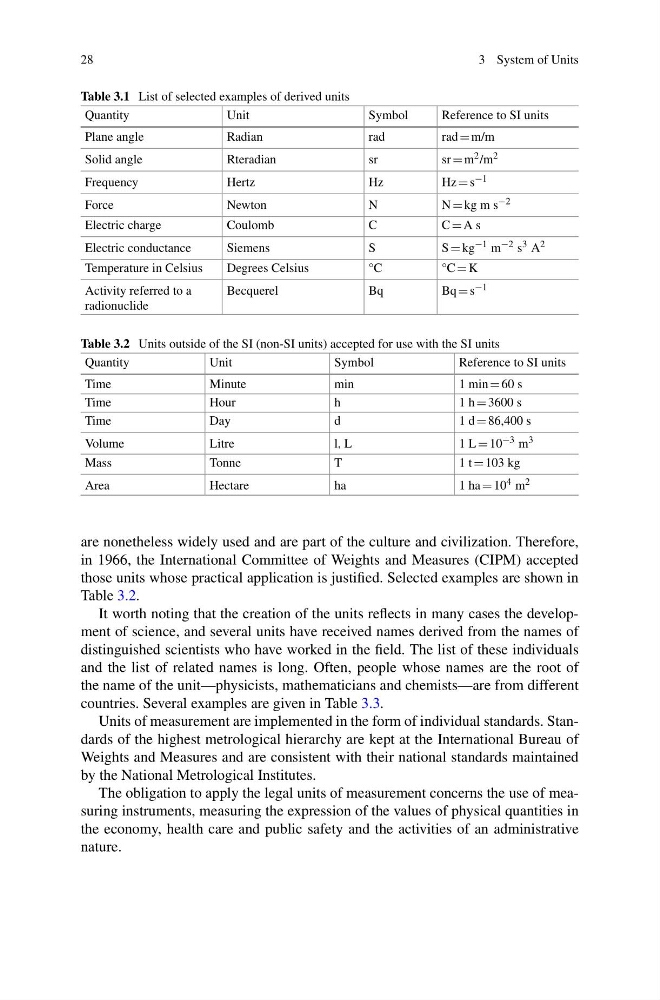
Table 3.1 List of selected examples of derived units
Quantity
Unit
Symbol
Reference to SI units
Plane angle
Radian
rad
rad m/m
Solid angle
Rteradian
sr
sr m 2 /m 2
Frequency
Hertz
Hz
Hz s −1
Force
Newton
N
N kg m s −2
Electric charge
Coulomb
C
C A s
Electric conductance
Siemens
S
S kg −1 m −2 s 3 A 2
Temperature in Celsius
Degrees Celsius
°C
°C K
Activity referred to a
radionuclide
Becquerel
Bq
Bq s −1
Table 3.2 Units outside of the SI (non-SI units) accepted for use with the SI units
Quantity
Unit
Symbol
Reference to SI units
Time
Minute
min
1 min 60 s
Time
Hour
h
1 h 3600 s
Time
Day
d
1 d 86,400 s
Volume
Litre
l, L
1 L 10 −3 m 3
Mass
Tonne
T
1 t 103 kg
Area
Hectare
ha
1 ha 10 4 m 2
are nonetheless widely used and are part of the culture and civilization. Therefore,
in 1966, the International Committee of Weights and Measures (CIPM) accepted
those units whose practical application is justified. Selected examples are shown in
Table 3.2.
It worth noting that the creation of the units reflects in many cases the development of science, and several units have received names derived from the names of
distinguished scientists who have worked in the field. The list of these individuals
and the list of related names is long. Often, people whose names are the root of
the name of the unit—physicists, mathematicians and chemists—are from different
countries. Several examples are given in Table 3.3.
Units of measurement are implemented in the form of individual standards. Standards of the highest metrological hierarchy are kept at the International Bureau of
Weights and Measures and are consistent with their national standards maintained
by the National Metrological Institutes.
The obligation to apply the legal units of measurement concerns the use of measuring instruments, measuring the expression of the values of physical quantities in
the economy, health care and public safety and the activities of an administrative
nature.
3 System of Units
Table 3.1 List of selected examples of derived units
Quantity
Unit
Symbol
Reference to SI units
Plane angle
Radian
rad
rad m/m
Solid angle
Rteradian
sr
sr m 2 /m 2
Frequency
Hertz
Hz
Hz s −1
Force
Newton
N
N kg m s −2
Electric charge
Coulomb
C
C A s
Electric conductance
Siemens
S
S kg −1 m −2 s 3 A 2
Temperature in Celsius
Degrees Celsius
°C
°C K
Activity referred to a
radionuclide
Becquerel
Bq
Bq s −1
Table 3.2 Units outside of the SI (non-SI units) accepted for use with the SI units
Quantity
Unit
Symbol
Reference to SI units
Time
Minute
min
1 min 60 s
Time
Hour
h
1 h 3600 s
Time
Day
d
1 d 86,400 s
Volume
Litre
l, L
1 L 10 −3 m 3
Mass
Tonne
T
1 t 103 kg
Area
Hectare
ha
1 ha 10 4 m 2
are nonetheless widely used and are part of the culture and civilization. Therefore,
in 1966, the International Committee of Weights and Measures (CIPM) accepted
those units whose practical application is justified. Selected examples are shown in
Table 3.2.
It worth noting that the creation of the units reflects in many cases the development of science, and several units have received names derived from the names of
distinguished scientists who have worked in the field. The list of these individuals
and the list of related names is long. Often, people whose names are the root of
the name of the unit—physicists, mathematicians and chemists—are from different
countries. Several examples are given in Table 3.3.
Units of measurement are implemented in the form of individual standards. Standards of the highest metrological hierarchy are kept at the International Bureau of
Weights and Measures and are consistent with their national standards maintained
by the National Metrological Institutes.
The obligation to apply the legal units of measurement concerns the use of measuring instruments, measuring the expression of the values of physical quantities in
the economy, health care and public safety and the activities of an administrative
nature.