

1.2 Specificity of Chemical Metrology
9
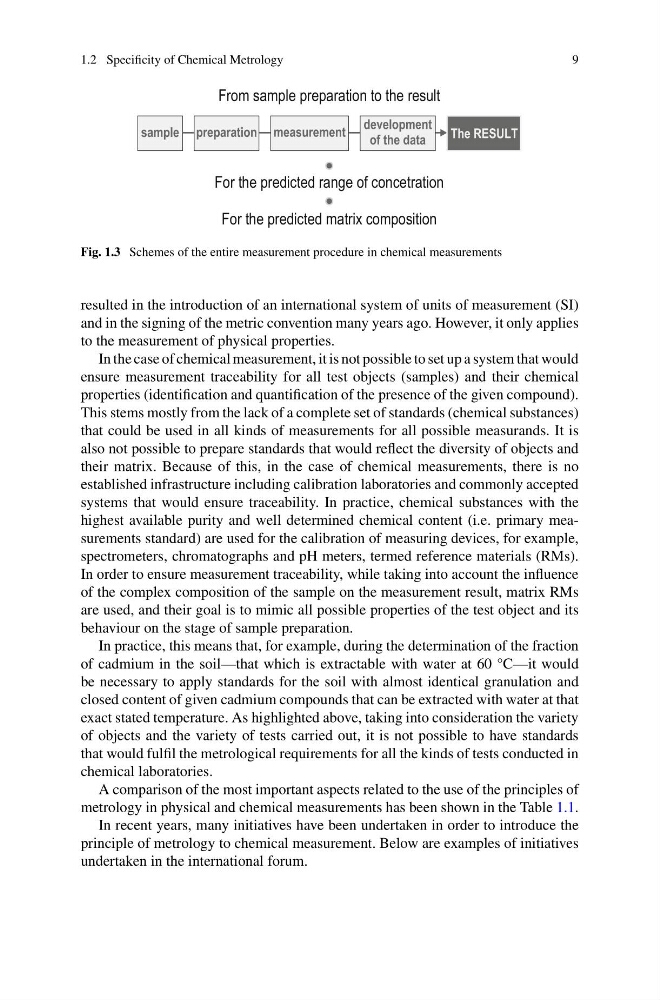
For the predicted range of concetration
From sample preparation to the result
For the predicted matrix composition
Fig. 1.3 Schemes of the entire measurement procedure in chemical measurements
resulted in the introduction of an international system of units of measurement (SI)
and in the signing of the metric convention many years ago. However, it only applies
to the measurement of physical properties.
In the case of chemical measurement, it is not possible to set up a system that would
ensure measurement traceability for all test objects (samples) and their chemical
properties (identification and quantification of the presence of the given compound).
This stems mostly from the lack of a complete set of standards (chemical substances)
that could be used in all kinds of measurements for all possible measurands. It is
also not possible to prepare standards that would reflect the diversity of objects and
their matrix. Because of this, in the case of chemical measurements, there is no
established infrastructure including calibration laboratories and commonly accepted
systems that would ensure traceability. In practice, chemical substances with the
highest available purity and well determined chemical content (i.e. primary measurements standard) are used for the calibration of measuring devices, for example,
spectrometers, chromatographs and pH meters, termed reference materials (RMs).
In order to ensure measurement traceability, while taking into account the influence
of the complex composition of the sample on the measurement result, matrix RMs
are used, and their goal is to mimic all possible properties of the test object and its
behaviour on the stage of sample preparation.
In practice, this means that, for example, during the determination of the fraction
of cadmium in the soil—that which is extractable with water at 60 °C—it would
be necessary to apply standards for the soil with almost identical granulation and
closed content of given cadmium compounds that can be extracted with water at that
exact stated temperature. As highlighted above, taking into consideration the variety
of objects and the variety of tests carried out, it is not possible to have standards
that would fulfil the metrological requirements for all the kinds of tests conducted in
chemical laboratories.
A comparison of the most important aspects related to the use of the principles of
metrology in physical and chemical measurements has been shown in the Table 1.1.
In recent years, many initiatives have been undertaken in order to introduce the
principle of metrology to chemical measurement. Below are examples of initiatives
undertaken in the international forum.
9
For the predicted range of concetration
From sample preparation to the result
For the predicted matrix composition
Fig. 1.3 Schemes of the entire measurement procedure in chemical measurements
resulted in the introduction of an international system of units of measurement (SI)
and in the signing of the metric convention many years ago. However, it only applies
to the measurement of physical properties.
In the case of chemical measurement, it is not possible to set up a system that would
ensure measurement traceability for all test objects (samples) and their chemical
properties (identification and quantification of the presence of the given compound).
This stems mostly from the lack of a complete set of standards (chemical substances)
that could be used in all kinds of measurements for all possible measurands. It is
also not possible to prepare standards that would reflect the diversity of objects and
their matrix. Because of this, in the case of chemical measurements, there is no
established infrastructure including calibration laboratories and commonly accepted
systems that would ensure traceability. In practice, chemical substances with the
highest available purity and well determined chemical content (i.e. primary measurements standard) are used for the calibration of measuring devices, for example,
spectrometers, chromatographs and pH meters, termed reference materials (RMs).
In order to ensure measurement traceability, while taking into account the influence
of the complex composition of the sample on the measurement result, matrix RMs
are used, and their goal is to mimic all possible properties of the test object and its
behaviour on the stage of sample preparation.
In practice, this means that, for example, during the determination of the fraction
of cadmium in the soil—that which is extractable with water at 60 °C—it would
be necessary to apply standards for the soil with almost identical granulation and
closed content of given cadmium compounds that can be extracted with water at that
exact stated temperature. As highlighted above, taking into consideration the variety
of objects and the variety of tests carried out, it is not possible to have standards
that would fulfil the metrological requirements for all the kinds of tests conducted in
chemical laboratories.
A comparison of the most important aspects related to the use of the principles of
metrology in physical and chemical measurements has been shown in the Table 1.1.
In recent years, many initiatives have been undertaken in order to introduce the
principle of metrology to chemical measurement. Below are examples of initiatives
undertaken in the international forum.