

10.9 z-Score
177
10.9 z-Score
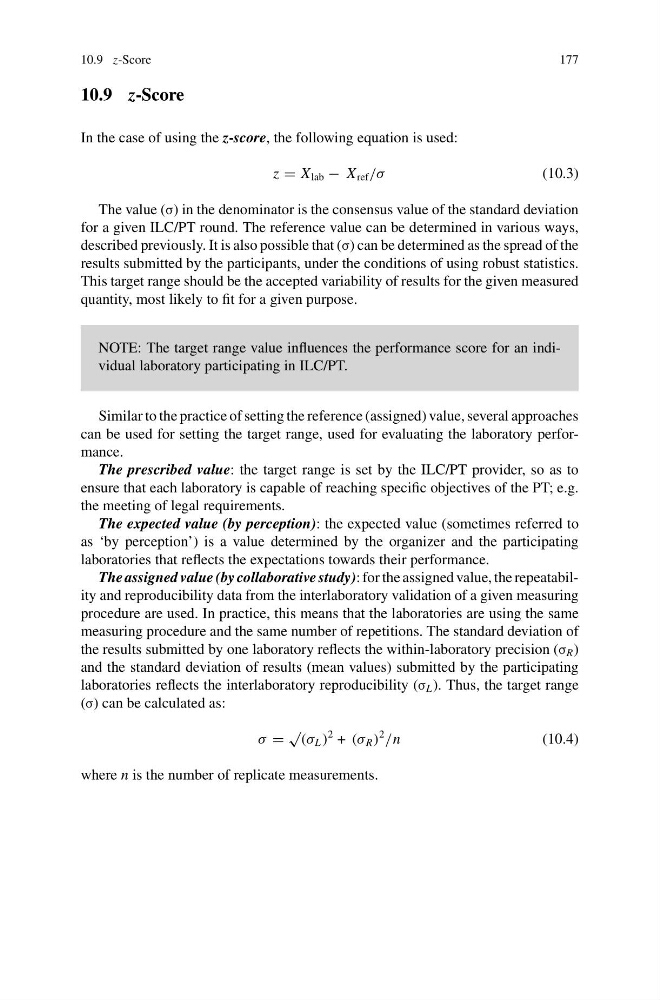
In the case of using the z-score, the following equation is used:
z X lab − X ref /σ
(10.3)
The value (σ) in the denominator is the consensus value of the standard deviation
for a given ILC/PT round. The reference value can be determined in various ways,
described previously. It is also possible that (σ) can be determined as the spread of the
results submitted by the participants, under the conditions of using robust statistics.
This target range should be the accepted variability of results for the given measured
quantity, most likely to fit for a given purpose.
NOTE: The target range value influences the performance score for an individual laboratory participating in ILC/PT.
Similar to the practice of setting the reference (assigned) value, several approaches
can be used for setting the target range, used for evaluating the laboratory performance.
The prescribed value: the target range is set by the ILC/PT provider, so as to
ensure that each laboratory is capable of reaching specific objectives of the PT; e.g.
the meeting of legal requirements.
The expected value (by perception): the expected value (sometimes referred to
as ‘by perception’) is a value determined by the organizer and the participating
laboratories that reflects the expectations towards their performance.
The assigned value (by collaborative study): for the assigned value, the repeatability and reproducibility data from the interlaboratory validation of a given measuring
procedure are used. In practice, this means that the laboratories are using the same
measuring procedure and the same number of repetitions. The standard deviation of
the results submitted by one laboratory reflects the within-laboratory precision (σ R )
and the standard deviation of results (mean values) submitted by the participating
laboratories reflects the interlaboratory reproducibility (σ L ). Thus, the target range
(σ) can be calculated as:
σ
√ (σ L )
2 + (σ R )
2
/n
(10.4)
where n is the number of replicate measurements.
177
10.9 z-Score
In the case of using the z-score, the following equation is used:
z X lab − X ref /σ
(10.3)
The value (σ) in the denominator is the consensus value of the standard deviation
for a given ILC/PT round. The reference value can be determined in various ways,
described previously. It is also possible that (σ) can be determined as the spread of the
results submitted by the participants, under the conditions of using robust statistics.
This target range should be the accepted variability of results for the given measured
quantity, most likely to fit for a given purpose.
NOTE: The target range value influences the performance score for an individual laboratory participating in ILC/PT.
Similar to the practice of setting the reference (assigned) value, several approaches
can be used for setting the target range, used for evaluating the laboratory performance.
The prescribed value: the target range is set by the ILC/PT provider, so as to
ensure that each laboratory is capable of reaching specific objectives of the PT; e.g.
the meeting of legal requirements.
The expected value (by perception): the expected value (sometimes referred to
as ‘by perception’) is a value determined by the organizer and the participating
laboratories that reflects the expectations towards their performance.
The assigned value (by collaborative study): for the assigned value, the repeatability and reproducibility data from the interlaboratory validation of a given measuring
procedure are used. In practice, this means that the laboratories are using the same
measuring procedure and the same number of repetitions. The standard deviation of
the results submitted by one laboratory reflects the within-laboratory precision (σ R )
and the standard deviation of results (mean values) submitted by the participating
laboratories reflects the interlaboratory reproducibility (σ L ). Thus, the target range
(σ) can be calculated as:
σ
√ (σ L )
2 + (σ R )
2
/n
(10.4)
where n is the number of replicate measurements.