

176
10 Interlaboratory Comparisons
enough for the reference value to be determined. Apart from that, there is always a
risk of the presence of an unidentified systematic error. Additionally, such a method
of operation does not ensure measurement traceability.
10.7 Evaluation of Laboratory Performance (Scores)
The main aim of all ILC/PT schemes is to provide external, objective evidence of
the laboratory performance. For this purpose, the evaluation of the results given by a
single laboratory is conducted by using various algorithms, by calculating the difference between the laboratory (X lab ) and the reference value (X ref ) versus the agreed
denominator. These are named ‘scores’ and are specifically designed depending on
the purpose. A number of different scoring algorithms are used by different ILC/PT
providers; therefore, it is always recommended to be aware of the system used, before
participation in given scheme.
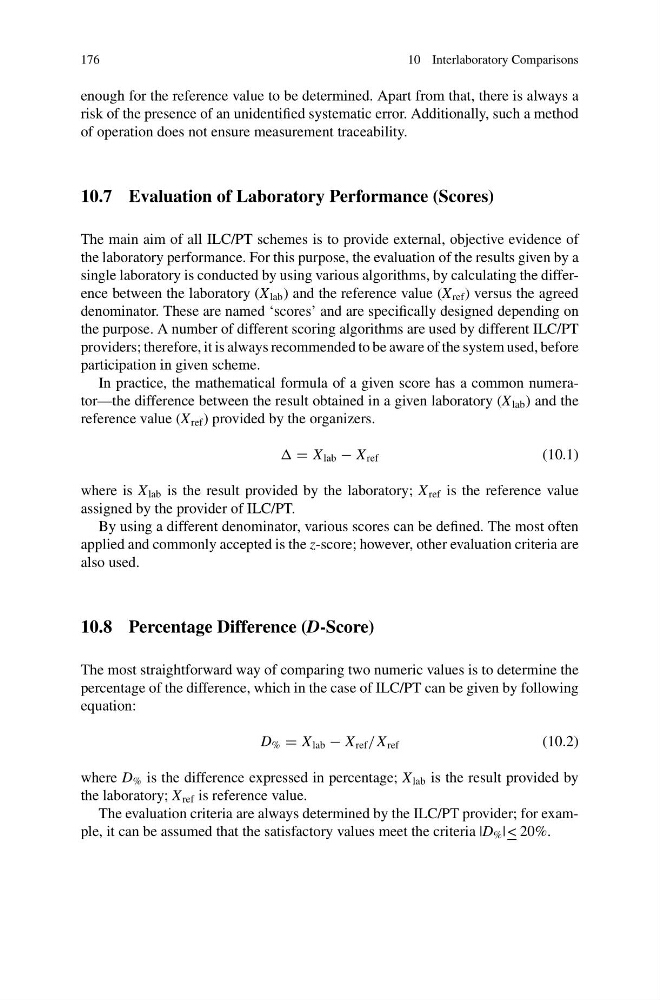
In practice, the mathematical formula of a given score has a common numerator—the difference between the result obtained in a given laboratory (X lab ) and the
reference value (X ref ) provided by the organizers.
X lab − X ref
(10.1)
where is X lab is the result provided by the laboratory; X ref is the reference value
assigned by the provider of ILC/PT.
By using a different denominator, various scores can be defined. The most often
applied and commonly accepted is the z-score; however, other evaluation criteria are
also used.
10.8 Percentage Difference (D-Score)
The most straightforward way of comparing two numeric values is to determine the
percentage of the difference, which in the case of ILC/PT can be given by following
equation:
D % X lab − X ref / X ref
(10.2)
where D % is the difference expressed in percentage; X lab is the result provided by
the laboratory; X ref is reference value.
The evaluation criteria are always determined by the ILC/PT provider; for example, it can be assumed that the satisfactory values meet the criteria |D % | < 20%.
10 Interlaboratory Comparisons
enough for the reference value to be determined. Apart from that, there is always a
risk of the presence of an unidentified systematic error. Additionally, such a method
of operation does not ensure measurement traceability.
10.7 Evaluation of Laboratory Performance (Scores)
The main aim of all ILC/PT schemes is to provide external, objective evidence of
the laboratory performance. For this purpose, the evaluation of the results given by a
single laboratory is conducted by using various algorithms, by calculating the difference between the laboratory (X lab ) and the reference value (X ref ) versus the agreed
denominator. These are named ‘scores’ and are specifically designed depending on
the purpose. A number of different scoring algorithms are used by different ILC/PT
providers; therefore, it is always recommended to be aware of the system used, before
participation in given scheme.
In practice, the mathematical formula of a given score has a common numerator—the difference between the result obtained in a given laboratory (X lab ) and the
reference value (X ref ) provided by the organizers.
X lab − X ref
(10.1)
where is X lab is the result provided by the laboratory; X ref is the reference value
assigned by the provider of ILC/PT.
By using a different denominator, various scores can be defined. The most often
applied and commonly accepted is the z-score; however, other evaluation criteria are
also used.
10.8 Percentage Difference (D-Score)
The most straightforward way of comparing two numeric values is to determine the
percentage of the difference, which in the case of ILC/PT can be given by following
equation:
D % X lab − X ref / X ref
(10.2)
where D % is the difference expressed in percentage; X lab is the result provided by
the laboratory; X ref is reference value.
The evaluation criteria are always determined by the ILC/PT provider; for example, it can be assumed that the satisfactory values meet the criteria |D % | < 20%.