

122
8 Measurement Uncertainty
¯
x − t
s
√
n
< μ < ¯
x + t
s
√
n
(8.6)
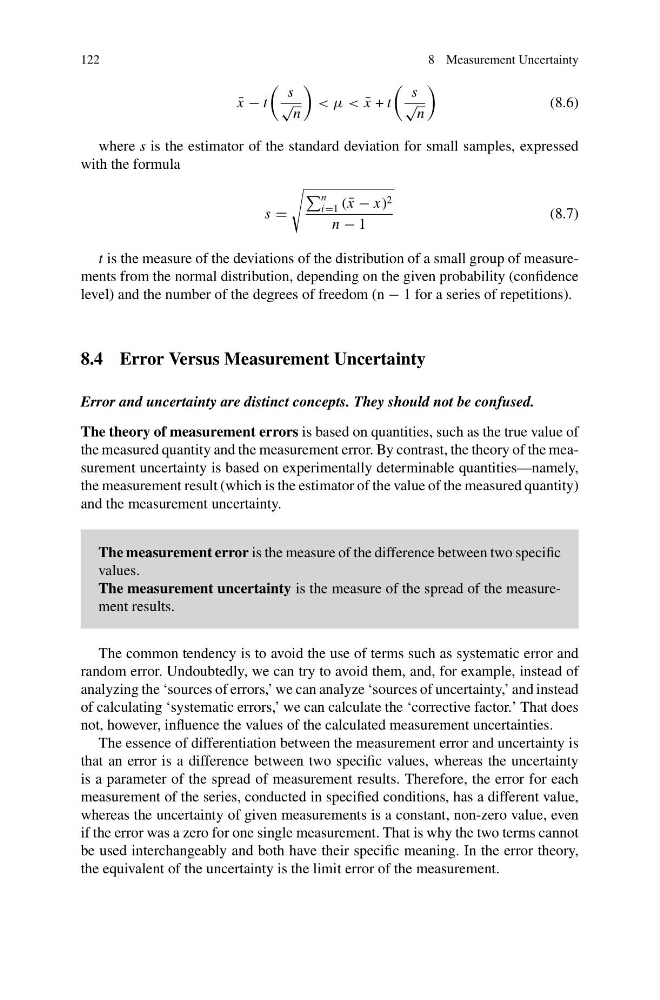
where s is the estimator of the standard deviation for small samples, expressed
with the formula
s
n
i1 ( ¯
x − x) 2
n − 1
(8.7)
t is the measure of the deviations of the distribution of a small group of measurements from the normal distribution, depending on the given probability (confidence
level) and the number of the degrees of freedom (n − 1 for a series of repetitions).
8.4 Error Versus Measurement Uncertainty
Error and uncertainty are distinct concepts. They should not be confused.
The theory of measurement errors is based on quantities, such as the true value of
the measured quantity and the measurement error. By contrast, the theory of the measurement uncertainty is based on experimentally determinable quantities—namely,
the measurement result (which is the estimator of the value of the measured quantity)
and the measurement uncertainty.
The measurement error is the measure of the difference between two specific
values.
The measurement uncertainty is the measure of the spread of the measurement results.
The common tendency is to avoid the use of terms such as systematic error and
random error. Undoubtedly, we can try to avoid them, and, for example, instead of
analyzing the ‘sources of errors,’ we can analyze ‘sources of uncertainty,’ and instead
of calculating ‘systematic errors,’ we can calculate the ‘corrective factor.’ That does
not, however, influence the values of the calculated measurement uncertainties.
The essence of differentiation between the measurement error and uncertainty is
that an error is a difference between two specific values, whereas the uncertainty
is a parameter of the spread of measurement results. Therefore, the error for each
measurement of the series, conducted in specified conditions, has a different value,
whereas the uncertainty of given measurements is a constant, non-zero value, even
if the error was a zero for one single measurement. That is why the two terms cannot
be used interchangeably and both have their specific meaning. In the error theory,
the equivalent of the uncertainty is the limit error of the measurement.
8 Measurement Uncertainty
¯
x − t
s
√
n
< μ < ¯
x + t
s
√
n
(8.6)
where s is the estimator of the standard deviation for small samples, expressed
with the formula
s
n
i1 ( ¯
x − x) 2
n − 1
(8.7)
t is the measure of the deviations of the distribution of a small group of measurements from the normal distribution, depending on the given probability (confidence
level) and the number of the degrees of freedom (n − 1 for a series of repetitions).
8.4 Error Versus Measurement Uncertainty
Error and uncertainty are distinct concepts. They should not be confused.
The theory of measurement errors is based on quantities, such as the true value of
the measured quantity and the measurement error. By contrast, the theory of the measurement uncertainty is based on experimentally determinable quantities—namely,
the measurement result (which is the estimator of the value of the measured quantity)
and the measurement uncertainty.
The measurement error is the measure of the difference between two specific
values.
The measurement uncertainty is the measure of the spread of the measurement results.
The common tendency is to avoid the use of terms such as systematic error and
random error. Undoubtedly, we can try to avoid them, and, for example, instead of
analyzing the ‘sources of errors,’ we can analyze ‘sources of uncertainty,’ and instead
of calculating ‘systematic errors,’ we can calculate the ‘corrective factor.’ That does
not, however, influence the values of the calculated measurement uncertainties.
The essence of differentiation between the measurement error and uncertainty is
that an error is a difference between two specific values, whereas the uncertainty
is a parameter of the spread of measurement results. Therefore, the error for each
measurement of the series, conducted in specified conditions, has a different value,
whereas the uncertainty of given measurements is a constant, non-zero value, even
if the error was a zero for one single measurement. That is why the two terms cannot
be used interchangeably and both have their specific meaning. In the error theory,
the equivalent of the uncertainty is the limit error of the measurement.