

7.15 Accuracy and Trueness
107
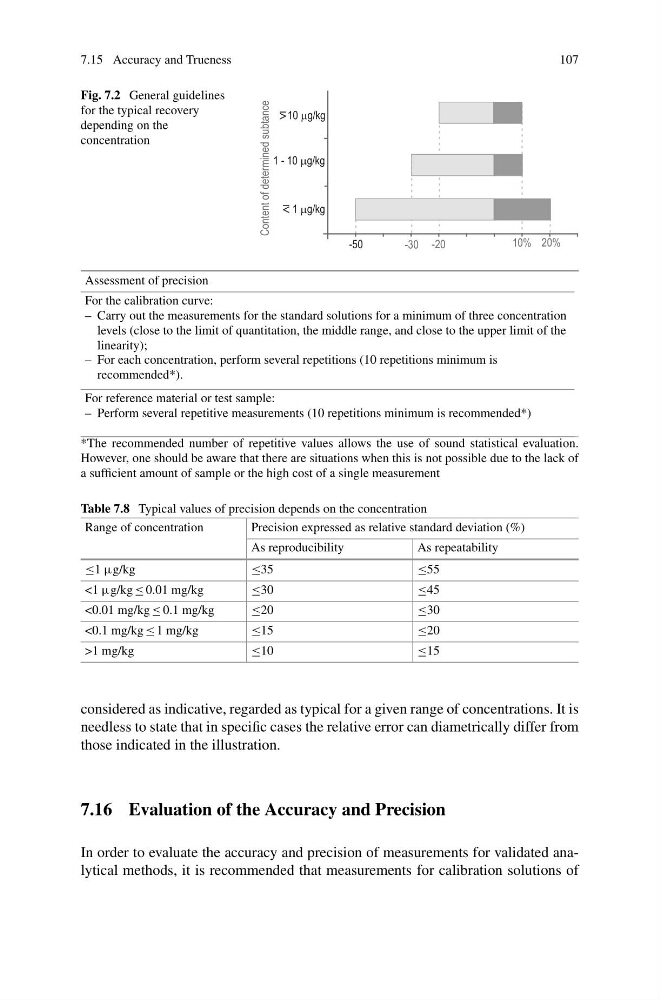
Fig. 7.2 General guidelines
for the typical recovery
depending on the
concentration
Content of determined subtance
1 g/kg
1 - 10 g/kg
10 g/kg
-20
-30
-50
10% 20%
Assessment of precision
For the calibration curve:
– Carry out the measurements for the standard solutions for a minimum of three concentration
levels (close to the limit of quantitation, the middle range, and close to the upper limit of the
linearity);
– For each concentration, perform several repetitions (10 repetitions minimum is
recommended*).
For reference material or test sample:
– Perform several repetitive measurements (10 repetitions minimum is recommended*)
*The recommended number of repetitive values allows the use of sound statistical evaluation.
However, one should be aware that there are situations when this is not possible due to the lack of
a sufficient amount of sample or the high cost of a single measurement
Table 7.8 Typical values of precision depends on the concentration
Range of concentration
Precision expressed as relative standard deviation (%)
As reproducibility
As repeatability
≤1 μg/kg
≤35
≤55
<1 μg/kg ≤ 0.01 mg/kg
≤30
≤45
<0.01 mg/kg ≤ 0.1 mg/kg
≤20
≤30
<0.1 mg/kg ≤ 1 mg/kg
≤15
≤20
>1 mg/kg
≤10
≤15
considered as indicative, regarded as typical for a given range of concentrations. It is
needless to state that in specific cases the relative error can diametrically differ from
those indicated in the illustration.
7.16 Evaluation of the Accuracy and Precision
In order to evaluate the accuracy and precision of measurements for validated analytical methods, it is recommended that measurements for calibration solutions of
107
Fig. 7.2 General guidelines
for the typical recovery
depending on the
concentration
Content of determined subtance
1 g/kg
1 - 10 g/kg
10 g/kg
-20
-30
-50
10% 20%
Assessment of precision
For the calibration curve:
– Carry out the measurements for the standard solutions for a minimum of three concentration
levels (close to the limit of quantitation, the middle range, and close to the upper limit of the
linearity);
– For each concentration, perform several repetitions (10 repetitions minimum is
recommended*).
For reference material or test sample:
– Perform several repetitive measurements (10 repetitions minimum is recommended*)
*The recommended number of repetitive values allows the use of sound statistical evaluation.
However, one should be aware that there are situations when this is not possible due to the lack of
a sufficient amount of sample or the high cost of a single measurement
Table 7.8 Typical values of precision depends on the concentration
Range of concentration
Precision expressed as relative standard deviation (%)
As reproducibility
As repeatability
≤1 μg/kg
≤35
≤55
<1 μg/kg ≤ 0.01 mg/kg
≤30
≤45
<0.01 mg/kg ≤ 0.1 mg/kg
≤20
≤30
<0.1 mg/kg ≤ 1 mg/kg
≤15
≤20
>1 mg/kg
≤10
≤15
considered as indicative, regarded as typical for a given range of concentrations. It is
needless to state that in specific cases the relative error can diametrically differ from
those indicated in the illustration.
7.16 Evaluation of the Accuracy and Precision
In order to evaluate the accuracy and precision of measurements for validated analytical methods, it is recommended that measurements for calibration solutions of