

104
7 Validation of the Measurement Procedure
of time. In analytical practice, it is recommended that validation should be carried
out again after each change of conditions. If so the validation within the originally
applied full scope or if justified with the limited scope, should be done, ensuring that
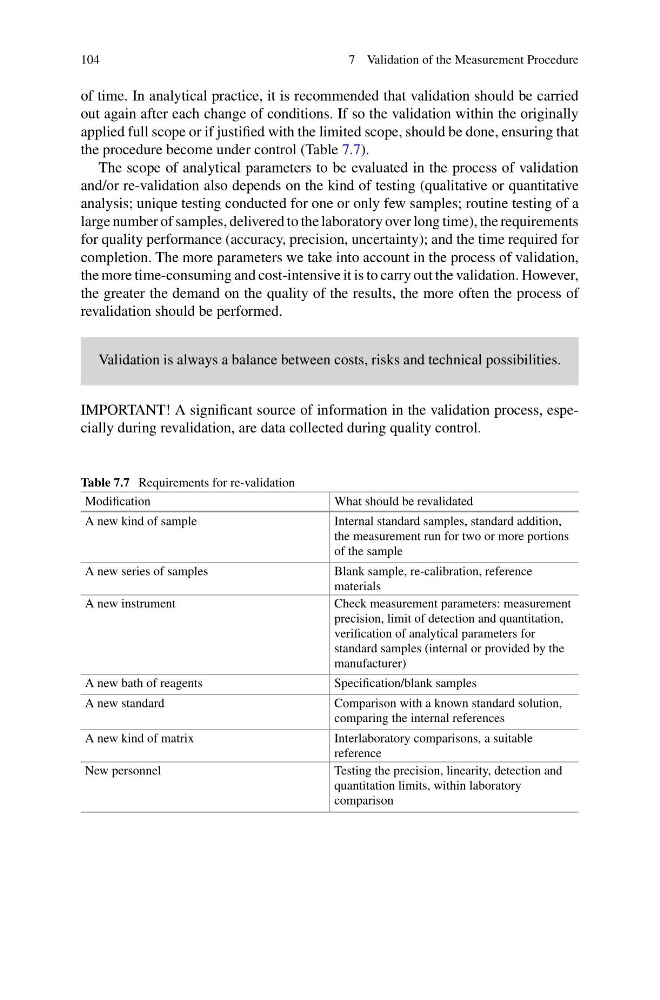
the procedure become under control (Table 7.7).
The scope of analytical parameters to be evaluated in the process of validation
and/or re-validation also depends on the kind of testing (qualitative or quantitative
analysis; unique testing conducted for one or only few samples; routine testing of a
large number of samples, delivered to the laboratory over long time), the requirements
for quality performance (accuracy, precision, uncertainty); and the time required for
completion. The more parameters we take into account in the process of validation,
the more time-consuming and cost-intensive it is to carry out the validation. However,
the greater the demand on the quality of the results, the more often the process of
revalidation should be performed.
Validation is always a balance between costs, risks and technical possibilities.
IMPORTANT! A significant source of information in the validation process, especially during revalidation, are data collected during quality control.
Table 7.7 Requirements for re-validation
Modification
What should be revalidated
A new kind of sample
Internal standard samples, standard addition,
the measurement run for two or more portions
of the sample
A new series of samples
Blank sample, re-calibration, reference
materials
A new instrument
Check measurement parameters: measurement
precision, limit of detection and quantitation,
verification of analytical parameters for
standard samples (internal or provided by the
manufacturer)
A new bath of reagents
Specification/blank samples
A new standard
Comparison with a known standard solution,
comparing the internal references
A new kind of matrix
Interlaboratory comparisons, a suitable
reference
New personnel
Testing the precision, linearity, detection and
quantitation limits, within laboratory
comparison
7 Validation of the Measurement Procedure
of time. In analytical practice, it is recommended that validation should be carried
out again after each change of conditions. If so the validation within the originally
applied full scope or if justified with the limited scope, should be done, ensuring that
the procedure become under control (Table 7.7).
The scope of analytical parameters to be evaluated in the process of validation
and/or re-validation also depends on the kind of testing (qualitative or quantitative
analysis; unique testing conducted for one or only few samples; routine testing of a
large number of samples, delivered to the laboratory over long time), the requirements
for quality performance (accuracy, precision, uncertainty); and the time required for
completion. The more parameters we take into account in the process of validation,
the more time-consuming and cost-intensive it is to carry out the validation. However,
the greater the demand on the quality of the results, the more often the process of
revalidation should be performed.
Validation is always a balance between costs, risks and technical possibilities.
IMPORTANT! A significant source of information in the validation process, especially during revalidation, are data collected during quality control.
Table 7.7 Requirements for re-validation
Modification
What should be revalidated
A new kind of sample
Internal standard samples, standard addition,
the measurement run for two or more portions
of the sample
A new series of samples
Blank sample, re-calibration, reference
materials
A new instrument
Check measurement parameters: measurement
precision, limit of detection and quantitation,
verification of analytical parameters for
standard samples (internal or provided by the
manufacturer)
A new bath of reagents
Specification/blank samples
A new standard
Comparison with a known standard solution,
comparing the internal references
A new kind of matrix
Interlaboratory comparisons, a suitable
reference
New personnel
Testing the precision, linearity, detection and
quantitation limits, within laboratory
comparison