

7.11 Validation Parameters
103
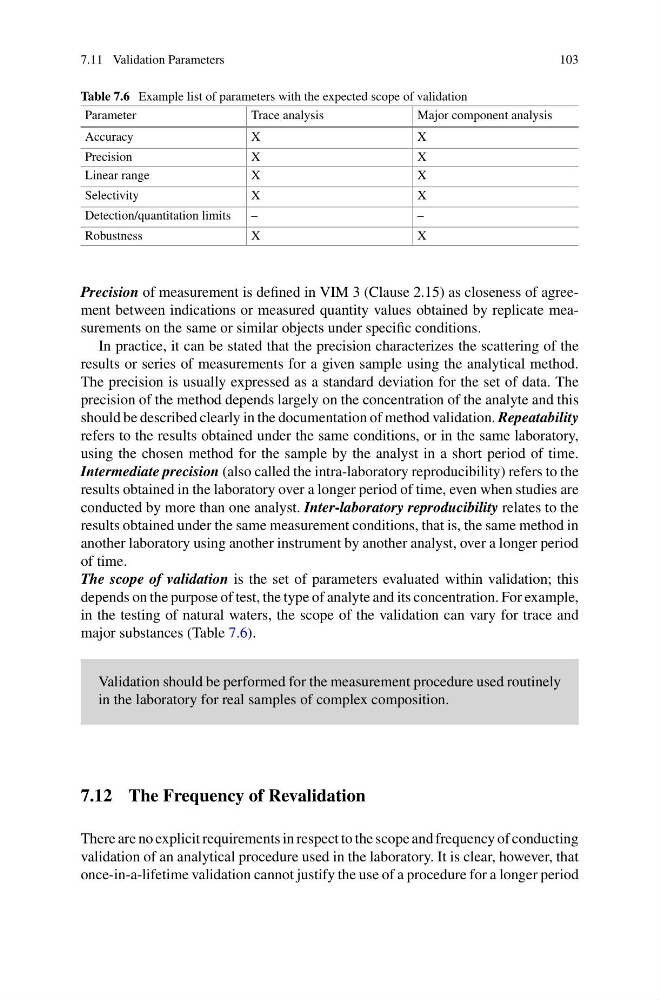
Table 7.6 Example list of parameters with the expected scope of validation
Parameter
Trace analysis
Major component analysis
Accuracy
X
X
Precision
X
X
Linear range
X
X
Selectivity
X
X
Detection/quantitation limits
–
–
Robustness
X
X
Precision of measurement is defined in VIM 3 (Clause 2.15) as closeness of agreement between indications or measured quantity values obtained by replicate measurements on the same or similar objects under specific conditions.
In practice, it can be stated that the precision characterizes the scattering of the
results or series of measurements for a given sample using the analytical method.
The precision is usually expressed as a standard deviation for the set of data. The
precision of the method depends largely on the concentration of the analyte and this
should be described clearly in the documentation of method validation. Repeatability
refers to the results obtained under the same conditions, or in the same laboratory,
using the chosen method for the sample by the analyst in a short period of time.
Intermediate precision (also called the intra-laboratory reproducibility) refers to the
results obtained in the laboratory over a longer period of time, even when studies are
conducted by more than one analyst. Inter-laboratory reproducibility relates to the
results obtained under the same measurement conditions, that is, the same method in
another laboratory using another instrument by another analyst, over a longer period
of time.
The scope of validation is the set of parameters evaluated within validation; this
depends on the purpose of test, the type of analyte and its concentration. For example,
in the testing of natural waters, the scope of the validation can vary for trace and
major substances (Table 7.6).
Validation should be performed for the measurement procedure used routinely
in the laboratory for real samples of complex composition.
7.12 The Frequency of Revalidation
There are no explicit requirements in respect to the scope and frequency of conducting
validation of an analytical procedure used in the laboratory. It is clear, however, that
once-in-a-lifetime validation cannot justify the use of a procedure for a longer period
103
Table 7.6 Example list of parameters with the expected scope of validation
Parameter
Trace analysis
Major component analysis
Accuracy
X
X
Precision
X
X
Linear range
X
X
Selectivity
X
X
Detection/quantitation limits
–
–
Robustness
X
X
Precision of measurement is defined in VIM 3 (Clause 2.15) as closeness of agreement between indications or measured quantity values obtained by replicate measurements on the same or similar objects under specific conditions.
In practice, it can be stated that the precision characterizes the scattering of the
results or series of measurements for a given sample using the analytical method.
The precision is usually expressed as a standard deviation for the set of data. The
precision of the method depends largely on the concentration of the analyte and this
should be described clearly in the documentation of method validation. Repeatability
refers to the results obtained under the same conditions, or in the same laboratory,
using the chosen method for the sample by the analyst in a short period of time.
Intermediate precision (also called the intra-laboratory reproducibility) refers to the
results obtained in the laboratory over a longer period of time, even when studies are
conducted by more than one analyst. Inter-laboratory reproducibility relates to the
results obtained under the same measurement conditions, that is, the same method in
another laboratory using another instrument by another analyst, over a longer period
of time.
The scope of validation is the set of parameters evaluated within validation; this
depends on the purpose of test, the type of analyte and its concentration. For example,
in the testing of natural waters, the scope of the validation can vary for trace and
major substances (Table 7.6).
Validation should be performed for the measurement procedure used routinely
in the laboratory for real samples of complex composition.
7.12 The Frequency of Revalidation
There are no explicit requirements in respect to the scope and frequency of conducting
validation of an analytical procedure used in the laboratory. It is clear, however, that
once-in-a-lifetime validation cannot justify the use of a procedure for a longer period