

98
7 Validation of the Measurement Procedure
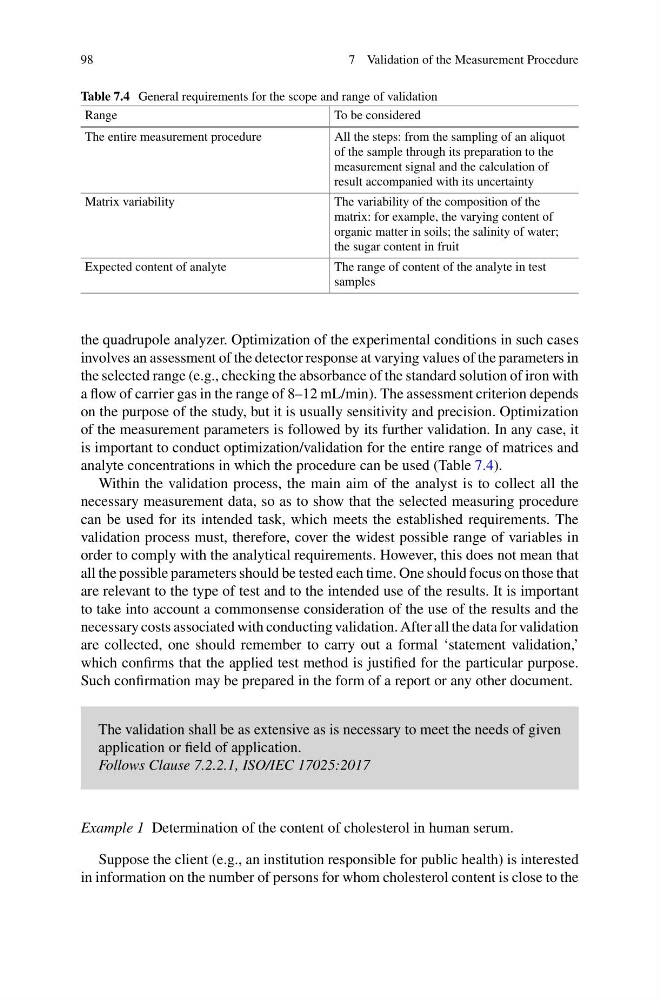
Table 7.4 General requirements for the scope and range of validation
Range
To be considered
The entire measurement procedure
All the steps: from the sampling of an aliquot
of the sample through its preparation to the
measurement signal and the calculation of
result accompanied with its uncertainty
Matrix variability
The variability of the composition of the
matrix: for example, the varying content of
organic matter in soils; the salinity of water;
the sugar content in fruit
Expected content of analyte
The range of content of the analyte in test
samples
the quadrupole analyzer. Optimization of the experimental conditions in such cases
involves an assessment of the detector response at varying values of the parameters in
the selected range (e.g., checking the absorbance of the standard solution of iron with
a flow of carrier gas in the range of 8–12 mL/min). The assessment criterion depends
on the purpose of the study, but it is usually sensitivity and precision. Optimization
of the measurement parameters is followed by its further validation. In any case, it
is important to conduct optimization/validation for the entire range of matrices and
analyte concentrations in which the procedure can be used (Table 7.4).
Within the validation process, the main aim of the analyst is to collect all the
necessary measurement data, so as to show that the selected measuring procedure
can be used for its intended task, which meets the established requirements. The
validation process must, therefore, cover the widest possible range of variables in
order to comply with the analytical requirements. However, this does not mean that
all the possible parameters should be tested each time. One should focus on those that
are relevant to the type of test and to the intended use of the results. It is important
to take into account a commonsense consideration of the use of the results and the
necessary costs associated with conducting validation. After all the data for validation
are collected, one should remember to carry out a formal ‘statement validation,’
which confirms that the applied test method is justified for the particular purpose.
Such confirmation may be prepared in the form of a report or any other document.
The validation shall be as extensive as is necessary to meet the needs of given
application or field of application.
Follows Clause 7.2.2.1, ISO/IEC 17025:2017
Example 1 Determination of the content of cholesterol in human serum.
Suppose the client (e.g., an institution responsible for public health) is interested
in information on the number of persons for whom cholesterol content is close to the
7 Validation of the Measurement Procedure
Table 7.4 General requirements for the scope and range of validation
Range
To be considered
The entire measurement procedure
All the steps: from the sampling of an aliquot
of the sample through its preparation to the
measurement signal and the calculation of
result accompanied with its uncertainty
Matrix variability
The variability of the composition of the
matrix: for example, the varying content of
organic matter in soils; the salinity of water;
the sugar content in fruit
Expected content of analyte
The range of content of the analyte in test
samples
the quadrupole analyzer. Optimization of the experimental conditions in such cases
involves an assessment of the detector response at varying values of the parameters in
the selected range (e.g., checking the absorbance of the standard solution of iron with
a flow of carrier gas in the range of 8–12 mL/min). The assessment criterion depends
on the purpose of the study, but it is usually sensitivity and precision. Optimization
of the measurement parameters is followed by its further validation. In any case, it
is important to conduct optimization/validation for the entire range of matrices and
analyte concentrations in which the procedure can be used (Table 7.4).
Within the validation process, the main aim of the analyst is to collect all the
necessary measurement data, so as to show that the selected measuring procedure
can be used for its intended task, which meets the established requirements. The
validation process must, therefore, cover the widest possible range of variables in
order to comply with the analytical requirements. However, this does not mean that
all the possible parameters should be tested each time. One should focus on those that
are relevant to the type of test and to the intended use of the results. It is important
to take into account a commonsense consideration of the use of the results and the
necessary costs associated with conducting validation. After all the data for validation
are collected, one should remember to carry out a formal ‘statement validation,’
which confirms that the applied test method is justified for the particular purpose.
Such confirmation may be prepared in the form of a report or any other document.
The validation shall be as extensive as is necessary to meet the needs of given
application or field of application.
Follows Clause 7.2.2.1, ISO/IEC 17025:2017
Example 1 Determination of the content of cholesterol in human serum.
Suppose the client (e.g., an institution responsible for public health) is interested
in information on the number of persons for whom cholesterol content is close to the