

7.8 Validation of Measurement Procedure
97
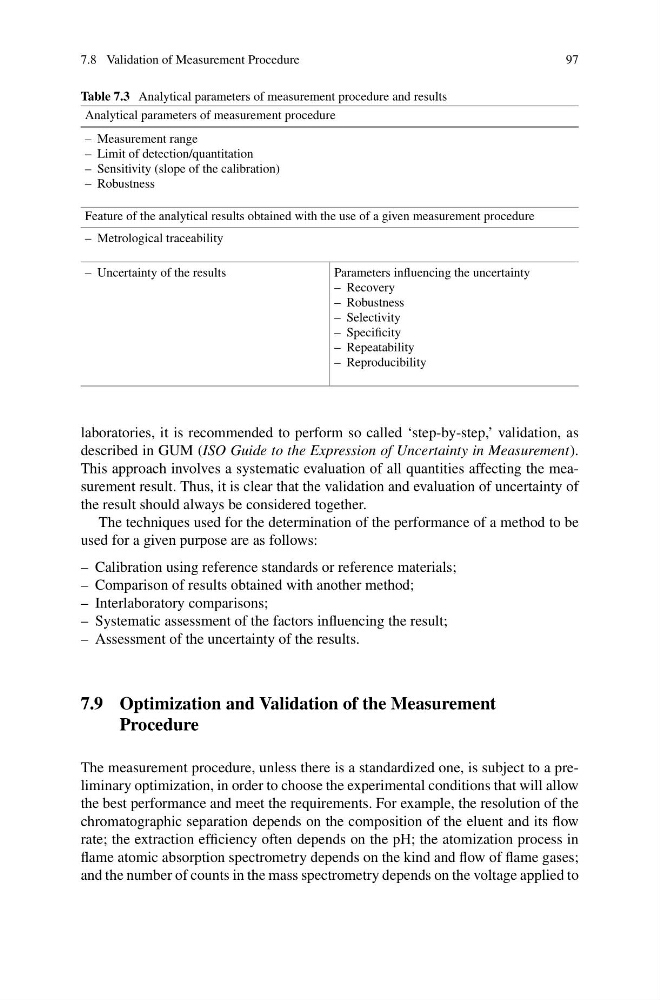
Table 7.3 Analytical parameters of measurement procedure and results
Analytical parameters of measurement procedure
– Measurement range
– Limit of detection/quantitation
– Sensitivity (slope of the calibration)
– Robustness
Feature of the analytical results obtained with the use of a given measurement procedure
– Metrological traceability
– Uncertainty of the results
Parameters influencing the uncertainty
– Recovery
– Robustness
– Selectivity
– Specificity
– Repeatability
– Reproducibility
laboratories, it is recommended to perform so called ‘step-by-step,’ validation, as
described in GUM (ISO Guide to the Expression of Uncertainty in Measurement).
This approach involves a systematic evaluation of all quantities affecting the measurement result. Thus, it is clear that the validation and evaluation of uncertainty of
the result should always be considered together.
The techniques used for the determination of the performance of a method to be
used for a given purpose are as follows:
– Calibration using reference standards or reference materials;
– Comparison of results obtained with another method;
– Interlaboratory comparisons;
– Systematic assessment of the factors influencing the result;
– Assessment of the uncertainty of the results.
7.9 Optimization and Validation of the Measurement
Procedure
The measurement procedure, unless there is a standardized one, is subject to a preliminary optimization, in order to choose the experimental conditions that will allow
the best performance and meet the requirements. For example, the resolution of the
chromatographic separation depends on the composition of the eluent and its flow
rate; the extraction efficiency often depends on the pH; the atomization process in
flame atomic absorption spectrometry depends on the kind and flow of flame gases;
and the number of counts in the mass spectrometry depends on the voltage applied to
97
Table 7.3 Analytical parameters of measurement procedure and results
Analytical parameters of measurement procedure
– Measurement range
– Limit of detection/quantitation
– Sensitivity (slope of the calibration)
– Robustness
Feature of the analytical results obtained with the use of a given measurement procedure
– Metrological traceability
– Uncertainty of the results
Parameters influencing the uncertainty
– Recovery
– Robustness
– Selectivity
– Specificity
– Repeatability
– Reproducibility
laboratories, it is recommended to perform so called ‘step-by-step,’ validation, as
described in GUM (ISO Guide to the Expression of Uncertainty in Measurement).
This approach involves a systematic evaluation of all quantities affecting the measurement result. Thus, it is clear that the validation and evaluation of uncertainty of
the result should always be considered together.
The techniques used for the determination of the performance of a method to be
used for a given purpose are as follows:
– Calibration using reference standards or reference materials;
– Comparison of results obtained with another method;
– Interlaboratory comparisons;
– Systematic assessment of the factors influencing the result;
– Assessment of the uncertainty of the results.
7.9 Optimization and Validation of the Measurement
Procedure
The measurement procedure, unless there is a standardized one, is subject to a preliminary optimization, in order to choose the experimental conditions that will allow
the best performance and meet the requirements. For example, the resolution of the
chromatographic separation depends on the composition of the eluent and its flow
rate; the extraction efficiency often depends on the pH; the atomization process in
flame atomic absorption spectrometry depends on the kind and flow of flame gases;
and the number of counts in the mass spectrometry depends on the voltage applied to