

6.2 Diagrams in the Hartree–Fock Representation
81
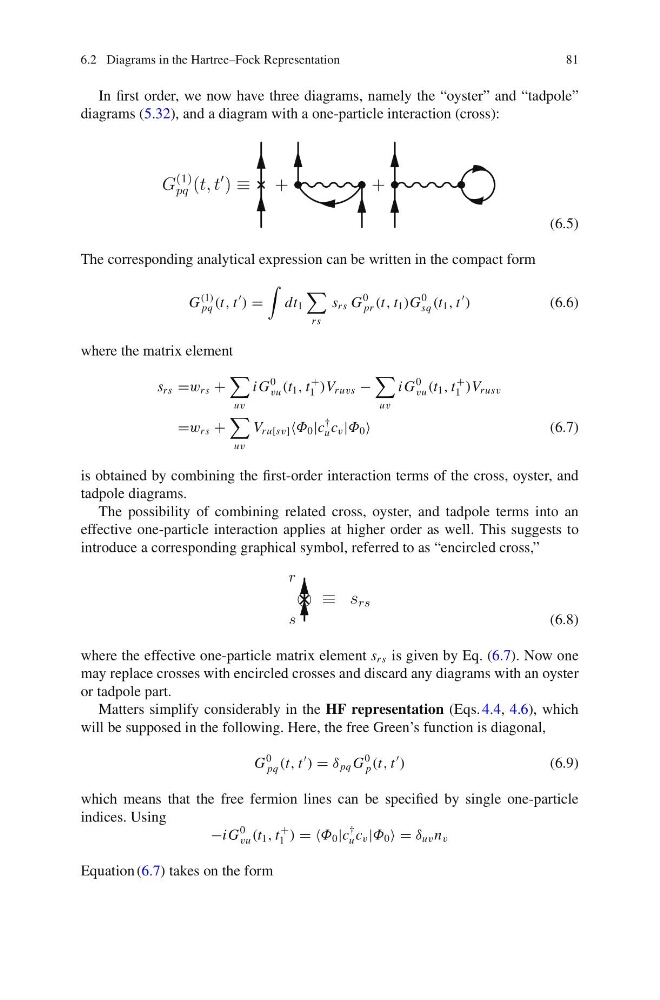
In first order, we now have three diagrams, namely the “oyster” and “tadpole”
diagrams (5.32), and a diagram with a one-particle interaction (cross):
(6.5)
The corresponding analytical expression can be written in the compact form
G
(1)
pq (t, t
) =
dt 1
rs
s rs G
0
pr (t, t 1 )G
0
sq (t 1 , t
)
(6.6)
where the matrix element
s rs =w rs +
uv
i G
0
vu (t 1 , t
+
1 )V ruvs −
uv
i G
0
vu (t 1 , t
+
1 )V rusv
=w rs +
uv
V ru[sv] Φ 0 |c
†
u c v |Φ 0
(6.7)
is obtained by combining the first-order interaction terms of the cross, oyster, and
tadpole diagrams.
The possibility of combining related cross, oyster, and tadpole terms into an
effective one-particle interaction applies at higher order as well. This suggests to
introduce a corresponding graphical symbol, referred to as “encircled cross,”
(6.8)
where the effective one-particle matrix element s rs is given by Eq. (6.7). Now one
may replace crosses with encircled crosses and discard any diagrams with an oyster
or tadpole part.
Matters simplify considerably in the HF representation (Eqs. 4.4, 4.6), which
will be supposed in the following. Here, the free Green’s function is diagonal,
G
0
pq (t, t
) = δ pq G
0
p (t, t
)
(6.9)
which means that the free fermion lines can be specified by single one-particle
indices. Using
−i G
0
vu (t 1 , t
+
1 ) = =Φ 0 |c
†
u c v |Φ 0 = δ uv n v
Equation (6.7) takes on the form
81
In first order, we now have three diagrams, namely the “oyster” and “tadpole”
diagrams (5.32), and a diagram with a one-particle interaction (cross):
(6.5)
The corresponding analytical expression can be written in the compact form
G
(1)
pq (t, t
) =
dt 1
rs
s rs G
0
pr (t, t 1 )G
0
sq (t 1 , t
)
(6.6)
where the matrix element
s rs =w rs +
uv
i G
0
vu (t 1 , t
+
1 )V ruvs −
uv
i G
0
vu (t 1 , t
+
1 )V rusv
=w rs +
uv
V ru[sv] Φ 0 |c
†
u c v |Φ 0
(6.7)
is obtained by combining the first-order interaction terms of the cross, oyster, and
tadpole diagrams.
The possibility of combining related cross, oyster, and tadpole terms into an
effective one-particle interaction applies at higher order as well. This suggests to
introduce a corresponding graphical symbol, referred to as “encircled cross,”
(6.8)
where the effective one-particle matrix element s rs is given by Eq. (6.7). Now one
may replace crosses with encircled crosses and discard any diagrams with an oyster
or tadpole part.
Matters simplify considerably in the HF representation (Eqs. 4.4, 4.6), which
will be supposed in the following. Here, the free Green’s function is diagonal,
G
0
pq (t, t
) = δ pq G
0
p (t, t
)
(6.9)
which means that the free fermion lines can be specified by single one-particle
indices. Using
−i G
0
vu (t 1 , t
+
1 ) = =Φ 0 |c
†
u c v |Φ 0 = δ uv n v
Equation (6.7) takes on the form