

5.3 Linked-Cluster Theorem
71
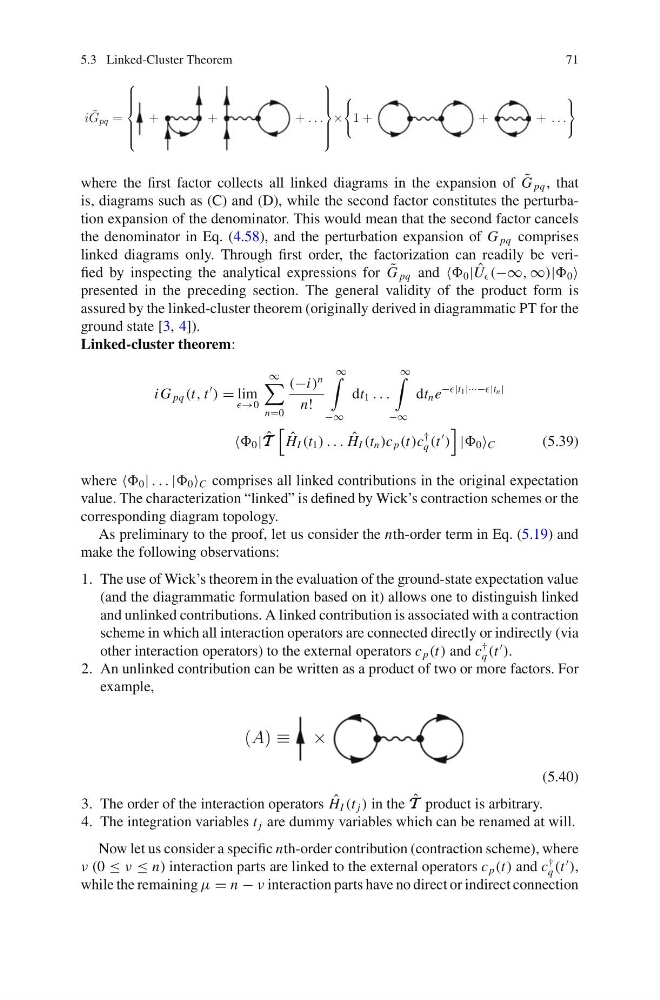
where the first factor collects all linked diagrams in the expansion of ˜
G pq , that
is, diagrams such as (C) and (D), while the second factor constitutes the perturbation expansion of the denominator. This would mean that the second factor cancels
the denominator in Eq. (4.58), and the perturbation expansion of G pq comprises
linked diagrams only. Through first order, the factorization can readily be verified by inspecting the analytical expressions for ˜
G pq and 0 | ˆ
U (−∞, ∞)| 0
presented in the preceding section. The general validity of the product form is
assured by the linked-cluster theorem (originally derived in diagrammatic PT for the
ground state [3, 4]).
Linked-cluster theorem:
i G pq (t, t
) = lim
→0
∞
n=0
(−i)
n
n!
∞
−∞
dt 1 . . .
∞
−∞
dt n e
−|t 1 |···−|t n |
0 | ˆ
T T T
ˆ
H I (t 1 ) . . . ˆ
H I (t n )c p (t)c
†
q (t
)
| 0 C
(5.39)
where 0 | . . . | 0 C comprises all linked contributions in the original expectation
value. The characterization “linked” is defined by Wick’s contraction schemes or the
corresponding diagram topology.
As preliminary to the proof, let us consider the nth-order term in Eq. (5.19) and
make the following observations:
1. The use of Wick’s theorem in the evaluation of the ground-state expectation value
(and the diagrammatic formulation based on it) allows one to distinguish linked
and unlinked contributions. A linked contribution is associated with a contraction
scheme in which all interaction operators are connected directly or indirectly (via
other interaction operators) to the external operators c p (t) and c
†
q (t
).
2. An unlinked contribution can be written as a product of two or more factors. For
example,
(5.40)
3. The order of the interaction operators ˆ
H I (t j ) in the ˆ
T T T product is arbitrary.
4. The integration variables t j are dummy variables which can be renamed at will.
Now let us consider a specific nth-order contribution (contraction scheme), where
ν (0 ≤ ν ≤ n) interaction parts are linked to the external operators c p (t) and c
†
q (t
),
while the remaining μ = n − ν interaction parts have no direct or indirect connection
71
where the first factor collects all linked diagrams in the expansion of ˜
G pq , that
is, diagrams such as (C) and (D), while the second factor constitutes the perturbation expansion of the denominator. This would mean that the second factor cancels
the denominator in Eq. (4.58), and the perturbation expansion of G pq comprises
linked diagrams only. Through first order, the factorization can readily be verified by inspecting the analytical expressions for ˜
G pq and 0 | ˆ
U (−∞, ∞)| 0
presented in the preceding section. The general validity of the product form is
assured by the linked-cluster theorem (originally derived in diagrammatic PT for the
ground state [3, 4]).
Linked-cluster theorem:
i G pq (t, t
) = lim
→0
∞
n=0
(−i)
n
n!
∞
−∞
dt 1 . . .
∞
−∞
dt n e
−|t 1 |···−|t n |
0 | ˆ
T T T
ˆ
H I (t 1 ) . . . ˆ
H I (t n )c p (t)c
†
q (t
)
| 0 C
(5.39)
where 0 | . . . | 0 C comprises all linked contributions in the original expectation
value. The characterization “linked” is defined by Wick’s contraction schemes or the
corresponding diagram topology.
As preliminary to the proof, let us consider the nth-order term in Eq. (5.19) and
make the following observations:
1. The use of Wick’s theorem in the evaluation of the ground-state expectation value
(and the diagrammatic formulation based on it) allows one to distinguish linked
and unlinked contributions. A linked contribution is associated with a contraction
scheme in which all interaction operators are connected directly or indirectly (via
other interaction operators) to the external operators c p (t) and c
†
q (t
).
2. An unlinked contribution can be written as a product of two or more factors. For
example,
(5.40)
3. The order of the interaction operators ˆ
H I (t j ) in the ˆ
T T T product is arbitrary.
4. The integration variables t j are dummy variables which can be renamed at will.
Now let us consider a specific nth-order contribution (contraction scheme), where
ν (0 ≤ ν ≤ n) interaction parts are linked to the external operators c p (t) and c
†
q (t
),
while the remaining μ = n − ν interaction parts have no direct or indirect connection