

64
5 Introducing Diagrams
While contractions of the types (i) and (ii) simply vanish, this is not necessarily the
case for the mixed-type contractions (iii). The anticommutator arising in Eq. (5.10) is
just a complex number though. This means that contractions are always c-numbers.
Using Eq. (5.5), a contraction can be written as the (non-interacting) ground-state
expectation value of the corresponding ˆ
T T T product,
ˆ
a
r ˆ
a
s = = 0 | ˆ
T T T
ˆ
a r ˆ
a s
| 0
(5.12)
As an obvious consequence, contractions of the original fermion operators become
c p (t)
c q (t
)
= c
†
p (t)
c
†
q (t
)
= 0
(5.13)
c p (t)
c
†
q (t
)
= = 0 | ˆ
T T T
c p (t)c
†
q (t
)
| 0 = i G
0
pq (t, t
)
(5.14)
where G
0
pq (t, t
) is the free one-particle Green’s function (Eq. 3.52). The only nonvanishing contractions are those between a creation and a destruction operator, and
such a contraction can be expressed by the free one-particle Green’s functions.
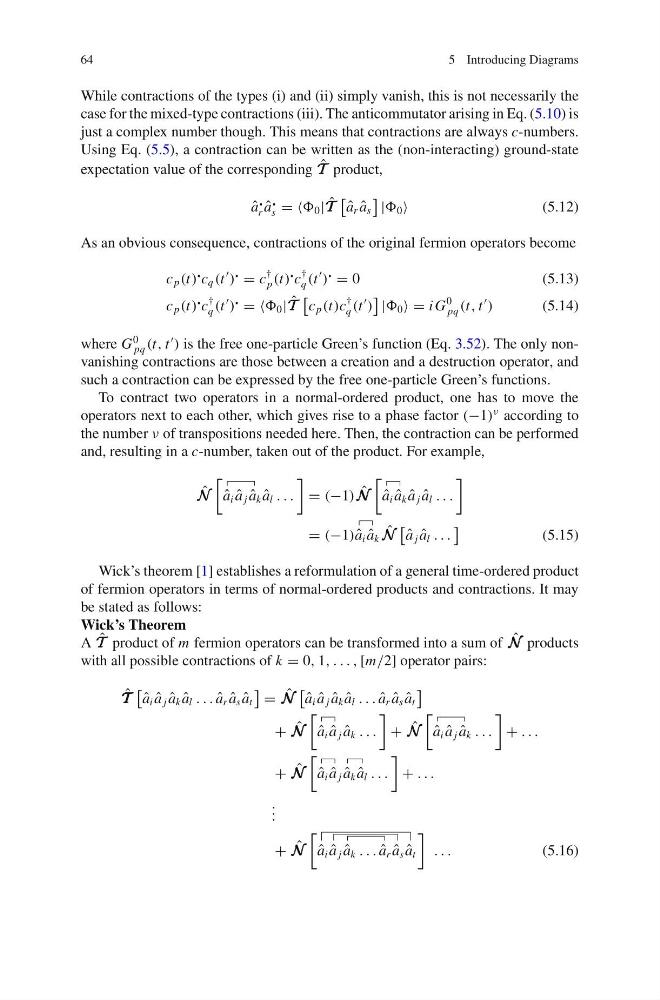
To contract two operators in a normal-ordered product, one has to move the
operators next to each other, which gives rise to a phase factor (−1)
ν according to
the number ν of transpositions needed here. Then, the contraction can be performed
and, resulting in a c-number, taken out of the product. For example,
ˆ
N N N
ˆ
a i ˆ
a j ˆ
a k ˆ
a l . . .
= (−1) ˆ
N N N
ˆ
a i ˆ
a k ˆ
a j ˆ
a l . . .
= (−1) ˆ
a i ˆ
a k ˆ
N N N
ˆ
a j ˆ
a l . . .
(5.15)
Wick’s theorem [1] establishes a reformulation of a general time-ordered product
of fermion operators in terms of normal-ordered products and contractions. It may
be stated as follows:
Wick’s Theorem
A ˆ
T T T product of m fermion operators can be transformed into a sum of ˆ
N N N products
with all possible contractions of k = 0, 1, . . . , [m/2] operator pairs:
ˆ
T T T
ˆ
a i ˆ
a j ˆ
a k ˆ
a l . . . ˆ
a r ˆ
a s ˆ
a t
= ˆ
N N N
ˆ
a i ˆ
a j ˆ
a k ˆ
a l . . . ˆ
a r ˆ
a s ˆ
a t
+ ˆ
N N N
ˆ
a i ˆ
a j ˆ
a k . . .
+ ˆ
N N N
ˆ
a i ˆ
a j ˆ
a k . . .
+ . . .
+ ˆ
N N N
ˆ
a i ˆ
a j ˆ
a k ˆ
a l . . .
+ . . .
. . .
+ ˆ
N N N
ˆ
a i ˆ
a j ˆ
a k . . . ˆ
a r ˆ
a s ˆ
a t
. . .
(5.16)
5 Introducing Diagrams
While contractions of the types (i) and (ii) simply vanish, this is not necessarily the
case for the mixed-type contractions (iii). The anticommutator arising in Eq. (5.10) is
just a complex number though. This means that contractions are always c-numbers.
Using Eq. (5.5), a contraction can be written as the (non-interacting) ground-state
expectation value of the corresponding ˆ
T T T product,
ˆ
a
r ˆ
a
s = = 0 | ˆ
T T T
ˆ
a r ˆ
a s
| 0
(5.12)
As an obvious consequence, contractions of the original fermion operators become
c p (t)
c q (t
)
= c
†
p (t)
c
†
q (t
)
= 0
(5.13)
c p (t)
c
†
q (t
)
= = 0 | ˆ
T T T
c p (t)c
†
q (t
)
| 0 = i G
0
pq (t, t
)
(5.14)
where G
0
pq (t, t
) is the free one-particle Green’s function (Eq. 3.52). The only nonvanishing contractions are those between a creation and a destruction operator, and
such a contraction can be expressed by the free one-particle Green’s functions.
To contract two operators in a normal-ordered product, one has to move the
operators next to each other, which gives rise to a phase factor (−1)
ν according to
the number ν of transpositions needed here. Then, the contraction can be performed
and, resulting in a c-number, taken out of the product. For example,
ˆ
N N N
ˆ
a i ˆ
a j ˆ
a k ˆ
a l . . .
= (−1) ˆ
N N N
ˆ
a i ˆ
a k ˆ
a j ˆ
a l . . .
= (−1) ˆ
a i ˆ
a k ˆ
N N N
ˆ
a j ˆ
a l . . .
(5.15)
Wick’s theorem [1] establishes a reformulation of a general time-ordered product
of fermion operators in terms of normal-ordered products and contractions. It may
be stated as follows:
Wick’s Theorem
A ˆ
T T T product of m fermion operators can be transformed into a sum of ˆ
N N N products
with all possible contractions of k = 0, 1, . . . , [m/2] operator pairs:
ˆ
T T T
ˆ
a i ˆ
a j ˆ
a k ˆ
a l . . . ˆ
a r ˆ
a s ˆ
a t
= ˆ
N N N
ˆ
a i ˆ
a j ˆ
a k ˆ
a l . . . ˆ
a r ˆ
a s ˆ
a t
+ ˆ
N N N
ˆ
a i ˆ
a j ˆ
a k . . .
+ ˆ
N N N
ˆ
a i ˆ
a j ˆ
a k . . .
+ . . .
+ ˆ
N N N
ˆ
a i ˆ
a j ˆ
a k ˆ
a l . . .
+ . . .
. . .
+ ˆ
N N N
ˆ
a i ˆ
a j ˆ
a k . . . ˆ
a r ˆ
a s ˆ
a t
. . .
(5.16)