

5.1 Wick’s Theorem
63
where P
is a permutation placing physical operators to the left of unphysical ones,
(−1)
P
being the sign of the permutation. The operator ˆ
N N N is referred to as the normalordering operator. As an obvious property of the ˆ
N N N product, the expectation value
taken with respect to the unperturbed ground state vanishes:
0 | ˆ
N N N
ˆ
a i ˆ
a j ˆ
a k . . .
| 0 = 0
(5.5)
Note that this relation also holds if all operators in the product are physical operators.
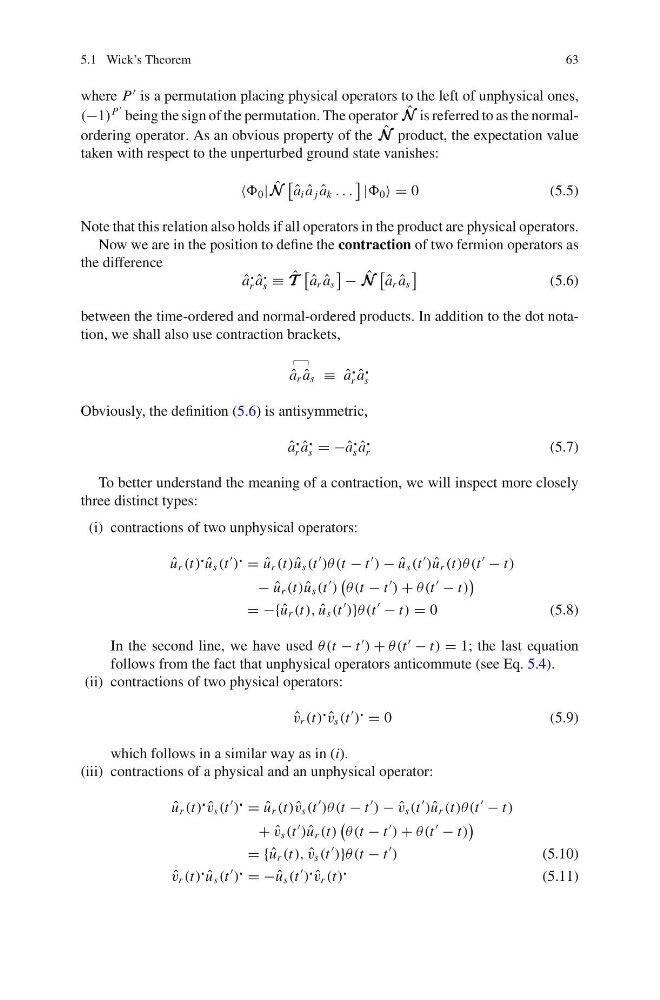
Now we are in the position to define the contraction of two fermion operators as
the difference
ˆ
a
r ˆ
a
s ≡ ˆ
T T T
ˆ
a r ˆ
a s
− ˆ
N N N
ˆ
a r ˆ
a s
(5.6)
between the time-ordered and normal-ordered products. In addition to the dot notation, we shall also use contraction brackets,
ˆ
a r ˆ
a s ≡ ˆ
a
r ˆ
a
s
Obviously, the definition (5.6) is antisymmetric,
ˆ
a
r ˆ
a
s = −ˆ a
s ˆ
a
r
(5.7)
To better understand the meaning of a contraction, we will inspect more closely
three distinct types:
(i) contractions of two unphysical operators:
ˆ
u r (t)
ˆ
u s (t
)
= ˆ
u r (t) ˆ
u s (t
)θ (t − t
) − ˆ
u s (t
) ˆ
u r (t)θ (t
− t)
− ˆ
u r (t) ˆ
u s (t
)
θ(t − t
) + θ(t
− t)
= −{ ˆ
u r (t), ˆ
u s (t
)}θ(t
− t) = 0
(5.8)
In the second line, we have used θ(t − t
) + θ(t
− t) = 1; the last equation
follows from the fact that unphysical operators anticommute (see Eq. 5.4).
(ii) contractions of two physical operators:
ˆ
v r (t)
ˆ
v s (t
)
= 0
(5.9)
which follows in a similar way as in (i).
(iii) contractions of a physical and an unphysical operator:
ˆ
u r (t)
ˆ
v s (t
)
= ˆ
u r (t) ˆ
v s (t
)θ (t − t
) − ˆ
v s (t
) ˆ
u r (t)θ (t
− t)
+ ˆ
v s (t
) ˆ
u r (t)
θ(t − t
) + θ(t
− t)
= { ˆ
u r (t), ˆ
v s (t
)}θ(t − t
)
(5.10)
ˆ
v r (t)
ˆ
u s (t
)
= − ˆ
u s (t
)
ˆ
v r (t)
(5.11)
63
where P
is a permutation placing physical operators to the left of unphysical ones,
(−1)
P
being the sign of the permutation. The operator ˆ
N N N is referred to as the normalordering operator. As an obvious property of the ˆ
N N N product, the expectation value
taken with respect to the unperturbed ground state vanishes:
0 | ˆ
N N N
ˆ
a i ˆ
a j ˆ
a k . . .
| 0 = 0
(5.5)
Note that this relation also holds if all operators in the product are physical operators.
Now we are in the position to define the contraction of two fermion operators as
the difference
ˆ
a
r ˆ
a
s ≡ ˆ
T T T
ˆ
a r ˆ
a s
− ˆ
N N N
ˆ
a r ˆ
a s
(5.6)
between the time-ordered and normal-ordered products. In addition to the dot notation, we shall also use contraction brackets,
ˆ
a r ˆ
a s ≡ ˆ
a
r ˆ
a
s
Obviously, the definition (5.6) is antisymmetric,
ˆ
a
r ˆ
a
s = −ˆ a
s ˆ
a
r
(5.7)
To better understand the meaning of a contraction, we will inspect more closely
three distinct types:
(i) contractions of two unphysical operators:
ˆ
u r (t)
ˆ
u s (t
)
= ˆ
u r (t) ˆ
u s (t
)θ (t − t
) − ˆ
u s (t
) ˆ
u r (t)θ (t
− t)
− ˆ
u r (t) ˆ
u s (t
)
θ(t − t
) + θ(t
− t)
= −{ ˆ
u r (t), ˆ
u s (t
)}θ(t
− t) = 0
(5.8)
In the second line, we have used θ(t − t
) + θ(t
− t) = 1; the last equation
follows from the fact that unphysical operators anticommute (see Eq. 5.4).
(ii) contractions of two physical operators:
ˆ
v r (t)
ˆ
v s (t
)
= 0
(5.9)
which follows in a similar way as in (i).
(iii) contractions of a physical and an unphysical operator:
ˆ
u r (t)
ˆ
v s (t
)
= ˆ
u r (t) ˆ
v s (t
)θ (t − t
) − ˆ
v s (t
) ˆ
u r (t)θ (t
− t)
+ ˆ
v s (t
) ˆ
u r (t)
θ(t − t
) + θ(t
− t)
= { ˆ
u r (t), ˆ
v s (t
)}θ(t − t
)
(5.10)
ˆ
v r (t)
ˆ
u s (t
)
= − ˆ
u s (t
)
ˆ
v r (t)
(5.11)