

40
3 One-Particle Green’s Function
Combining this result with the ground-state expectation value of ˆ
T according to
Eqs. (3.35), (3.44) is readily retrieved.
3.4 Free One-Particle Green’s Function
The electron propagator can be specialized to a system of N non-interacting particles
with a hamiltonian of the form
ˆ
H 0 =
N
i=1
ˆ
h 0 (i) =
ε r c
†
r c r
(3.49)
The orbitals |r are supposed to be eigenstates of ˆ
h 0 , and the N -particle ground state
| 0 is given by the Slater determinant of the N energetically lowest orbitals |r . As
an example of particular importance, we may consider the HF approximation for an
atom or molecule, where |r are ground-state HF orbitals, and ˆ
h 0 is the (one-particle)
HF operator.
The time-dependent Heisenberg operators simply become
c p (t) = e
i ˆ
H 0 t c p e
−i ˆ
H 0 t
= e
−iε p t c p
(3.50)
since
i
∂
∂t
c p (t) = e
i ˆ
H 0 t
[c p , ˆ
H 0 ]e
−i ˆ
H 0 t
= ε p c p (t)
(3.51)
Replacing ˆ
H with ˆ
H 0 and | 0 with | 0 in the general definition (3.3), one obtains
the so-called free Green’s function (free electron propagator)
G
0
pq (t, t
) = −ie
−iε p (t−t
)
δ pq
θ(t − t
) ¯
n p − θ(t
− t)n p
(3.52)
Here n p , n q = 1 − n q denote occupation numbers with respect to | 0 ,
n p =
1, p ≤ N
0, p > N
(3.53)
The corresponding energy representation
G
0
pq (ω) = δ pq
¯
n p
ω − ε p + iη
+
n p
ω − ε p − iη
(3.54)
is obtained via Fourier transformation using convergence factors e
±η(t−t
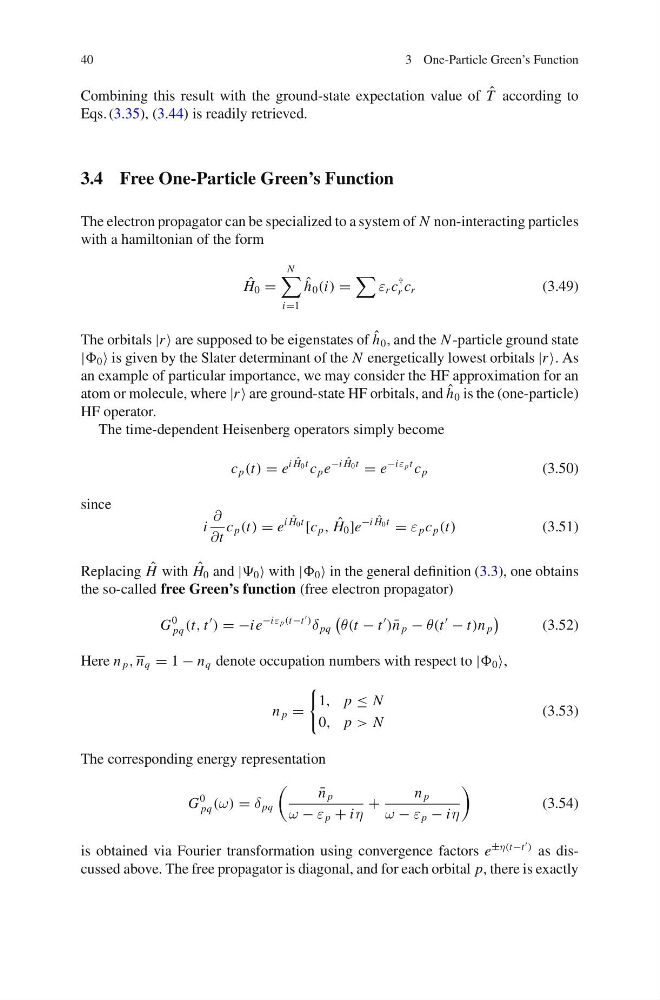
) as discussed above. The free propagator is diagonal, and for each orbital p, there is exactly
3 One-Particle Green’s Function
Combining this result with the ground-state expectation value of ˆ
T according to
Eqs. (3.35), (3.44) is readily retrieved.
3.4 Free One-Particle Green’s Function
The electron propagator can be specialized to a system of N non-interacting particles
with a hamiltonian of the form
ˆ
H 0 =
N
i=1
ˆ
h 0 (i) =
ε r c
†
r c r
(3.49)
The orbitals |r are supposed to be eigenstates of ˆ
h 0 , and the N -particle ground state
| 0 is given by the Slater determinant of the N energetically lowest orbitals |r . As
an example of particular importance, we may consider the HF approximation for an
atom or molecule, where |r are ground-state HF orbitals, and ˆ
h 0 is the (one-particle)
HF operator.
The time-dependent Heisenberg operators simply become
c p (t) = e
i ˆ
H 0 t c p e
−i ˆ
H 0 t
= e
−iε p t c p
(3.50)
since
i
∂
∂t
c p (t) = e
i ˆ
H 0 t
[c p , ˆ
H 0 ]e
−i ˆ
H 0 t
= ε p c p (t)
(3.51)
Replacing ˆ
H with ˆ
H 0 and | 0 with | 0 in the general definition (3.3), one obtains
the so-called free Green’s function (free electron propagator)
G
0
pq (t, t
) = −ie
−iε p (t−t
)
δ pq
θ(t − t
) ¯
n p − θ(t
− t)n p
(3.52)
Here n p , n q = 1 − n q denote occupation numbers with respect to | 0 ,
n p =
1, p ≤ N
0, p > N
(3.53)
The corresponding energy representation
G
0
pq (ω) = δ pq
¯
n p
ω − ε p + iη
+
n p
ω − ε p − iη
(3.54)
is obtained via Fourier transformation using convergence factors e
±η(t−t
) as discussed above. The free propagator is diagonal, and for each orbital p, there is exactly