

322
Appendix
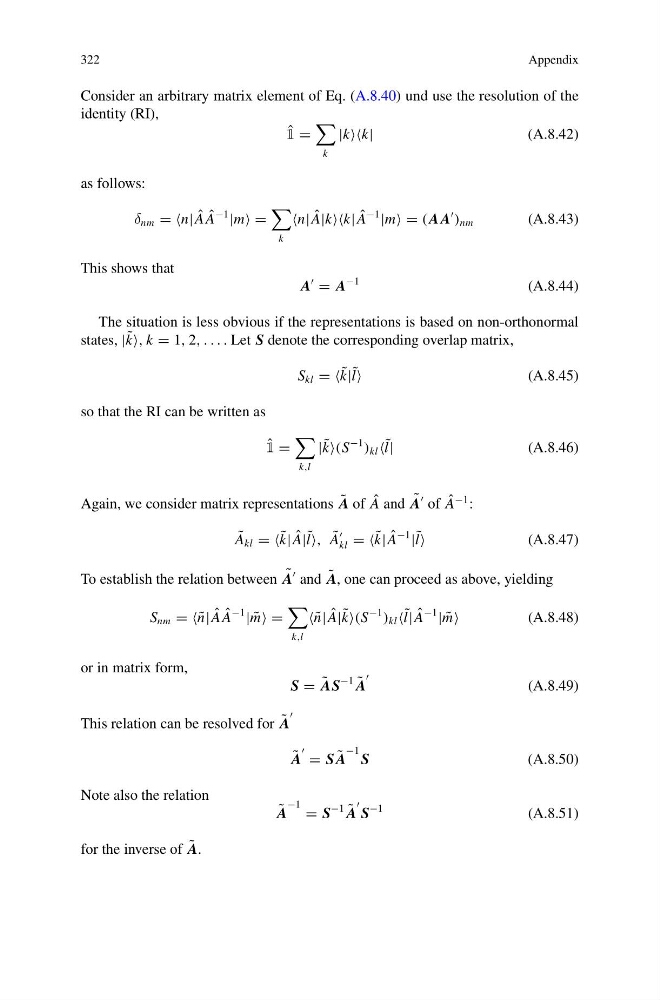
Consider an arbitrary matrix element of Eq. (A.8.40) und use the resolution of the
identity (RI),
ˆ
1 =
k
|kk|
(A.8.42)
as follows:
δ nm = =n| ˆ
A ˆ
A
−1
|m =
k
n| ˆ
A|kk| ˆ
A
−1
|m = ( AA
) nm
(A.8.43)
This shows that
A
= A
−1
(A.8.44)
The situation is less obvious if the representations is based on non-orthonormal
states, | ˜
k, k = 1, 2, . . . . Let S denote the corresponding overlap matrix,
S kl = = ˜
k| ˜
l
(A.8.45)
so that the RI can be written as
ˆ
1 =
k,l
| ˜
k(S
−1
) kl ˜
l|
(A.8.46)
Again, we consider matrix representations ˜
A of ˆ
A and ˜
A
of ˆ
A
−1 :
˜
A kl = = ˜
k| ˆ
A| ˜
l, ˜
A
kl = = ˜
k| ˆ
A
−1
| ˜
l
(A.8.47)
To establish the relation between ˜
A
and ˜
A, one can proceed as above, yielding
S nm = =˜ n| ˆ
A ˆ
A
−1
| ˜
m =
k,l
˜
n| ˆ
A| ˜
k(S
−1
) kl ˜
l| ˆ
A
−1
| ˜
m
(A.8.48)
or in matrix form,
S = ˜
AS
−1 ˜
A
(A.8.49)
This relation can be resolved for ˜
A
˜
A
= S ˜
A
−1 S
(A.8.50)
Note also the relation
˜
A
−1 = S
−1 ˜
A
S
−1
(A.8.51)
for the inverse of ˜
A.
Appendix
Consider an arbitrary matrix element of Eq. (A.8.40) und use the resolution of the
identity (RI),
ˆ
1 =
k
|kk|
(A.8.42)
as follows:
δ nm = =n| ˆ
A ˆ
A
−1
|m =
k
n| ˆ
A|kk| ˆ
A
−1
|m = ( AA
) nm
(A.8.43)
This shows that
A
= A
−1
(A.8.44)
The situation is less obvious if the representations is based on non-orthonormal
states, | ˜
k, k = 1, 2, . . . . Let S denote the corresponding overlap matrix,
S kl = = ˜
k| ˜
l
(A.8.45)
so that the RI can be written as
ˆ
1 =
k,l
| ˜
k(S
−1
) kl ˜
l|
(A.8.46)
Again, we consider matrix representations ˜
A of ˆ
A and ˜
A
of ˆ
A
−1 :
˜
A kl = = ˜
k| ˆ
A| ˜
l, ˜
A
kl = = ˜
k| ˆ
A
−1
| ˜
l
(A.8.47)
To establish the relation between ˜
A
and ˜
A, one can proceed as above, yielding
S nm = =˜ n| ˆ
A ˆ
A
−1
| ˜
m =
k,l
˜
n| ˆ
A| ˜
k(S
−1
) kl ˜
l| ˆ
A
−1
| ˜
m
(A.8.48)
or in matrix form,
S = ˜
AS
−1 ˜
A
(A.8.49)
This relation can be resolved for ˜
A
˜
A
= S ˜
A
−1 S
(A.8.50)
Note also the relation
˜
A
−1 = S
−1 ˜
A
S
−1
(A.8.51)
for the inverse of ˜
A.