

320
Appendix
S I J = = I | J = =0|{ ˆ
O
†
I , ˆ
O J }|0 = ( ˆ
O I | ˆ
O J )
(A.8.27)
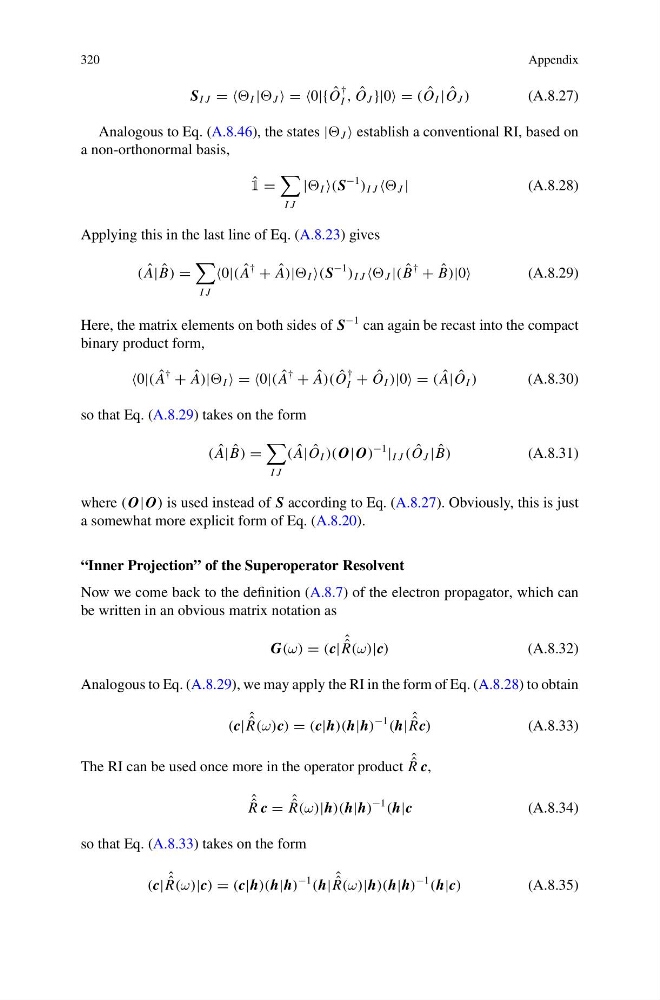
Analogous to Eq. (A.8.46), the states | J establish a conventional RI, based on
a non-orthonormal basis,
ˆ
1 =
I J
| I (S
−1
) I J J |
(A.8.28)
Applying this in the last line of Eq. (A.8.23) gives
( ˆ
A| ˆ
B) =
I J
0|( ˆ
A
†
+ ˆ
A)| I (S
−1
) I J J |( ˆ
B
†
+ ˆ
B)|0
(A.8.29)
Here, the matrix elements on both sides of S
−1 can again be recast into the compact
binary product form,
0|( ˆ
A
†
+ ˆ
A)| I = =0|( ˆ
A
†
+ ˆ
A)( ˆ
O
†
I + ˆ
O I )|0 = ( ˆ
A| ˆ
O I )
(A.8.30)
so that Eq. (A.8.29) takes on the form
( ˆ
A| ˆ
B) =
I J
( ˆ
A| ˆ
O I )(O|O)
−1
| I J ( ˆ
O J | ˆ
B)
(A.8.31)
where (O|O) is used instead of S according to Eq. (A.8.27). Obviously, this is just
a somewhat more explicit form of Eq. (A.8.20).
“Inner Projection” of the Superoperator Resolvent
Now we come back to the definition (A.8.7) of the electron propagator, which can
be written in an obvious matrix notation as
G(ω) = (c| ˆ ˆ
R(ω)|c)
(A.8.32)
Analogous to Eq. (A.8.29), we may apply the RI in the form of Eq. (A.8.28) to obtain
(c| ˆ ˆ
R(ω)c) = (c|h)(h|h)
−1
(h| ˆ ˆ
Rc)
(A.8.33)
The RI can be used once more in the operator product ˆ ˆ
R c,
ˆ ˆ
R c = ˆ ˆ
R(ω)|h)(h|h)
−1
(h|c
(A.8.34)
so that Eq. (A.8.33) takes on the form
(c| ˆ ˆ
R(ω)|c) = (c|h)(h|h)
−1
(h| ˆ ˆ
R(ω)|h)(h|h)
−1
(h|c)
(A.8.35)
Appendix
S I J = = I | J = =0|{ ˆ
O
†
I , ˆ
O J }|0 = ( ˆ
O I | ˆ
O J )
(A.8.27)
Analogous to Eq. (A.8.46), the states | J establish a conventional RI, based on
a non-orthonormal basis,
ˆ
1 =
I J
| I (S
−1
) I J J |
(A.8.28)
Applying this in the last line of Eq. (A.8.23) gives
( ˆ
A| ˆ
B) =
I J
0|( ˆ
A
†
+ ˆ
A)| I (S
−1
) I J J |( ˆ
B
†
+ ˆ
B)|0
(A.8.29)
Here, the matrix elements on both sides of S
−1 can again be recast into the compact
binary product form,
0|( ˆ
A
†
+ ˆ
A)| I = =0|( ˆ
A
†
+ ˆ
A)( ˆ
O
†
I + ˆ
O I )|0 = ( ˆ
A| ˆ
O I )
(A.8.30)
so that Eq. (A.8.29) takes on the form
( ˆ
A| ˆ
B) =
I J
( ˆ
A| ˆ
O I )(O|O)
−1
| I J ( ˆ
O J | ˆ
B)
(A.8.31)
where (O|O) is used instead of S according to Eq. (A.8.27). Obviously, this is just
a somewhat more explicit form of Eq. (A.8.20).
“Inner Projection” of the Superoperator Resolvent
Now we come back to the definition (A.8.7) of the electron propagator, which can
be written in an obvious matrix notation as
G(ω) = (c| ˆ ˆ
R(ω)|c)
(A.8.32)
Analogous to Eq. (A.8.29), we may apply the RI in the form of Eq. (A.8.28) to obtain
(c| ˆ ˆ
R(ω)c) = (c|h)(h|h)
−1
(h| ˆ ˆ
Rc)
(A.8.33)
The RI can be used once more in the operator product ˆ ˆ
R c,
ˆ ˆ
R c = ˆ ˆ
R(ω)|h)(h|h)
−1
(h|c
(A.8.34)
so that Eq. (A.8.33) takes on the form
(c| ˆ ˆ
R(ω)|c) = (c|h)(h|h)
−1
(h| ˆ ˆ
R(ω)|h)(h|h)
−1
(h|c)
(A.8.35)