

316
Appendix
A.8 Superoperator Approach to the Electron Propagator
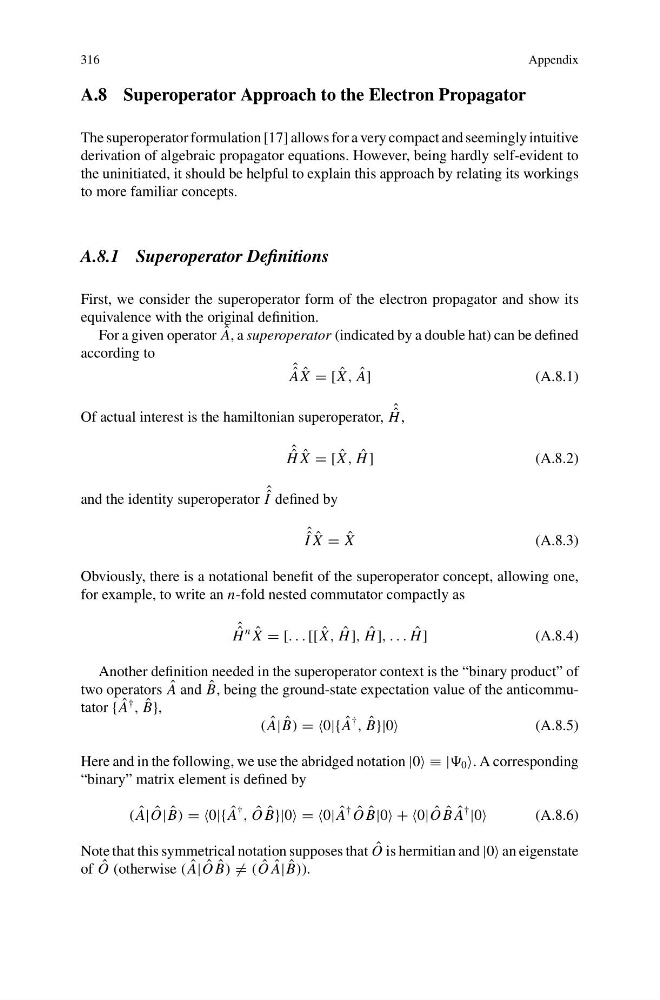
The superoperator formulation [17] allows for a very compact and seemingly intuitive
derivation of algebraic propagator equations. However, being hardly self-evident to
the uninitiated, it should be helpful to explain this approach by relating its workings
to more familiar concepts.
A.8.1 Superoperator Definitions
First, we consider the superoperator form of the electron propagator and show its
equivalence with the original definition.
For a given operator ˆ
A, a superoperator (indicated by a double hat) can be defined
according to
ˆ ˆ
A ˆ
X = [ ˆ
X , ˆ
A]
(A.8.1)
Of actual interest is the hamiltonian superoperator, ˆ ˆ
H ,
ˆ ˆ
H ˆ
X = [ ˆ
X , ˆ
H ]
(A.8.2)
and the identity superoperator ˆ ˆ
I defined by
ˆ ˆ
I ˆ
X = ˆ
X
(A.8.3)
Obviously, there is a notational benefit of the superoperator concept, allowing one,
for example, to write an n-fold nested commutator compactly as
ˆ ˆ
H
n ˆ
X = [. . . [[ ˆ
X , ˆ
H ], ˆ
H ], . . . ˆ
H ]
(A.8.4)
Another definition needed in the superoperator context is the “binary product” of
two operators ˆ
A and ˆ
B, being the ground-state expectation value of the anticommutator { ˆ
A
†
, ˆ
B},
( ˆ
A| ˆ
B) = =0|{ ˆ
A
†
, ˆ
B}|0
(A.8.5)
Here and in the following, we use the abridged notation |0 ≡ | 0 . A corresponding
“binary” matrix element is defined by
( ˆ
A| ˆ
O| ˆ
B) = =0|{ ˆ
A
†
, ˆ
O ˆ
B}|0 = =0| ˆ
A
† ˆ
O ˆ
B|0 + +0| ˆ
O ˆ
B ˆ
A
†
|0
(A.8.6)
Note that this symmetrical notation supposes that ˆ
O is hermitian and |0 an eigenstate
of ˆ
O (otherwise ( ˆ
A| ˆ
O ˆ
B) = ( ˆ
O ˆ
A| ˆ
B)).
Appendix
A.8 Superoperator Approach to the Electron Propagator
The superoperator formulation [17] allows for a very compact and seemingly intuitive
derivation of algebraic propagator equations. However, being hardly self-evident to
the uninitiated, it should be helpful to explain this approach by relating its workings
to more familiar concepts.
A.8.1 Superoperator Definitions
First, we consider the superoperator form of the electron propagator and show its
equivalence with the original definition.
For a given operator ˆ
A, a superoperator (indicated by a double hat) can be defined
according to
ˆ ˆ
A ˆ
X = [ ˆ
X , ˆ
A]
(A.8.1)
Of actual interest is the hamiltonian superoperator, ˆ ˆ
H ,
ˆ ˆ
H ˆ
X = [ ˆ
X , ˆ
H ]
(A.8.2)
and the identity superoperator ˆ ˆ
I defined by
ˆ ˆ
I ˆ
X = ˆ
X
(A.8.3)
Obviously, there is a notational benefit of the superoperator concept, allowing one,
for example, to write an n-fold nested commutator compactly as
ˆ ˆ
H
n ˆ
X = [. . . [[ ˆ
X , ˆ
H ], ˆ
H ], . . . ˆ
H ]
(A.8.4)
Another definition needed in the superoperator context is the “binary product” of
two operators ˆ
A and ˆ
B, being the ground-state expectation value of the anticommutator { ˆ
A
†
, ˆ
B},
( ˆ
A| ˆ
B) = =0|{ ˆ
A
†
, ˆ
B}|0
(A.8.5)
Here and in the following, we use the abridged notation |0 ≡ | 0 . A corresponding
“binary” matrix element is defined by
( ˆ
A| ˆ
O| ˆ
B) = =0|{ ˆ
A
†
, ˆ
O ˆ
B}|0 = =0| ˆ
A
† ˆ
O ˆ
B|0 + +0| ˆ
O ˆ
B ˆ
A
†
|0
(A.8.6)
Note that this symmetrical notation supposes that ˆ
O is hermitian and |0 an eigenstate
of ˆ
O (otherwise ( ˆ
A| ˆ
O ˆ
B) = ( ˆ
O ˆ
A| ˆ
B)).