

314
Appendix
Here, the convergence factor e
−ηt has been introduced to ensure the definiteness of
the Fourier integral at the upper limit, t = ∞ (see Eq. 3.13 in Sect. 3.1); note that
the lower bound of the integral actually is t = 0 due to the step function θ(t).
Like in the spectral representation of the electron propagator (see Sect. 3.1), the
Fourier transformation (A.7.15) can explicitly be performed upon employing the
resolution of the identity in terms of the exact eigenstates | n , n = 0, 1, . . . in the
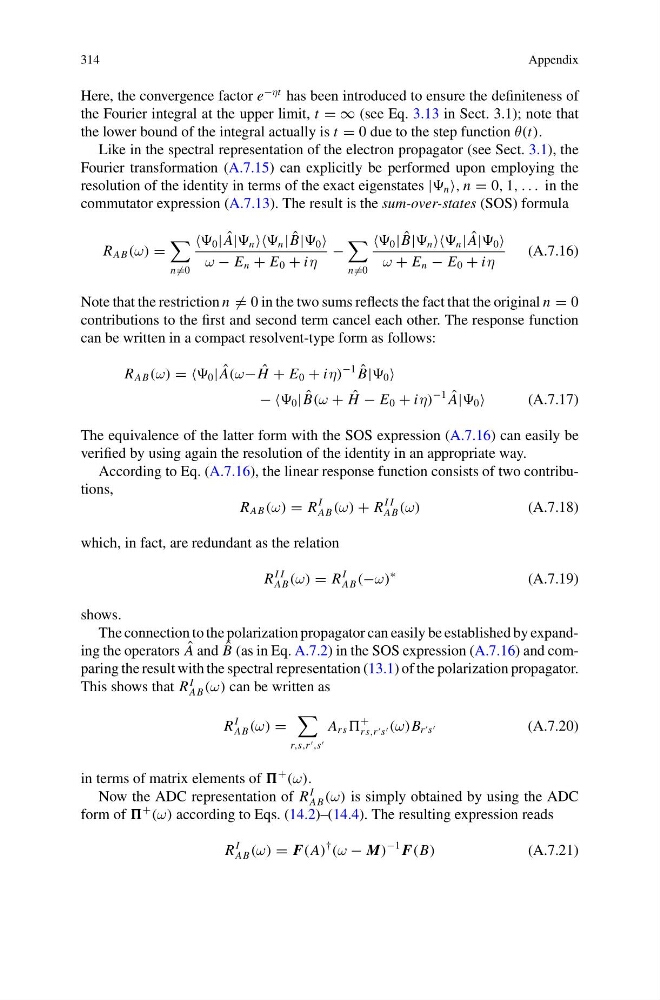
commutator expression (A.7.13). The result is the sum-over-states (SOS) formula
R AB (ω) =
n =0
0 | ˆ
A| n n | ˆ
B| 0
ω − E n + E 0 + iη
−
n =0
0 | ˆ
B| n n | ˆ
A| 0
ω + E n − E 0 + iη
(A.7.16)
Note that the restriction n = 0 in the two sums reflects the fact that the original n = 0
contributions to the first and second term cancel each other. The response function
can be written in a compact resolvent-type form as follows:
R AB (ω) = = 0 | ˆ
A(ω− ˆ
H + E 0 + iη)
−1 ˆ
B| 0
− − 0 | ˆ
B(ω + ˆ
H − E 0 + iη)
−1 ˆ
A| 0
(A.7.17)
The equivalence of the latter form with the SOS expression (A.7.16) can easily be
verified by using again the resolution of the identity in an appropriate way.
According to Eq. (A.7.16), the linear response function consists of two contributions,
R AB (ω) = R
I
AB (ω) + R
I I
AB (ω)
(A.7.18)
which, in fact, are redundant as the relation
R
I I
AB (ω) = R
I
AB (−ω)
∗
(A.7.19)
shows.
The connection to the polarization propagator can easily be established by expanding the operators ˆ
A and ˆ
B (as in Eq. A.7.2) in the SOS expression (A.7.16) and comparing the result with the spectral representation (13.1) of the polarization propagator.
This shows that R
I
AB (ω) can be written as
R
I
AB (ω) =
r,s,r ,s
A rs
+
rs,r s (ω)B r s
(A.7.20)
in terms of matrix elements of
+
(ω).
Now the ADC representation of R
I
AB (ω) is simply obtained by using the ADC
form of
+
(ω) according to Eqs. (14.2)–(14.4). The resulting expression reads
R
I
AB (ω) = F(A)
†
(ω − M)
−1 F(B)
(A.7.21)
Appendix
Here, the convergence factor e
−ηt has been introduced to ensure the definiteness of
the Fourier integral at the upper limit, t = ∞ (see Eq. 3.13 in Sect. 3.1); note that
the lower bound of the integral actually is t = 0 due to the step function θ(t).
Like in the spectral representation of the electron propagator (see Sect. 3.1), the
Fourier transformation (A.7.15) can explicitly be performed upon employing the
resolution of the identity in terms of the exact eigenstates | n , n = 0, 1, . . . in the
commutator expression (A.7.13). The result is the sum-over-states (SOS) formula
R AB (ω) =
n =0
0 | ˆ
A| n n | ˆ
B| 0
ω − E n + E 0 + iη
−
n =0
0 | ˆ
B| n n | ˆ
A| 0
ω + E n − E 0 + iη
(A.7.16)
Note that the restriction n = 0 in the two sums reflects the fact that the original n = 0
contributions to the first and second term cancel each other. The response function
can be written in a compact resolvent-type form as follows:
R AB (ω) = = 0 | ˆ
A(ω− ˆ
H + E 0 + iη)
−1 ˆ
B| 0
− − 0 | ˆ
B(ω + ˆ
H − E 0 + iη)
−1 ˆ
A| 0
(A.7.17)
The equivalence of the latter form with the SOS expression (A.7.16) can easily be
verified by using again the resolution of the identity in an appropriate way.
According to Eq. (A.7.16), the linear response function consists of two contributions,
R AB (ω) = R
I
AB (ω) + R
I I
AB (ω)
(A.7.18)
which, in fact, are redundant as the relation
R
I I
AB (ω) = R
I
AB (−ω)
∗
(A.7.19)
shows.
The connection to the polarization propagator can easily be established by expanding the operators ˆ
A and ˆ
B (as in Eq. A.7.2) in the SOS expression (A.7.16) and comparing the result with the spectral representation (13.1) of the polarization propagator.
This shows that R
I
AB (ω) can be written as
R
I
AB (ω) =
r,s,r ,s
A rs
+
rs,r s (ω)B r s
(A.7.20)
in terms of matrix elements of
+
(ω).
Now the ADC representation of R
I
AB (ω) is simply obtained by using the ADC
form of
+
(ω) according to Eqs. (14.2)–(14.4). The resulting expression reads
R
I
AB (ω) = F(A)
†
(ω − M)
−1 F(B)
(A.7.21)