

308
Appendix
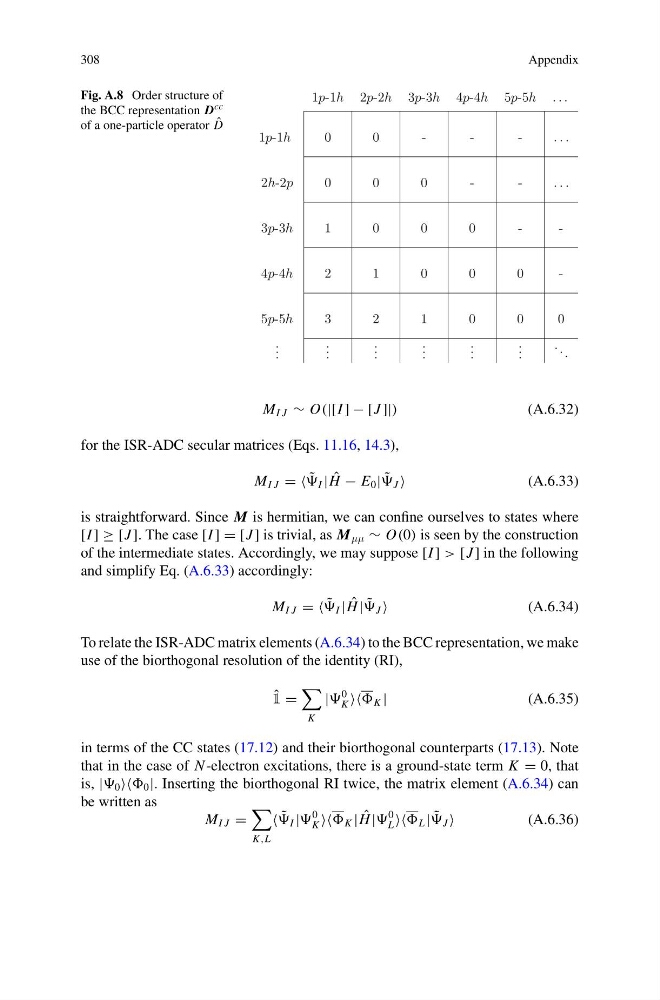
Fig. A.8 Order structure of
the BCC representation D cc
of a one-particle operator ˆ
D
1p-1h 2p-2h 3p-3h 4p-4h 5p-5h . . .
1p-1h
0
0
-
-
-
. . .
2h-2p
0
0
0
-
-
. . .
3p-3h
1
0
0
0
-
-
4p-4h
2
1
0
0
0
-
5p-5h
3
2
1
0
0
0
. . .
. . .
. . .
. . .
. . .
. . .
. . .
M I J ∼ O(|[I ] − [J ]|)
(A.6.32)
for the ISR-ADC secular matrices (Eqs. 11.16, 14.3),
M I J = = ˜
I | ˆ
H − E 0 | ˜
J
(A.6.33)
is straightforward. Since M is hermitian, we can confine ourselves to states where
[I ] ≥ [J ]. The case [I ] = [J ] is trivial, as M μμ ∼ O(0) is seen by the construction
of the intermediate states. Accordingly, we may suppose [I ] > [J ] in the following
and simplify Eq. (A.6.33) accordingly:
M I J = = ˜
I | ˆ
H | ˜
J
(A.6.34)
To relate the ISR-ADC matrix elements (A.6.34) to the BCC representation, we make
use of the biorthogonal resolution of the identity (RI),
ˆ
1 =
K
|
0
K K |
(A.6.35)
in terms of the CC states (17.12) and their biorthogonal counterparts (17.13). Note
that in the case of N -electron excitations, there is a ground-state term K = 0, that
is, | 0 0 |. Inserting the biorthogonal RI twice, the matrix element (A.6.34) can
be written as
M I J =
K ,L
˜
I |
0
K K | ˆ
H |
0
L L | ˜
J
(A.6.36)
Appendix
Fig. A.8 Order structure of
the BCC representation D cc
of a one-particle operator ˆ
D
1p-1h 2p-2h 3p-3h 4p-4h 5p-5h . . .
1p-1h
0
0
-
-
-
. . .
2h-2p
0
0
0
-
-
. . .
3p-3h
1
0
0
0
-
-
4p-4h
2
1
0
0
0
-
5p-5h
3
2
1
0
0
0
. . .
. . .
. . .
. . .
. . .
. . .
. . .
M I J ∼ O(|[I ] − [J ]|)
(A.6.32)
for the ISR-ADC secular matrices (Eqs. 11.16, 14.3),
M I J = = ˜
I | ˆ
H − E 0 | ˜
J
(A.6.33)
is straightforward. Since M is hermitian, we can confine ourselves to states where
[I ] ≥ [J ]. The case [I ] = [J ] is trivial, as M μμ ∼ O(0) is seen by the construction
of the intermediate states. Accordingly, we may suppose [I ] > [J ] in the following
and simplify Eq. (A.6.33) accordingly:
M I J = = ˜
I | ˆ
H | ˜
J
(A.6.34)
To relate the ISR-ADC matrix elements (A.6.34) to the BCC representation, we make
use of the biorthogonal resolution of the identity (RI),
ˆ
1 =
K
|
0
K K |
(A.6.35)
in terms of the CC states (17.12) and their biorthogonal counterparts (17.13). Note
that in the case of N -electron excitations, there is a ground-state term K = 0, that
is, | 0 0 |. Inserting the biorthogonal RI twice, the matrix element (A.6.34) can
be written as
M I J =
K ,L
˜
I |
0
K K | ˆ
H |
0
L L | ˜
J
(A.6.36)