

Appendix
307
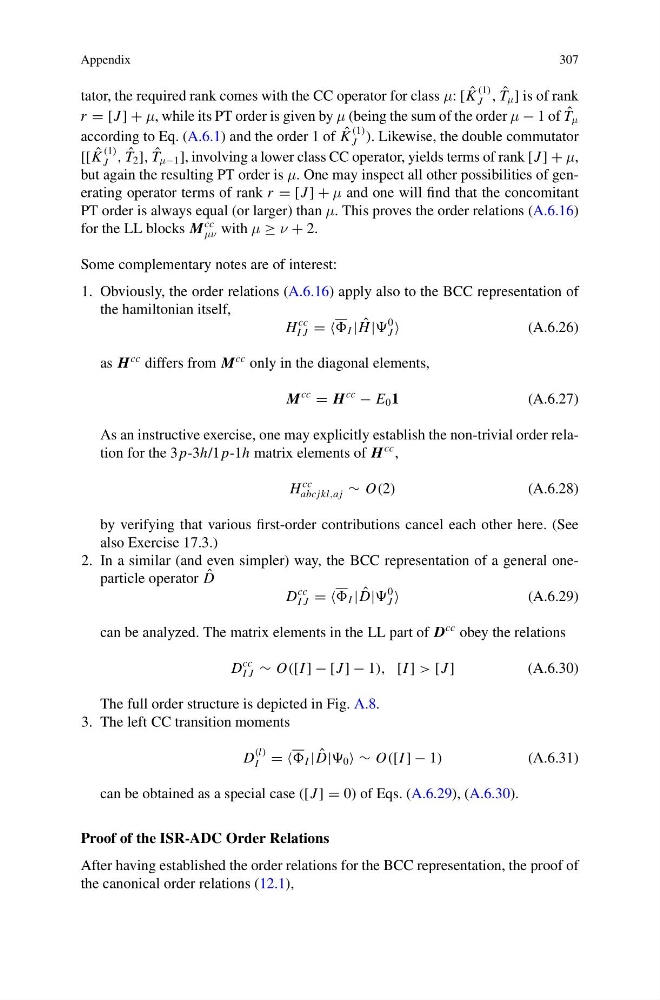
tator, the required rank comes with the CC operator for class μ: [ ˆ
K
(1)
J , ˆ
T μ ] is of rank
r = [J ] + μ, while its PT order is given by μ (being the sum of the order μ − 1 of ˆ
T μ
according to Eq. (A.6.1) and the order 1 of ˆ
K
(1)
J ). Likewise, the double commutator
[[ ˆ
K
(1)
J , ˆ
T 2 ], ˆ
T μ−1 ], involving a lower class CC operator, yields terms of rank [J ] + μ,
but again the resulting PT order is μ. One may inspect all other possibilities of generating operator terms of rank r = [J ] + μ and one will find that the concomitant
PT order is always equal (or larger) than μ. This proves the order relations (A.6.16)
for the LL blocks M
cc
μν with μ ≥ ν + 2.
Some complementary notes are of interest:
1. Obviously, the order relations (A.6.16) apply also to the BCC representation of
the hamiltonian itself,
H
cc
I J = = I | ˆ
H |
0
J
(A.6.26)
as H
cc differs from M
cc only in the diagonal elements,
M
cc
= H
cc
− E 0 1
(A.6.27)
As an instructive exercise, one may explicitly establish the non-trivial order relation for the 3 p-3h/1 p-1h matrix elements of H
cc ,
H
cc
abcjkl,aj ∼ O(2)
(A.6.28)
by verifying that various first-order contributions cancel each other here. (See
also Exercise 17.3.)
2. In a similar (and even simpler) way, the BCC representation of a general oneparticle operator ˆ
D
D
cc
I J = = I | ˆ
D|
0
J
(A.6.29)
can be analyzed. The matrix elements in the LL part of D
cc obey the relations
D
cc
I J ∼ O([I ] − [J ] − 1), [I ] > [J ]
(A.6.30)
The full order structure is depicted in Fig. A.8.
3. The left CC transition moments
D
(l)
I = = I | ˆ
D| 0 ∼ O([I ] − 1)
(A.6.31)
can be obtained as a special case ([J ] = 0) of Eqs. (A.6.29), (A.6.30).
Proof of the ISR-ADC Order Relations
After having established the order relations for the BCC representation, the proof of
the canonical order relations (12.1),
307
tator, the required rank comes with the CC operator for class μ: [ ˆ
K
(1)
J , ˆ
T μ ] is of rank
r = [J ] + μ, while its PT order is given by μ (being the sum of the order μ − 1 of ˆ
T μ
according to Eq. (A.6.1) and the order 1 of ˆ
K
(1)
J ). Likewise, the double commutator
[[ ˆ
K
(1)
J , ˆ
T 2 ], ˆ
T μ−1 ], involving a lower class CC operator, yields terms of rank [J ] + μ,
but again the resulting PT order is μ. One may inspect all other possibilities of generating operator terms of rank r = [J ] + μ and one will find that the concomitant
PT order is always equal (or larger) than μ. This proves the order relations (A.6.16)
for the LL blocks M
cc
μν with μ ≥ ν + 2.
Some complementary notes are of interest:
1. Obviously, the order relations (A.6.16) apply also to the BCC representation of
the hamiltonian itself,
H
cc
I J = = I | ˆ
H |
0
J
(A.6.26)
as H
cc differs from M
cc only in the diagonal elements,
M
cc
= H
cc
− E 0 1
(A.6.27)
As an instructive exercise, one may explicitly establish the non-trivial order relation for the 3 p-3h/1 p-1h matrix elements of H
cc ,
H
cc
abcjkl,aj ∼ O(2)
(A.6.28)
by verifying that various first-order contributions cancel each other here. (See
also Exercise 17.3.)
2. In a similar (and even simpler) way, the BCC representation of a general oneparticle operator ˆ
D
D
cc
I J = = I | ˆ
D|
0
J
(A.6.29)
can be analyzed. The matrix elements in the LL part of D
cc obey the relations
D
cc
I J ∼ O([I ] − [J ] − 1), [I ] > [J ]
(A.6.30)
The full order structure is depicted in Fig. A.8.
3. The left CC transition moments
D
(l)
I = = I | ˆ
D| 0 ∼ O([I ] − 1)
(A.6.31)
can be obtained as a special case ([J ] = 0) of Eqs. (A.6.29), (A.6.30).
Proof of the ISR-ADC Order Relations
After having established the order relations for the BCC representation, the proof of
the canonical order relations (12.1),